

Many English learners stop in the middle of a sentence and think,
“Should I say new to me, new for me, or news to me?”
All three sound almost the same. The words look similar. Even native speakers sometimes mix them up in fast speech. So it’s easy to feel unsure.
You might hear:
- “This song is new to me.”
- “This job is new for me.”
- “That’s news to me!”
They look related, but the meanings are different.
If you use the wrong one, people may still understand you. But your sentence can sound strange or unnatural. And if you’re taking an exam like IELTS or TOEFL, small grammar mistakes matter.
These expressions are very common in daily life. We use them at school, work, and in casual conversations. That’s why learning the difference is important.
After reading this guide, you will clearly understand:
- when to use new to me
- when to use new for me
- when to use news to me
- how their meanings change
- and how to avoid common mistakes
Everything is explained in simple English with many examples, just like a real classroom lesson.
What Does “New to Me” Mean?
Simple meaning
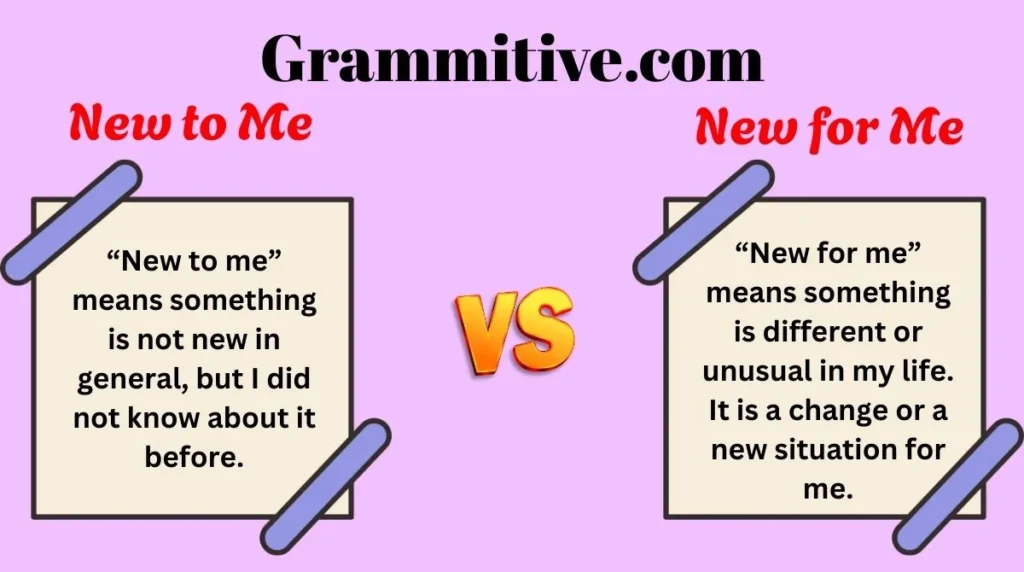
“New to me” means something is not new in general, but I did not know about it before.
So it is new for my experience only.
Other people may already know it.
When to use it
Use new to me when:
- you discover something for the first time
- you see or try something you didn’t know before
- you talk about personal experience
It focuses on your knowledge, not the world.
Grammar rule
Structure:
noun + is/was + new to me
Examples:
- This movie is new to me.
- That idea was new to me.
You can also use it with:
- sounds
- smells
- experiences
- places
- people
- information
Examples (6–8 sentences)
- This app is new to me. I never used it before.
- That singer is new to me. I don’t know her songs.
- This food is new to me. It tastes interesting.
- The word “sustainable” was new to me last year.
- This game is new to me. Can you teach me how to play?
- That rule is new to me. Nobody told me about it.
- This neighborhood is new to me. I just moved here.
- The concept of meditation was new to me at first.
Common learner confusion
Many students think new to me = brand new.
But that’s not true.
❌ Wrong idea: It was created today
✅ Correct idea: I just learned about it
For example:
“This song is new to me”
→ It might be 20 years old, but you just heard it.
What Does “New for Me” Mean?
Simple meaning
“New for me” means something is different or unusual in my life. It is a change or a new situation for me.
It often talks about experiences or actions, not objects.
When to use it
Use new for me when:
- you try something different
- you start a new habit
- you talk about a new role or responsibility
- your lifestyle changes
It focuses on a new situation, not knowledge.
Grammar rule
Structure:
something + is/was + new for me
It often describes:
- jobs
- activities
- experiences
- habits
- challenges
Examples (6–8 sentences)
- Working from home is new for me.
- Cooking every day is new for me.
- This kind of exercise is new for me.
- Managing a team is new for me.
- Living alone was new for me at first.
- Driving in the city is new for me.
- Speaking English at work is still new for me.
- Teaching children online is new for me this year.
Common learner confusion
Students sometimes use new for me when they should say new to me.
For example:
❌ This word is new for me.
✅ This word is new to me.
Because a word is knowledge, not an experience.
Think:
- information → new to me
- activity or life situation → new for me
What Does “News to Me” Mean?
Simple meaning
“News to me” means I didn’t know that information before. It’s often used when someone tells you something surprising.
It’s an expression, not about newspapers.
It means: “I didn’t know that.”
When to use it
Use news to me:
- when you are surprised
- when someone tells you something unexpected
- in casual conversations
- to show new information
Often spoken in daily English.
Grammar rule
Structure:
That’s + news to me.
Sometimes:
- It’s news to me.
- This is news to me.
We usually use it with that’s or it’s.
Examples (6–8 sentences)
- “They got married?” — “That’s news to me!”
- “The meeting is canceled.” — “Really? That’s news to me.”
- It’s news to me that she quit her job.
- This is news to me. I had no idea.
- “He moved to Canada.” — “Wow, news to me.”
- That rumor is news to me.
- It was news to me when I heard the results.
- That’s definitely news to me!
Common learner confusion
Students sometimes say:
❌ It is new to me. (when they mean surprise information)
✅ That’s news to me.
“News to me” sounds more natural when reacting to information.
Difference Between New to Me and New for Me (Detailed)
Here’s a clear comparison.
Comparison Table
| Feature | New to Me | New for Me |
|---|---|---|
| Focus | Knowledge | Experience |
| Meaning | I didn’t know it | I haven’t done/experienced it |
| Used with | info, things, ideas | activities, situations |
| Feeling | discovery | change or challenge |
| Common? | Very common | Less common but correct |
Usage difference
New to me → learning something
New for me → doing something different
Grammar logic
“to me” = my knowledge
“for me” = my life or benefit
Sentence structure difference
- This word is new to me.
- This job is new for me.
Notice:
- word → knowledge
- job → life experience
Meaning comparison
Compare:
1️⃣ This software is new to me.
→ I didn’t know it existed.
2️⃣ Using this software daily is new for me.
→ I’m not used to working with it.
Small change. Big difference.
Grammar Rules You Must Remember
Rule #1 – Use “new to me” for information
This rule is the most important.
Example:
- This rule is new to me.
If it’s knowledge, choose to.
Rule #2 – Use “new for me” for experiences
When your life changes or you try something new:
Example:
- Teaching online is new for me.
If it’s an activity, choose for.
Rule #3 – Use “news to me” for surprise reactions
Use it in conversations.
Example:
- “He left?” — “That’s news to me!”
It sounds natural and friendly.
Rule #4 – Don’t mix them
These are not interchangeable.
❌ That’s new to me! (when reacting to gossip)
Better:
✅ That’s news to me!
Common Mistakes Students Make
Why mistakes happen
Three reasons:
- Similar spelling
- Same pronunciation speed
- “to” and “for” confusion
Also, many languages don’t separate knowledge and experience this way.
Wrong vs correct examples
❌ This movie is new for me.
✅ This movie is new to me.
❌ That’s new to me! (surprised reaction)
✅ That’s news to me!
❌ This exercise is new to me.
(It sounds okay but slightly unnatural)
Better:
✅ This exercise is new for me.
Easy correction tips
Ask yourself:
- Is it information? → to
- Is it experience? → for
- Am I reacting to news? → news to me
Easy Trick to Remember the Difference
Here’s a simple memory trick my students love.
Think like this:
TO = brain (knowledge)
FOR = life (experience)
NEWS = surprise
So:
- new TO me → my brain
- new FOR me → my life
- news to me → surprise info
Imagine arrows:
Information → head
Experience → body
Surprise → reaction
This mental picture helps many learners choose quickly.
Daily Life Examples (Very Important)
Here are natural spoken sentences you may hear every day:
- This café is new to me. I’ve never seen it before.
- Working night shifts is new for me. I feel tired.
- “You’re moving?” — “That’s news to me!”
- This music style is new to me, but I like it.
- Living in a big city is new for me.
- That policy change is news to me.
- Meditation is new for me, but it’s relaxing.
- This author is new to me. Any good books?
- “The exam is tomorrow!” — “Wait… that’s news to me.”
- Driving a truck is totally new for me.
Notice how natural they sound in conversation.
Practice Section
Choose the correct option:
1
This app is new ___ me.
a) to
b) for
2
Teaching kids online is new ___ me.
a) to
b) for
3
“That’s ___ to me!” (surprised reaction)
a) new
b) news
4
That rule was new ___ me.
a) to
b) for
5
Living abroad is new ___ me.
a) to
b) for
Answers
1 → a
2 → b
3 → b
4 → a
5 → b
FAQs
What is the difference between new to me and new for me?
“New to me” is about knowledge or discovery. “New for me” is about experiences or life changes. One is mental, the other is practical.
Can we use “new to me” for people?
Yes. You can say, “He’s new to me,” meaning you don’t know him. But usually we say, “I haven’t met him before.”
Is “news to me” formal or informal?
It’s mostly informal and conversational. Perfect for daily speech. In formal writing, you might say, “I wasn’t aware of that.”
Can I say “this is news for me”?
No. That sounds unnatural. Always say “news to me.”
Which is more common in everyday English?
“New to me” and “news to me” are very common. “New for me” is correct but slightly less frequent.
Can these phrases be used in past tense?
Yes.
- It was new to me.
- It was new for me.
- That was news to me.
All are correct.
Final Conclusion
Small grammar differences can feel big when you’re learning English. Words like “to,” “for,” and “news” look tiny, but they change the meaning a lot.
Remember the simple idea:
- knowledge → new to me
- experience → new for me
- surprise information → news to me
Once you connect each phrase to its meaning, choosing becomes easy and natural. Listen to native speakers.
Notice how they use these expressions in daily talk. Then try using them yourself when you speak or write.
Practice a little every day. Make your own sentences. Talk about things that are new in your life or new in your knowledge.
Soon, these phrases won’t feel confusing at all. They’ll feel completely natural—just like real English should.

I am Lucas Bennett, a digital content creator passionate about social media trends and online growth strategies.
I share practical insights and guides to help users better understand and navigate the digital world.