

English has many small words that cause big confusion.
Two of them are naught and nought.
They look almost the same.
They sound almost the same.
And both can mean zero.
So naturally, learners stop and think:
“Wait… which one should I use?”
If you have ever seen a football score like two–nil, or heard someone say all for naught, or read nought point five, you might have felt unsure.
Are these words old-fashioned? British? Formal? Do they even matter today?
Yes — they still matter, especially in British English, math, literature, and everyday expressions.
Many students mix them up because dictionaries often show similar meanings. But their usage, tone, and grammar are different.
One appears more in expressions and emotions, while the other is used more for numbers and counting.
By the end of this guide, you will clearly understand:
- what each word really means
- where to use it
- where NOT to use it
- simple grammar rules
- common mistakes
- easy memory tricks
- and real-life examples
After reading, you won’t hesitate again when you see or hear either word.
What Does “Naught” Mean?
Simple meaning
Naught means:
👉 nothing
👉 zero
👉 not anything
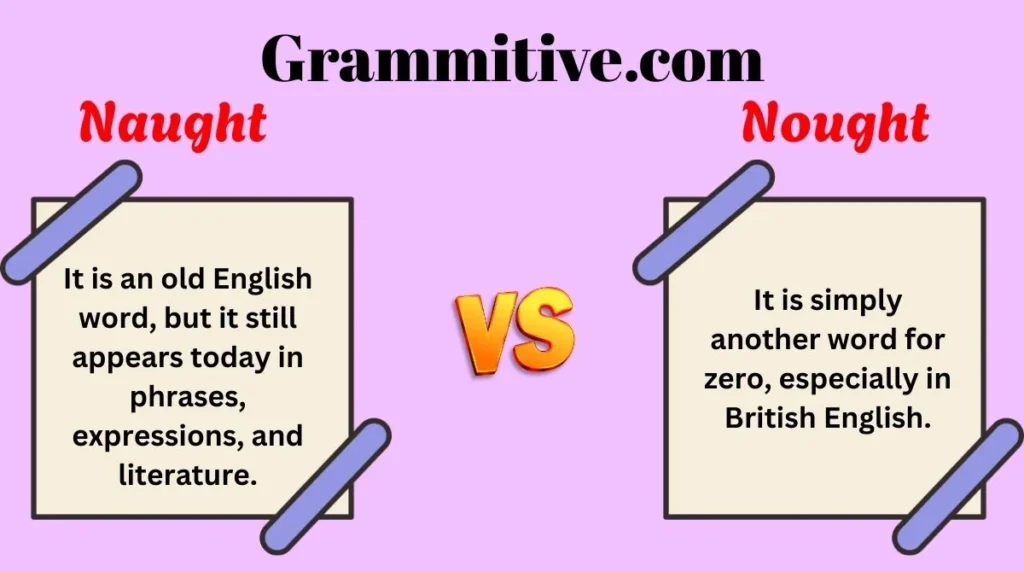
It is an old English word, but it still appears today in phrases, expressions, and literature.
It is less common in modern daily speech, except in set expressions.
When to use “naught”
Use naught when you want to talk about:
- nothingness
- failure
- something becoming useless
- emotional or dramatic language
It is often found in idioms and fixed phrases, not in regular math or numbers.
Grammar rule
Naught is usually:
- a noun (meaning nothing)
- sometimes part of an expression
It is not normally used for counting numbers in modern English.
Example sentences
- All his hard work came to naught.
- The plan ended in naught.
- They fought for hours, but it was all for naught.
- The old king ruled the land with naught but fear.
- He had naught to give.
- Without love, wealth means naught.
- She started with naught and built everything herself.
- Their effort turned to naught overnight.
Common learner confusion
Many students think:
❌ “Naught equals zero, so I can use it for numbers.”
But saying:
❌ “The score was two–naught”
sounds unusual or incorrect.
We normally use nought or zero for numbers.
So remember:
Naught → feelings, results, nothingness (not math)
What Does “Nought” Mean?
Simple meaning
Nought means:
👉 zero (0)
That’s it.
It is simply another word for zero, especially in British English.
When to use “nought”
Use nought when talking about:
- numbers
- math
- scores
- decimals
- measurements
British speakers often say nought instead of zero.
Grammar rule
Nought is a number word.
It functions like:
- zero
- one
- two
- three
So it fits naturally in counting and mathematics.
Example sentences
- The score was three–nought.
- Add a nought to the end to make ten.
- The temperature dropped to nought degrees.
- The answer is nought point five.
- He wrote two noughts after the number.
- My bank balance shows nought today.
- Start counting from nought, not one.
- The machine resets to nought every time.
Common learner confusion
Students sometimes say:
❌ “All our effort was for nought” (when they mean emotional loss)
This sounds strange.
In that case, naught is better because it expresses failure or nothingness, not a number.
So remember:
Nought → numbers and math
Difference Between Naught and Nought (Detailed)
Even though both can mean “zero,” their usage is quite different.
Here’s a clear comparison.
Quick comparison table
| Feature | Naught | Nought |
|---|---|---|
| Meaning | Nothing | Zero (0) |
| Type | Idea/feeling | Number |
| Usage | Expressions, phrases | Math, scores |
| Style | Literary/old-fashioned | British everyday |
| Example | All for naught | Two–nought score |
Usage difference
- Naught talks about emptiness or failure
- Nought talks about numbers and counting
So one is emotional, the other mathematical
Grammar logic
Think of it this way:
If you can replace the word with zero, use nought.
If you can replace the word with nothing, use naught.
Sentence structure difference
✔ Correct
The score was two–nought.
✔ Correct
All their work was for naught.
❌ Incorrect
The score was two–naught.
❌ Incorrect
All their work was for nought.
Meaning comparison
- naught → poetic or dramatic tone
- nought → practical and factual
One belongs to feelings.
One belongs to math.
Grammar Rules You Must Remember
Rule #1 – Use “nought” for numbers
The answer is nought point two.
If it’s math or counting → choose nought.
Rule #2 – Use “naught” for nothingness or failure
Their efforts were for naught.
If it means “nothing” → choose naught.
Rule #3 – Fixed expressions use “naught”
“All for naught” is standard English.
Don’t change it to nought.
Expressions stay the same.
Rule #4 – American English prefers “zero”
In the US, people rarely say nought.
They usually say zero instead.
Example:
“Zero degrees” (not “nought degrees”)
Common Mistakes Students Make
Why mistakes happen
The words:
- look similar
- sound similar
- both mean zero
So learners guess.
But guessing causes problems.
Wrong vs Correct examples
❌ My test score was naught.
✔ My test score was nought.
❌ Our work was for nought.
✔ Our work was for naught.
❌ Add two naughts to make 100.
✔ Add two noughts.
Easy correction tips
Ask yourself:
👉 “Is this a number or a feeling?”
Number → nought
Feeling → naught
That simple question solves most errors.
Easy Trick to Remember the Difference
Here’s a small memory trick students love.
Look at the spelling.
Nought → has “O” like ZERO
Both have a round shape (0).
So think:
👉 O → zero → numbers
Now look at naught.
It looks softer and older.
It appears in stories and emotions.
👉 Naught → nothing → feelings
This tiny visual trick helps many learners remember fast.
Daily Life Examples (Very Important)
These are the kinds of sentences you may actually hear.
- “The match ended three–nought.”
- “All that stress was for naught.”
- “Write a nought after the five.”
- “We started with naught and built everything.”
- “The temperature is nought degrees today.”
- “His promises meant naught to her.”
- “Put two noughts to make five hundred.”
- “Our effort came to naught in the end.”
- “It’s nought point eight litres.”
- “Without practice, talent is naught.”
Notice how numbers use nought, and feelings use naught.
Practice Section
Choose the correct word: naught or nought
- The score was four–____.
- All our plans came to ____.
- Add a ____ to the number.
- His warning meant ____.
- The answer is ____ point seven.
Answers
- nought
- naught
- nought
- naught
- nought
FAQs
What is the difference between naught and nought?
Naught means nothing or failure.
Nought means zero.
One is emotional, the other is mathematical.
Can we use naught for numbers?
Not normally. It sounds old or incorrect.
Use nought or zero instead.
Can we use nought in expressions like “all for naught”?
No. That expression always uses naught.
It is fixed and should not be changed.
Is nought British or American?
Mostly British.
Americans usually say zero.
Which word is more common today?
Nought is still used in math and scores.
Naught is mainly used in phrases and literature.
Are these words formal?
Nought is neutral.
Naught sounds more literary or old-fashioned, but still acceptable.
Final Conclusion
Small spelling differences can create big confusion in English.
“Naught” and “nought” are a perfect example.
They started with similar meanings long ago, but today they serve different jobs.
Naught talks about nothingness, failure, or emotion.
Nought simply means zero and belongs to numbers.
When you separate them this way, everything becomes easier.
If it’s math, counting, or scores, choose nought.
If it’s about something becoming useless or meaning nothing, choose naught.
Read examples aloud. Notice them in books, sports scores, and conversations. Practice a few sentences every day.
Soon, choosing the correct word will feel natural, and you won’t need to stop and think.
Small details like this make your English sound clear, confident, and natural.

