
English can feel tricky sometimes, especially when you try to compare things. You learn a rule, and then suddenly you see a sentence that looks different. That’s when confusion starts.
One common question students often ask is:
Should I say “more proud” or “prouder”?
Both sound possible. Both seem correct. But which one should you actually use?
Maybe you’ve said sentences like:
- I am more proud of you.
- I am prouder of you.
If you feel unsure about which sounds better, you’re not alone. Even intermediate learners hesitate here.
This topic matters more than you think because “proud” is used in daily life all the time. We talk about our children, our friends, our work, our country, or ourselves.
It’s a very emotional word. So using it correctly helps you sound natural and confident.
By the time you finish reading, you will clearly understand:
- What more proud means
- What prouder means
- Which one is grammatically correct
- When to use each
- Common mistakes to avoid
- Easy tricks to remember forever
Think of this like a friendly classroom chat, not a grammar lecture. Everything will be simple and clear.
What Does “More Proud” Mean?
Simple meaning
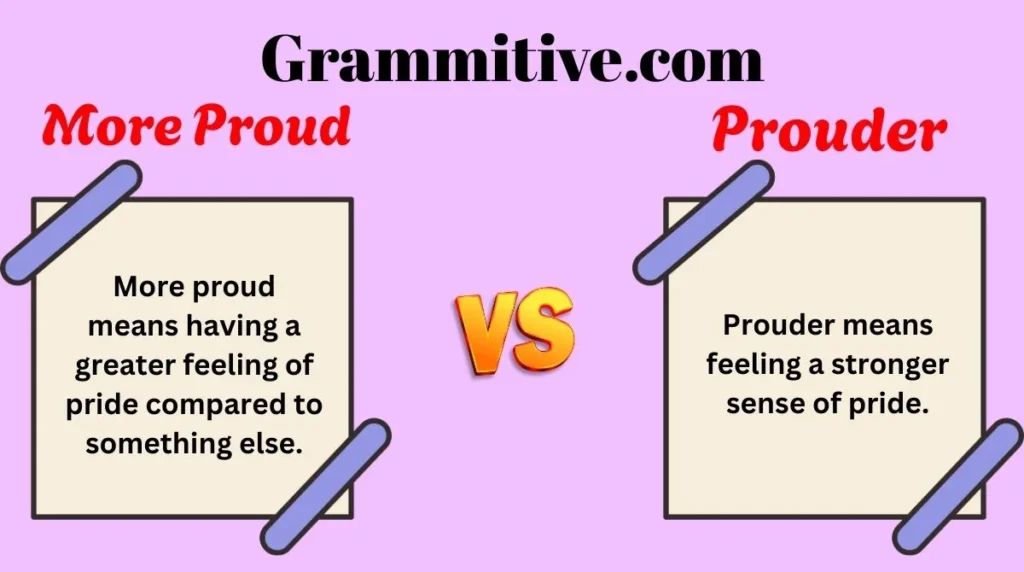
More proud means having a greater feeling of pride compared to something else.
It tries to compare two things.
Example idea:
- Today I feel more proud than yesterday.
When learners use it
Many students use more proud because they know one basic rule:
For longer adjectives → use “more”
Like:
- more beautiful
- more interesting
- more expensive
So they think:
- proud → more proud
This feels logical.
Grammar rule
But here is the important point:
“Proud” is a short adjective (one syllable).
Short adjectives usually take -er, not “more”.
So grammatically, English prefers:
- proud → prouder
Because of this, “more proud” is not the standard or natural form in normal speech.
Is “more proud” always wrong?
Not completely.
Sometimes native speakers use more proud for:
- extra emphasis
- poetic or emotional effect
- formal writing
But in daily English, it sounds a bit unnatural.
Example sentences with “more proud”
These are grammatically possible, but not the most natural:
- I feel more proud today than ever before.
- She was more proud of her son than of her job.
- They seemed more proud after winning the match.
- I am more proud of your effort than your result.
- He looked more proud than happy.
- The teacher felt more proud this year.
- She became more proud as her business grew.
- I am more proud of you than you know.
All these sentences work — but most native speakers would choose prouder instead.
Common learner confusion
Students often think:
If “more beautiful” is correct, why not “more proud”?
Because “beautiful” has 3 syllables, but “proud” has only 1.
Syllables matter a lot in comparisons.
What Does “Prouder” Mean?
Simple meaning
Prouder means feeling a stronger sense of pride.
It’s the comparative form of “proud.”
When to use it
Use prouder when comparing:
- two people
- two times
- two situations
- two feelings
Grammar rule
Short adjectives (one syllable) usually add -er:
- tall → taller
- small → smaller
- fast → faster
- proud → prouder
So:
✅ proud → prouder
❌ proud → more proud (less natural)
Example sentences with “prouder”
These sound natural and are used every day:
- I am prouder of you today.
- She feels prouder than before.
- He looks prouder after the win.
- I have never been prouder in my life.
- My parents are prouder of me now.
- She became prouder as she improved.
- The team is prouder this season.
- You should be prouder of your hard work.
These sentences sound smooth and native-like.
Why it sounds better
English loves short forms. They are faster to say.
Compare:
- more proud (2 words)
- prouder (1 word)
Native speakers usually choose the shorter one.
Common learner confusion
Some students avoid “prouder” because it feels strange to pronounce.
But don’t worry.
Just say:
proud + er → prou-der
After a few times, it feels easy.
Difference Between More Proud and Prouder (Detailed)
Here’s a clear comparison to help you see everything quickly.
Comparison Table
| Feature | More Proud | Prouder |
|---|---|---|
| Type | Two-word form | Comparative adjective |
| Grammar style | Less natural | Standard rule |
| Syllables | 2 words | 1 word |
| Common use | Rare | Very common |
| Sounds native | Sometimes awkward | Natural |
| Best for | Emphasis/poetry | Daily English |
Usage difference
Prouder is the normal everyday choice.
More proud is only used when someone wants extra emotional stress or special style.
Grammar logic
Short adjective → add -er
So:
- proud → prouder
Not → more proud
Sentence structure difference
With prouder:
- I am prouder of you.
With more proud:
- I am more proud of you.
Both are correct, but the first sounds smoother.
Meaning comparison
The meaning is almost the same.
The difference is about style and naturalness, not meaning.
Grammar Rules You Must Remember
Rule #1 – One-syllable adjectives take “-er”
Example:
- proud → prouder
- tall → taller
Sentence:
- I am prouder today.
Rule #2 – Long adjectives use “more”
Example:
- more beautiful
- more interesting
Sentence:
- This book is more interesting.
Rule #3 – Don’t mix both forms
Never say:
❌ more prouder
❌ most proudest
Sentence:
- She is prouder, not more prouder.
Rule #4 – Use “than” for comparison
When comparing two things, use than.
Example:
- I am prouder than before.
- She is prouder than her sister.
Common Mistakes Students Make
Why mistakes happen
Most errors happen because:
- students memorize “use more” rule
- they forget syllables
- they translate from their native language
Wrong vs Correct
❌ I am more prouder of you.
✅ I am prouder of you.
❌ She is very more proud.
✅ She is much prouder.
❌ He feels most proudest.
✅ He feels proudest.
Easy correction tips
If the word is short → add -er
Just ask:
“Can I say it faster with -er?”
If yes → use it.
Easy Trick to Remember the Difference
Here’s a small memory trick students love.
The “Short = Short” rule
If the adjective is short, make the comparison short too.
- proud → prouder
- tall → taller
- fast → faster
Short word → short form
But:
- beautiful → more beautiful
(long word → longer form)
Your brain likes patterns. This one is easy to remember.
Daily Life Examples (Very Important)
These sound like real conversations you hear every day.
- I’m so proud of you.
- I’m even prouder today.
- My dad was prouder than ever.
- She looked prouder after graduation.
- I couldn’t be prouder of my team.
- He felt prouder than his friends.
- Are you prouder now?
- I’m prouder of your effort than your score.
- She seems prouder these days.
- You should feel prouder of yourself.
Notice how natural “prouder” feels in speech.
Nobody says “more proud” in these casual talks.
Practice Section
Choose the correct option.
- I am (more proud / prouder) of you today.
- She feels (more proud / prouder) than yesterday.
- He looks (more proud / prouder) after winning.
- This moment makes me (more proud / prouder).
- My parents are (more proud / prouder) of me now.
Answers
- prouder
- prouder
- prouder
- prouder
- prouder
(Yes, all of them!)
FAQs
1. What is the difference between more proud and prouder?
Both show comparison. However, prouder follows standard grammar rules for short adjectives and sounds more natural. “More proud” is less common.
2. Which one do native speakers use more?
Native speakers almost always say prouder in everyday speech. It’s shorter and smoother.
3. Is “more proud” wrong?
Not exactly wrong, but it’s uncommon. It may sound formal or emotional. For daily English, use “prouder.”
4. Can we use prouder in questions?
Yes.
Example: Are you prouder of yourself now?
It works perfectly in questions.
5. Is prouder formal or informal?
It works in both. You can use it in conversation, emails, speeches, or writing.
6. Why can’t we say “more prouder”?
Because that repeats the comparison. Use only one form: either more or -er, never both.
Final Conclusion
Comparatives don’t need to feel scary. Once you understand the pattern, everything becomes simple.
“Proud” is a short adjective. Short adjectives usually take -er. So prouder is the natural and correct form for almost all situations.
“More proud” is not completely wrong, but it’s rare and often sounds heavy or unnatural. If you want your English to sound smooth and native-like, choose prouder every time.
Try using it in your daily life:
- I’m prouder of myself.
- My parents are prouder of me.
- I’ve never been prouder.
The more you say it, the easier it feels.
Small grammar fixes like this make a big difference in how confident you sound. Keep practicing, stay curious, and remember — learning English is a journey, not a race.

I am Lucas Bennett, a digital content creator passionate about social media trends and online growth strategies.
I share practical insights and guides to help users better understand and navigate the digital world.