
English looks simple at first. Small words. Short sentences. Easy verbs.
But then one day, a tiny pair of words causes big confusion.
“Mean” or “means”?
Many learners stop and think:
Should I say “What mean this?” or “What means this?”
Is it “This mean…” or “This means…”?
Why do native speakers add s sometimes?
It feels strange because both words look almost the same. The only difference is one small s. Yet that small letter changes the grammar completely.
This topic matters more than you think. We use these words every day. When we explain ideas. When we ask questions.
When we talk about meaning. When we describe ways to do something.
You hear them in school, movies, offices, and daily conversation:
- “What does this mean?”
- “This means trouble.”
- “By all means, come in.”
If you use the wrong form, your sentence sounds unnatural. Sometimes it even sounds incorrect.
By the end of this guide, everything will feel clear and simple. You’ll understand:
- when to use mean
- when to use means
- the grammar rules
- common mistakes
- easy memory tricks
- and lots of real-life examples
After that, you won’t hesitate again.
What Does “Mean” Mean?
Simple definition
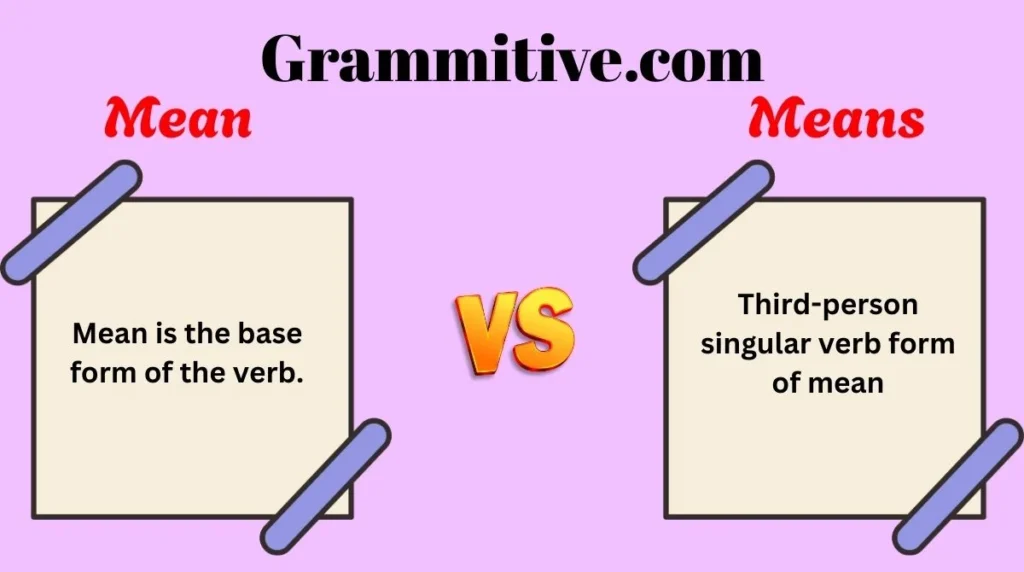
Mean is the base form of the verb.
It shows the basic action:
👉 to show the meaning of something
When to use it
Use mean with:
- I
- You
- We
- They
- plural nouns
These subjects do not take “-s” in the present tense.
Grammar rule
Present simple:
- I mean
- You mean
- They mean
- Cats mean
No s.
Example sentences
- I mean what I say.
- What do you mean?
- They mean no harm.
- We mean business today.
- These signs mean danger.
- The words mean nothing to me.
- You mean a lot to your family.
- Teachers mean well.
Common learner confusion
Many students think:
❌ “What you means?”
❌ “I means this…”
But remember:
Only he / she / it takes means.
Everyone else uses mean.
So:
✔ What do you mean?
✔ I mean this.
Also, don’t forget: after do/does/did, we always use the base verb.
✔ What does this mean? (not means)
This point is very important and causes many mistakes.
What Does “Means” Mean?
Simple definition
Means has two main uses:
- Third-person singular verb form of mean
- A noun meaning a method or way
Yes, one word, two jobs!
Use 1: Verb form
Use means with:
- he
- she
- it
- singular nouns
Grammar rule
Present simple:
- He means
- She means
- It means
- This means
Add -s.
Example sentences (verb)
- He means what he says.
- She means no offense.
- This means trouble.
- The red light means stop.
- My teacher means something different.
- It means a lot to me.
- The sign means “no parking.”
- The test result means you passed.
Use 2: Noun form
Means can also mean:
👉 a way or method to do something
Example sentences (noun)
- Money is a means of survival.
- We need a means of transport.
- Email is a fast means of communication.
- This is the best means to solve the problem.
- They found new means to save time.
Notice: here, means is always plural in form but can be singular in meaning. That’s normal in English.
Common learner confusion
Students often mix these:
❌ This mean stop
❌ He mean well
Correct:
✔ This means stop
✔ He means well
Because this/he/she/it = means
Difference Between Mean and Means (Detailed)
Understanding the difference becomes easy when you compare them side by side.
Comparison table
| Feature | Mean | Means |
|---|---|---|
| Type | Verb (base form) | Verb + Noun |
| Subject | I/You/We/They | He/She/It |
| Present tense | No “s” | Add “s” |
| Extra meaning | — | method/way (noun) |
| Example | They mean it | It means a lot |
Usage difference
Mean → used with plural or non-third-person subjects
Means → used with singular third-person subjects
Think: one person = add s
Grammar logic
English present simple rule:
- Singular → verb + s
- Plural → base form
This rule applies to almost all verbs:
- run / runs
- eat / eats
- play / plays
- mean / means
So this is not special. It’s just normal English grammar.
Sentence structure difference
Mean
Subject + mean + object
They mean good things.
Means
Subject + means + object
It means danger.
Meaning comparison
Sometimes both forms appear in similar sentences:
- These signs mean “stop.”
- This sign means “stop.”
Difference? Only subject number.
Grammar Rules You Must Remember
Rule #1 – He/She/It takes “means”
Add s for third person singular.
✔ He means well.
✔ It means a lot.
Rule #2 – I/You/We/They use “mean”
No s.
✔ I mean that.
✔ They mean business.
Rule #3 – After “does,” use base form
Never add s after does.
✔ What does this mean?
❌ What does this means?
Because “does” already shows third person.
Rule #4 – “Means” can be a noun
When talking about a method, use means.
✔ Walking is a cheap means of exercise.
✔ We need a means to travel.
This use is not about verb tense at all.
Common Mistakes Students Make
Why mistakes happen
There are three main reasons:
- Small spelling difference
- Third-person rule confusion
- Mixing verb and noun forms
Let’s fix them.
Mistake 1
❌ He mean it.
✔ He means it.
Tip: one person → add s
Mistake 2
❌ What does it means?
✔ What does it mean?
Tip: after does, always base verb.
Mistake 3
❌ This mean danger.
✔ This means danger.
Tip: this/that/it → singular → means
Mistake 4
❌ We needs a means.
✔ We need a means.
Tip: don’t mix up verbs.
Easy correction tip
When unsure, ask:
Who is the subject?
- one thing/person → means
- more than one → mean
Simple check. Works every time.
Easy Trick to Remember the Difference
Here’s a small classroom trick many students love.
Think of the S rule.
S = Single
If your subject is single (one) → add S
- He → means
- She → means
- It → means
- This → means
If it’s not single → no S
- I → mean
- You → mean
- We → mean
- They → mean
Picture one person standing alone. Add an “S” to keep them company.
It sounds funny, but students remember it for years.
Daily Life Examples (Very Important)
These are the kinds of sentences you hear every day.
- What do you mean by that?
- This means we are late.
- I didn’t mean to hurt you.
- The sign means “no entry.”
- They mean a lot to me.
- That means we must hurry.
- Do you mean this one?
- He means every word.
- What does this word mean?
- Hard work means success.
Read them out loud. They sound natural because they follow the rules correctly.
Practice Section
Choose the correct option.
Questions
- She (mean / means) well.
- What does this (mean / means)?
- They (mean / means) no harm.
- This (mean / means) trouble.
- We need a (mean / means) to travel.
Answers
- means
- mean
- mean
- means
- means
If you got 4 or 5 correct, great job. If not, review the rules again and try once more.
FAQs
What is the difference between mean and means?
“Mean” is the base verb used with I/you/we/they. “Means” is used with he/she/it or as a noun meaning a method.
Can we use “means” in questions?
Yes, but only when it’s the noun. For verbs, after “does,” use “mean.”
Example: What does it mean?
Is “means” formal or informal?
It’s neutral. You can use it in both casual speech and formal writing.
Why don’t we say “does it means”?
Because “does” already shows third person. English grammar uses the base verb after helping verbs.
Can “means” be singular?
Yes. “A means” is correct. It sounds plural but can act as singular.
Which is more common in daily speech?
Both are common. “Mean” appears in questions often, while “means” appears in statements with singular subjects.
Final Conclusion
Small grammar points sometimes cause the biggest stress. “Mean” and “means” look almost identical, but the difference is simple once you see the pattern.
Everything depends on the subject.
If the subject is I, you, we, or they — use mean.
If it’s he, she, it, or one thing — use means.
And after “does,” always go back to mean.
Plus, don’t forget the special noun form of means, which talks about methods or ways to do something.
With a little practice, these forms will start to feel natural. Try to notice them when watching movies or reading books. Repeat the sentences aloud. Use them in conversation.
Soon, you won’t even think about the rule. You’ll just say it correctly, like native speakers do.
Keep practicing. Small steps lead to strong English.

I am Lucas Bennett, a digital content creator passionate about social media trends and online growth strategies.
I share practical insights and guides to help users better understand and navigate the digital world.