
English has many small phrases that look easy but feel confusing when you try to use them in real life. One of those tricky expressions is “may or may not.”
At first, the words seem simple. You already know may. You already know not. But when they come together, the meaning becomes a little foggy.
Students often ask questions like:
- Does it mean yes or no?
- Is the speaker sure or unsure?
- Is it positive or negative?
- Why not just say “maybe”?
These are fair questions. Even intermediate learners hesitate when they hear this phrase in movies, daily conversations, or emails.
The truth is that “may or may not” is very common in everyday English, especially when we talk about uncertainty.
Native speakers use it all the time without thinking. If you understand it well, your English will sound more natural and relaxed.
By the end, you will clearly understand:
- what may means
- what not means
- how they work together
- the exact meaning of “may or may not”
- grammar rules
- common mistakes
- and how to use it confidently in real life
Everything is explained in simple, friendly English — just like a classroom lesson.
What Does “May” Mean?
Simple definition
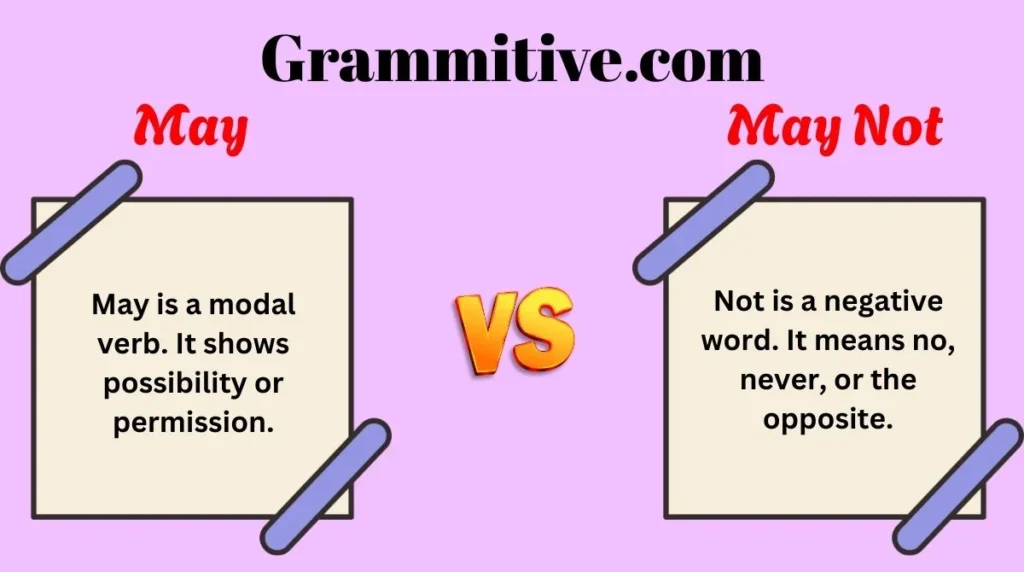
May is a modal verb. It shows possibility or permission.
It tells us that something can happen, but we are not 100% sure.
Think of it like this:
👉 Maybe yes. Maybe no.
When to use “may”
We use may when:
- something is possible
- we are guessing
- we are not certain
- we ask or give permission (formal)
Grammar rule
Structure:
Subject + may + base verb
Examples:
- I may go
- She may come
- They may call
No “to”. No “-ing”. Always base form.
Example sentences
- It may rain today.
- She may join us later.
- I may buy that phone.
- They may cancel the meeting.
- He may feel tired after work.
- We may travel next month.
- The shop may close early.
- You may try again.
Common learner confusion
Many students think may = will.
But that is wrong.
❌ It may rain → NOT sure
✅ It will rain → 100% sure
“May” is weaker. It shows uncertainty.
Another confusion: some students use may to go.
That is incorrect.
❌ I may to go
✅ I may go
Remember: may + base verb only
What Does “Not” Mean?
Simple definition
Not is a negative word. It means no, never, or the opposite.
It changes a sentence from positive to negative.
It tells us something does not happen or is not true.
When to use “not”
We use not to:
- deny something
- say something is false
- show the opposite meaning
- make negatives
Grammar rule
Usually:
Helping verb + not + verb
Examples:
- do not go
- is not ready
- may not come
With modal verbs like may, can, should, must, we put not after them.
Example sentences
- I am not tired.
- She is not ready.
- They do not like coffee.
- We are not late.
- He may not come.
- You should not worry.
- It is not easy.
- The shop is not open.
Common learner confusion
Some students forget not or put it in the wrong place.
❌ I not understand
✅ I do not understand
❌ She may come not
✅ She may not come
Word order is important.
Difference Between May and Not (Detailed)
Now let’s compare them clearly.
They have very different jobs in English.
Comparison Table
| Feature | May | Not |
|---|---|---|
| Type | Modal verb | Negative word |
| Meaning | Possibility | Negation |
| Shows | Maybe | No / opposite |
| Position | Before verb | After helping verb |
| Example | may go | may not go |
Usage difference
May → uncertainty or possibility
Not → negative meaning
Example:
- She may come → maybe yes
- She may not come → maybe no
Notice something interesting:
Both sentences are uncertain!
Even “may not” still shows possibility, just negative possibility.
Grammar logic
- May controls the verb
- Not changes the meaning
Together, they create different shades of meaning.
Sentence structure difference
- Subject + may + verb
- Subject + may not + verb
Very simple change, but meaning changes a lot.
Meaning comparison
Listen to these:
- She may call. → possible call
- She may not call. → possible no call
- She may or may not call. → totally unsure
The third one means both are possible.
What Does “May or May Not” Mean?
Now we combine everything.
Simple meaning
“May or may not” means something is uncertain. Both yes and no are possible.
We don’t know what will happen.
It’s like saying:
- maybe
- not sure
- 50/50
- anything can happen
When to use it
Use this phrase when:
- you have no clear information
- you don’t want to promise
- you want to sound honest
- the result is unknown
Grammar structure
Subject + may or may not + base verb
Examples:
- I may or may not go
- She may or may not come
- They may or may not agree
Example sentences
- I may or may not attend the party.
- She may or may not reply tonight.
- We may or may not finish early.
- They may or may not accept the offer.
- He may or may not remember you.
- The train may or may not be late.
- The movie may or may not be good.
- I may or may not buy it.
Common learner confusion
Some students think this phrase is negative.
It’s not negative.
It means neutral uncertainty.
❌ It means no
❌ It means yes
✅ It means “I don’t know”
Grammar Rules You Must Remember
Rule #1: Use base verb after “may”
Correct: She may come
Wrong: She may comes
Rule #2: Don’t repeat the subject
Correct: I may or may not go
Wrong: I may or I may not go (grammatically okay but longer and less natural)
Rule #3: Use for uncertainty only
Correct: I may or may not join
Wrong: I may or may not (no verb)
Always add a verb.
Rule #4: Not for strong decisions
If you are sure, don’t use this.
❌ I may or may not be your teacher (when clearly teacher)
✅ I am your teacher
Use only for real doubt.
Common Mistakes Students Make
Why mistakes happen
This phrase is confusing because:
- two “may” words
- sounds repetitive
- learners mix it with “maybe”
- unclear meaning
Wrong vs correct examples
❌ Maybe or maybe not come
✅ I may or may not come
❌ I may not or may come
✅ I may or may not come
❌ I may or may not to go
✅ I may or may not go
Easy correction tips
- Always start with subject
- Use “may or may not” together
- Add base verb
- Think: 50/50 chance
Easy Trick to Remember the Difference
Here’s a simple memory trick students love.
Think of a coin.
Flip a coin.
Heads = yes
Tails = no
That’s exactly what “may or may not” means.
It’s like saying:
👉 “I’m flipping a coin. I don’t know the result.”
If you feel unsure, use this phrase.
If you feel sure, don’t use it.
Easy.
Daily Life Examples (Very Important)
These sound very natural in real conversations.
- I may or may not go to the gym today.
- She may or may not call you later.
- We may or may not order pizza tonight.
- He may or may not finish the work.
- They may or may not visit us this weekend.
- The bus may or may not arrive on time.
- I may or may not watch that show.
- My boss may or may not approve the plan.
- The exam may or may not be difficult.
- I may or may not wake up early tomorrow.
These are normal, everyday sentences you will hear often.
Practice Section
Choose the correct option.
Questions
- I ___ go shopping later. (may / may or may not)
- She ___ come to the party. I’m not sure.
- They ___ finish today or tomorrow.
- He ___ like spicy food.
- We ___ travel if we have money.
Answers
- may
- may or may not
- may or may not
- may or may not
- may
FAQs (SEO Focused)
What is the difference between “may” and “may or may not”?
“May” shows simple possibility. Something might happen.
“May or may not” shows total uncertainty. Both yes and no are equally possible.
Can we use “may or may not” in questions?
It’s rare but possible.
Example: “May or may not join us?” sounds unnatural.
Better: “Are you coming or not?”
It’s mostly used in statements.
Is “may or may not” formal or informal?
It works in both.
You can use it in conversations, emails, or even formal writing.
It sounds polite and honest.
Is it the same as “maybe”?
Similar, but not exactly.
“Maybe” is shorter and casual.
“May or may not” feels clearer and stronger about uncertainty.
Can I say “might or might not”?
Yes.
It has the same meaning.
“Might” sounds slightly less formal and softer.
Why do native speakers use this phrase so often?
Because life is uncertain.
People don’t want to promise something they can’t guarantee.
This phrase sounds natural and safe.
Final Conclusion
English becomes easier when you understand small phrases deeply. “May or may not” looks simple, but it carries an important idea — uncertainty.
Whenever you are unsure about something, this expression helps you speak honestly. You don’t promise. You don’t guess strongly. You simply say the truth: you don’t know yet.
Remember the basics:
- may = possible
- not = negative
- may or may not = 50/50 chance
Practice using it in daily conversations. Try small sentences first. Then use it naturally with friends, coworkers, or classmates.
Soon, it will feel normal, just like native speakers use it every day.
Small phrases like this make your English sound real, relaxed, and confident.

I am Lucas Bennett, a digital content creator passionate about social media trends and online growth strategies.
I share practical insights and guides to help users better understand and navigate the digital world.