
English has many word pairs that look almost the same but behave differently. These words often confuse learners. Maximal and maximum are a good example.
At first glance, they seem identical. Both come from the idea of “the most” or “the highest.” Many students think they can use them in the same way.
But that is not true. One is mostly an adjective used in technical or scientific English. The other is far more common and works as both a noun and an adjective.
Because they look similar, learners mix them up in speaking, writing, and exams.
You might hear someone say, “This is the maximal speed,” when native speakers usually say, “This is the maximum speed.”
Small mistakes like this can make your English sound unnatural.
Understanding the difference helps you sound more natural and confident. It also improves your writing, especially in school, tests, and professional English.
After reading this guide, you will clearly know:
- what each word means
- when to use each one
- the grammar rules
- common mistakes
- and easy tricks to remember
By the end, choosing the right word will feel simple and automatic.
What Does “Maximal” Mean?
Simple Definition
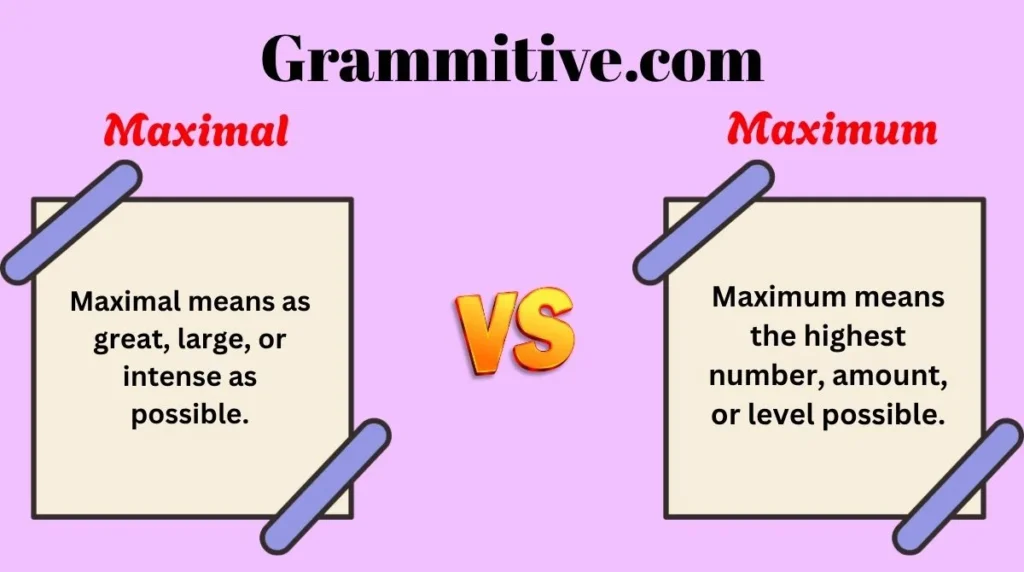
Maximal means as great, large, or intense as possible.
It describes the highest level that can be reached.
It is mostly used in formal, technical, scientific, medical, or academic English. You don’t hear it much in daily conversation.
Grammar Rule
Maximal = adjective only
It describes a noun.
It does NOT work as a noun.
Structure:
maximal + noun
When to Use It
Use maximal when:
- talking about effort, force, or intensity
- discussing science, sports, or research
- writing formally
It sounds professional or technical.
Example Sentences
- The athlete gave maximal effort during training.
- This machine works at maximal capacity.
- Doctors measured maximal heart rate.
- The team applied maximal pressure.
- We need maximal protection for safety.
- The experiment reached maximal output.
- The body uses maximal energy during sprinting.
- Soldiers must maintain maximal focus.
Common Learner Confusion
Many students say:
❌ maximal price
❌ maximal score
❌ maximal number
These sound strange to native speakers.
In daily English, people prefer maximum, not maximal.
Think of maximal as formal or scientific.
What Does “Maximum” Mean?
Simple Definition
Maximum means the highest number, amount, or level possible.
It is much more common in everyday English.
Grammar Rule
Maximum = noun + adjective
This makes it very flexible.
As a noun:
the maximum
As an adjective:
maximum + noun
When to Use It
Use maximum when:
- talking about limits
- numbers or scores
- prices or amounts
- everyday situations
It sounds natural and normal in conversation.
Example Sentences
- The maximum speed is 80 km/h.
- This bus has a maximum capacity of 50 people.
- The maximum score is 100.
- We reached the maximum level.
- The maximum price is $20.
- Please give your maximum effort.
- The river reached its maximum height.
- That is the maximum we can do today. (noun)
Common Learner Confusion
Students often think maximum is only an adjective.
But remember:
✔ adjective → maximum speed
✔ noun → the maximum
Maximal cannot do this.
Difference Between Maximal and Maximum (Detailed)
Quick Comparison Table
| Feature | Maximal | Maximum |
|---|---|---|
| Part of speech | Adjective only | Noun + adjective |
| Common in daily English | No | Yes |
| Formal/technical tone | Yes | Sometimes |
| Used for numbers/limits | Rare | Very common |
| Sounds natural in speech | Not often | Yes |
Usage Difference
Maximal
- used for intensity or effort
- often scientific
- less common
Maximum
- used for limits, numbers, sizes
- everyday English
- very common
Grammar Logic
Maximal describes a quality.
Maximum describes a limit or amount.
So:
- maximal effort (quality)
- maximum score (limit/number)
Sentence Structure Difference
Maximal:
adjective only
maximal + noun
Maximum:
adjective + noun
OR
the maximum (noun)
Meaning Comparison
Maximal = strongest possible
Maximum = highest possible number or level
Small difference, but very important in real English.
Grammar Rules You Must Remember
Rule #1: Maximal is only an adjective
✔ maximal force
❌ the maximal
Example:
She used maximal strength.
Rule #2: Maximum can be a noun
✔ This is the maximum.
❌ This is the maximal.
Example:
100 is the maximum score.
Rule #3: Use maximum for limits and numbers
✔ maximum price
✔ maximum height
✔ maximum number
Example:
The maximum age is 60.
Rule #4: Use maximal in formal or technical writing
✔ maximal oxygen intake
✔ maximal effort
Example:
Athletes train for maximal performance.
Common Mistakes Students Make
Why mistakes happen
- words look similar
- same root word
- dictionaries seem confusing
- overthinking grammar
Mistake 1
❌ maximal speed
✔ maximum speed
Tip: speeds and limits use maximum.
Mistake 2
❌ the maximal is 50
✔ the maximum is 50
Tip: only maximum can be a noun.
Mistake 3
❌ maximum effort (sometimes OK but less technical)
✔ maximal effort (formal/scientific)
Tip: strong effort → maximal sounds better in formal English.
Easy Correction Tip
Ask yourself:
👉 Is it a number or limit? → maximum
👉 Is it about strength or intensity? → maximal
Easy Trick to Remember the Difference
Here’s a simple memory trick.
“Maximum has U for number”
Think:
U = Unit (number)
Maximum → numbers and limits
Maximal → strength and intensity
Another trick:
Maximum is common like “minimum.”
Both talk about numbers.
Minimum / Maximum
They match.
Maximal does not match.
So you remember quickly.
Daily Life Examples (Spoken English)
These sound natural in conversation.
- What’s the maximum score in this exam?
- The maximum weight is 20 kilos.
- Please give your maximum effort.
- This room has a maximum of 30 people.
- He trained at maximal intensity today.
- Drive at the maximum speed limit only.
- My phone battery reached maximum level.
- The coach asked for maximal focus.
- What’s the maximum price you can pay?
- The system is running at maximal performance.
Notice how maximum appears more often.
Practice Section
Choose the correct word: maximal or maximum.
- The _____ speed is 100 km/h.
- She showed _____ effort during practice.
- This is the _____ we can offer.
- The engine works at _____ capacity.
- The _____ number of students is 40.
Answers
- maximum
- maximal
- maximum
- maximal
- maximum
FAQs
What is the difference between maximal and maximum?
Maximal describes the greatest intensity or strength and is usually formal. Maximum refers to the highest number or limit and is common in everyday English.
Can we use maximal in daily conversation?
Yes, but it sounds technical. Most native speakers prefer maximum in normal speech.
Is maximum formal or informal?
It works in both. You can use it in casual talk and formal writing.
Can maximum be a noun?
Yes. You can say “the maximum.” Maximal cannot be used this way.
Which is correct: maximal speed or maximum speed?
Maximum speed is correct and natural. Maximal speed sounds unusual.
Do scientists prefer maximal?
Often yes. In research or medical fields, maximal is common for effort, force, or performance.
Final Conclusion
Small differences between words can change how natural your English sounds. Maximal and maximum look very close, but their uses are not the same.
Maximum is your everyday word. It works for limits, numbers, prices, and scores. You will hear it everywhere. It can be both a noun and an adjective, which makes it very useful.
Maximal is more special. It describes the strongest or highest intensity and appears more in formal, scientific, or technical language.
If you remember one thing, remember this: numbers and limits need maximum. Strength and intensity often use maximal.
Practice these words in your speaking and writing. After a few days, the difference will feel natural. Soon, you won’t even need to think about it.
Good English grows step by step. Keep practicing.

I am Lucas Bennett, a digital content creator passionate about social media trends and online growth strategies.
I share practical insights and guides to help users better understand and navigate the digital world.