

English has many small grammar points that look tiny but cause big confusion. One classic example is the choice between “who” and “whom.”
And when these words come after phrases like “many of,” “some of,” or “all of,” learners often freeze.
You might have written a sentence like:
“Many of who came to the party were my friends.”
It sounds okay at first, right? But something feels strange.
Should it be who or whom?
Even native speakers sometimes guess. That’s because modern spoken English often drops “whom,” while formal writing still uses it.
So students hear one thing and read another. No wonder it feels confusing.
This topic matters more than you think. It appears in emails, reports, essays, exams, news articles, and business writing.
If you use the wrong word, the sentence can sound awkward or incorrect, especially in formal English.
By the time you finish reading, you’ll clearly understand:
- when to use who
- when to use whom
- which one is correct after many of
- how to remember the rule easily
- how to avoid common mistakes
Everything will be explained in simple, everyday English with lots of examples. Think of this like a friendly classroom lesson, not a heavy grammar book.
What Does “Who” Mean?
Simple definition
Who is a subject pronoun.
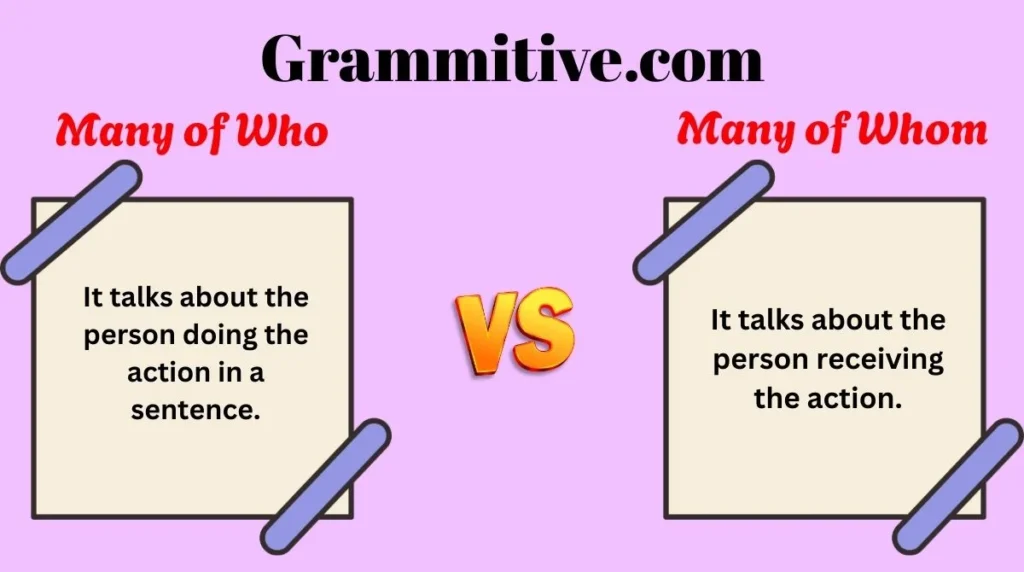
It talks about the person doing the action in a sentence.
Think of it like he, she, they.
If you can replace it with he/she/they, you usually need who.
When to use it
Use who when:
- the person is the subject
- the person does the action
- you are asking about the doer
Grammar rule
Who = subject of the verb
Structure:
who + verb
Examples
- Who called you last night?
- The boy who won the race is my cousin.
- I know the teacher who helped you.
- Who wants pizza?
- The students who study hard pass the test.
- Who broke the window?
- She met a woman who speaks five languages.
- Who is at the door?
Notice something:
In every sentence, who is doing something.
- who called
- who won
- who helped
The action comes after who.
Common learner confusion
Many students think who is only for questions. That’s not true.
It is also used inside sentences:
- The girl who lives next door
- The man who called me
So don’t limit it to questions only.
What Does “Whom” Mean?
Simple definition
Whom is an object pronoun.
It talks about the person receiving the action.
Think of it like him, her, them.
If you can replace it with him/her/them, you usually need whom.
When to use it
Use whom when:
- the person is the object
- the action happens to the person
- it comes after prepositions (to, for, with, of, from, etc.)
Grammar rule
Whom = object of the verb or preposition
Structure:
- verb + whom
- preposition + whom
Examples
- Whom did you call?
- The man whom I met was kind.
- To whom are you speaking?
- She is the teacher whom we respect.
- Whom should I invite?
- The girl whom they chose won the prize.
- With whom are you going?
- The customers whom we served left happy.
Here, whom receives the action:
- I met him → whom
- we respect him → whom
- speak to him → to whom
Common learner confusion
Many learners avoid whom completely. They use who everywhere because it feels easier.
In daily conversation, this is often okay. But in formal writing or exams, “whom” is still important.
Especially after prepositions like of, to, for, with.
Difference Between Who and Whom (Detailed)
The difference is actually simple once you see the pattern.
Quick idea
- Who → subject (does action)
- Whom → object (receives action)
Comparison Table
| Feature | Who | Whom |
|---|---|---|
| Type | Subject pronoun | Object pronoun |
| Similar to | he / she / they | him / her / them |
| Position | before verb | after verb or preposition |
| Common use | questions & clauses | formal writing |
| Example | who called | to whom I spoke |
Usage difference
Look at these:
- Who called me? (who = caller)
- Whom did you call? (whom = person called)
Same idea, different role.
Grammar logic
Try replacing with he/him:
- He called → who
- You called him → whom
Works every time.
Sentence structure difference
Who structure
who + verb
Example:
The students who arrived late apologized.
Whom structure
verb + whom
or
preposition + whom
Example:
The students whom the teacher scolded apologized.
Meaning comparison
Both refer to people. The meaning doesn’t change much.
Only the grammar role changes.
That’s why many people mix them up.
Grammar Rules You Must Remember
Rule #1 — Use who as the subject
The person does the action.
Example:
The girl who sings is my sister.
She sings → subject → who
Rule #2 — Use whom as the object
The person receives the action.
Example:
The girl whom we invited didn’t come.
We invited her → object → whom
Rule #3 — After prepositions, use whom
Very important for phrases like many of whom.
Example:
She has many friends, many of whom live abroad.
“Of” → use whom
Rule #4 — Use the he/him test
Replace the word:
- he → who
- him → whom
Example:
I spoke to him → to whom
Common Mistakes Students Make
Why mistakes happen
There are three main reasons:
- Spoken English rarely uses “whom”
- Teachers don’t explain object pronouns clearly
- Learners try to guess
Wrong vs correct examples
❌ Many of who came were tired
✅ Many of whom came were tired
❌ The man whom called me
✅ The man who called me
❌ Who did you meet him?
✅ Whom did you meet?
Easy correction tips
- Look for a preposition → use whom
- Look for the action doer → use who
- Try he/him trick
Slow down and check.
Easy Trick to Remember the Difference
Here’s a simple memory trick students love.
Think:
M → him → whom
Both him and whom end in M.
So if him fits, use whom.
Example:
I talked to him
I talked to whom
Easy, right?
This little letter M saves you every time.
Daily Life Examples
These sound like real conversations.
- Many of whom work here are my friends.
- The people who live upstairs are noisy.
- Who sent this message?
- The manager, whom you met yesterday, is kind.
- Many of whom didn’t understand the rule asked questions.
- Who wants coffee?
- The students whom the teacher praised felt proud.
- She has many cousins, many of whom are doctors.
- Who is knocking?
- The clients, many of whom are new, need help.
These are exactly how English sounds in real life.
Understanding “Many of Who or Many of Whom”
Now the main question.
Which is correct?
The answer
“Many of whom” is correct.
“Many of who” is grammatically wrong.
Why?
Because:
- “of” is a preposition
- after a preposition → object pronoun
- object pronoun → whom
So:
many of + whom
Structure
many of + whom + verb
Example:
Many of whom live abroad still call their parents daily.
More examples
- She invited ten people, many of whom arrived early.
- I have several friends, many of whom love hiking.
- There were 50 students, many of whom passed.
- He works with experts, many of whom have PhDs.
- They adopted dogs, many of whom were sick.
Every time → after “of” → whom
Why “many of who” sounds wrong
Try replacing:
many of he ❌
many of him ✅
Since “him” fits, we need “whom”.
Practice Section
Choose the correct answer.
- The man ___ called me is waiting.
- She has many friends, many of ___ live abroad.
- ___ did you invite?
- The teacher ___ we respect retired.
- The players, many of ___ were tired, kept playing.
Answers
- who
- whom
- whom
- whom
- whom
FAQs
What is the difference between who and whom?
Who is the subject. Whom is the object.
Who does the action. Whom receives it.
Can we use whom in questions?
Yes, especially formal questions.
Example: Whom did you call?
In casual speech, many people say “who,” but “whom” is more correct.
Is whom formal or informal?
It sounds more formal.
You’ll see it in writing, emails, exams, and professional English.
Can I always replace whom with who?
In casual speech, yes.
In formal writing, no. Use whom after prepositions.
Why do we say many of whom?
Because “of” is a preposition.
Prepositions need object pronouns.
So we use whom.
Do native speakers still use whom?
Less in daily speech, but yes in formal English.
News articles and books still use it often.
Final Conclusion
The difference between who and whom may look small, but it becomes very important in clear and correct English. Once you understand that who is the subject and whom is the object, everything becomes easier.
The key point to remember is simple: after prepositions like of, always choose whom. That’s why many of whom is correct and many of who isn’t.
Don’t try to memorize complicated rules. Just use the he/him trick. If “him” fits, use “whom.” It works almost every time.
Practice with real sentences. Listen to English around you. Notice how it appears in books and articles. Little by little, it will feel natural.
Grammar doesn’t need to be scary. It just needs clear logic and a bit of practice. Keep going, and you’ll sound more confident every day.

