

Many English learners stop and think when they hear sentences like:
“Your clothes are lying around the room.”
“My phone is laying around somewhere.”
Both sound similar. Both talk about things resting somewhere. So they must mean the same thing, right?Not exactly.
This small difference between lying and laying causes a lot of confusion. Even native speakers mix them up in daily speech.
You might hear both forms in movies, songs, or casual talk. But grammatically, only one is correct in most situations.
And here’s the tricky part: the verbs lie and lay look alike, but they follow very different grammar rules. One needs an object.
The other doesn’t. One changes form in a strange way in the past tense. The other doesn’t. It’s easy to get lost.
If you’ve ever paused mid-sentence wondering which word to use, you’re not alone.
By the end, everything will feel simple. You’ll clearly understand:
- what each word really means
- when to use each one
- how to avoid common mistakes
- and how to sound natural in everyday English
What Does “Lying Around” Mean?
Simple definition
Lying around means something is resting or staying somewhere without moving, often in a messy, lazy, or casual way.
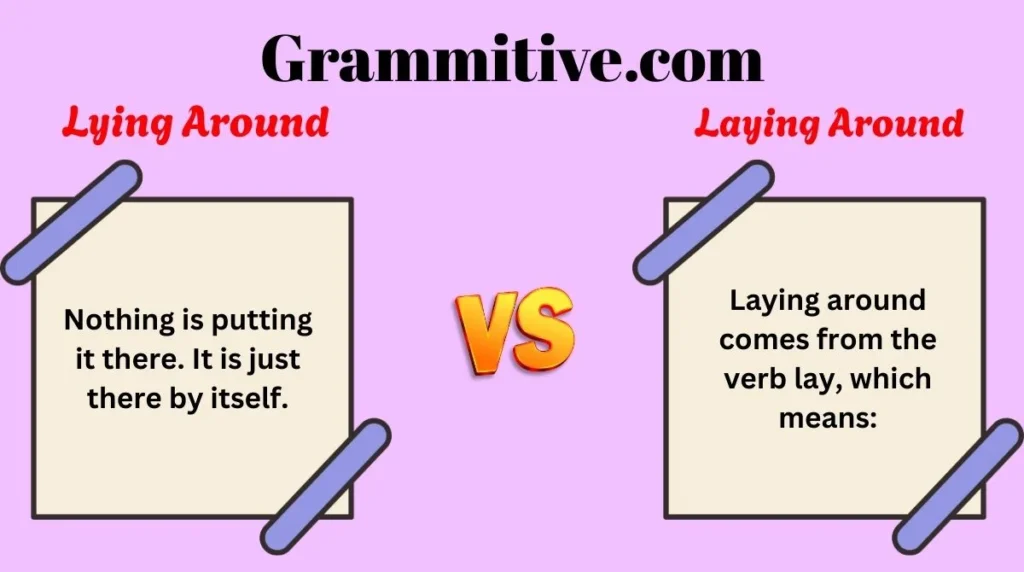
Nothing is putting it there. It is just there by itself.
When to use it
Use lying around when:
- something is already on the ground or surface
- no action is being done to place it
- there is NO object after the verb
This comes from the verb lie (to rest or recline).
Grammar rule
Lie = no object needed (intransitive verb)
Structure:
Subject + lie/lying + place
You don’t put anything after it.
Correct:
✔ The book is lying on the table.
Wrong:
✘ The book is lying the table.
6–8 example sentences
- My keys are lying around the kitchen somewhere.
- There are papers lying around my desk.
- The dog is lying around all day.
- Old shoes were lying around the door.
- A coin was lying on the floor.
- Toys are lying around the house again.
- He spent Sunday lying around doing nothing.
- A towel is lying on the bed.
Common learner confusion
Students often think:
“Laying sounds better. It feels more active.”
But remember: when something simply rests by itself, use lying, not laying.
Even if it sounds strange at first, lying around is grammatically correct.
What Does “Laying Around” Mean?
Simple definition
Laying around comes from the verb lay, which means:
👉 to put or place something somewhere
This action needs an object.
You must be placing something.
When to use it
Use laying when:
- someone is putting something down
- an object receives the action
- you can answer: “lay what?”
Grammar rule
Lay = needs an object (transitive verb)
Structure:
Subject + lay/laying + object + place
6–8 example sentences
- She is laying the baby on the bed.
- He is laying the phone on the table.
- They were laying blankets around the fire.
- The hen is laying eggs.
- She is laying the books around the room.
- He kept laying tools around the garage.
- The worker is laying tiles on the floor.
- Stop laying your clothes on my chair.
Common learner confusion
Many learners say:
✘ My shoes are laying around.
But shoes are not placing themselves. Nobody is laying them.
So it should be:
✔ My shoes are lying around.
“Laying around” only works if someone is actively placing things around.
Difference Between Lying Around and Laying Around (Detailed)
Quick comparison table
| Feature | Lying Around | Laying Around |
|---|---|---|
| Verb base | Lie | Lay |
| Needs object? | No | Yes |
| Meaning | Resting somewhere | Placing something somewhere |
| Grammar type | Intransitive | Transitive |
| Common use | Very common | Less common |
| Example | Clothes are lying around | She is laying clothes around |
Usage difference
Lying around
→ Something already resting
Laying around
→ Someone placing things
Small change, big meaning difference.
Grammar logic
Think of it this way:
- Lie = relax
- Lay = place
If no one is doing the placing → lie
If someone is putting something → lay
Sentence structure difference
Lying:
The books are lying around.
Laying:
She is laying the books around.
Notice how books becomes the object in the second sentence.
Meaning comparison
“Clothes are lying around”
→ Messy room, clothes already there
“She is laying clothes around”
→ She is putting them in different places
The second sounds strange unless she is organizing or spreading them out.
Grammar Rules You Must Remember
Rule #1 – Lie does NOT take an object
✔ The cat is lying on the sofa.
✘ The cat is lying the sofa.
No object after lie.
Rule #2 – Lay MUST take an object
✔ She is laying the baby down.
✘ She is laying down. (in this meaning)
Always ask: lay what?
Rule #3 – The past tense is tricky
This is where learners struggle most.
- Lie → lay (past)
- Lay → laid (past)
Examples:
Yesterday I lay on the bed.
She laid the phone on the table.
Confusing, yes. But very important.
Rule #4 – “Around” doesn’t change the grammar
Adding “around” doesn’t change anything.
The same rule stays:
✔ Books are lying around
✔ She is laying books around
Grammar still depends on object or no object.
Common Mistakes Students Make
Why mistakes happen
Three reasons:
- Words sound similar
- Native speakers sometimes speak casually
- Past tense forms are confusing
So learners copy what they hear, even if it’s wrong.
Wrong vs correct examples
✘ My bag is laying around
✔ My bag is lying around
✘ The kids are laying on the floor
✔ The kids are lying on the floor
✘ Papers were laying everywhere
✔ Papers were lying everywhere
Easy correction tips
Ask yourself:
“Is something being placed?”
If no → lying
If yes → laying
Simple.
Easy Trick to Remember the Difference
Here’s a small memory trick many students love.
Think of the letter “A”
Lay has A → Action
Lay = Action = placing something
Think of “Lie” as “Relax”
When you lie down, you relax.
No action. Just resting.
So:
Relax → lie
Action → lay
This tiny trick works every time.

Daily Life Examples (Very Important)
These are natural spoken English sentences you’ll really hear.
- Your socks are lying around the room again.
- I saw your phone lying around the couch.
- Stop lying around all day and help me clean.
- There’s money lying around on the table.
- Who’s laying the plates around for dinner?
- She’s laying decorations around the house.
- Toys were lying around after the party.
- He spent the weekend lying around watching TV.
- The worker is laying cables around the building.
- Old magazines are lying around the office.
Notice how most daily sentences use lying around.
That’s because we usually describe things resting, not placing.
Practice Section
Choose the correct option:
- The books are (lying / laying) around the floor.
- She is (lying / laying) the baby on the bed.
- My shoes were (lying / laying) outside.
- He is (lying / laying) blankets around the fire.
- Papers are (lying / laying) everywhere.
Answers
- lying
- laying
- lying
- laying
- lying
FAQs
What is the difference between lying around and laying around?
Lying around means something is resting somewhere. No object is needed. Laying around means someone is placing things around, and it needs an object.
Can we use laying around for objects?
Only if someone is placing them. For example: “She is laying books around the room.” If the books are already there, use lying.
Is lying around more common?
Yes. It’s much more common in everyday English because we often describe things resting, not placing.
Why do native speakers say laying around sometimes?
Casual speech often ignores grammar rules. But in writing and correct English, lying is the right form in most cases.
Can we use these in questions?
Yes.
“Are my keys lying around here?”
“Are you laying the chairs around the table?”
Is this formal or informal English?
Both forms are normal and natural in daily English. They work in both formal and informal situations when used correctly.
Final Conclusion
Small grammar differences can feel big and scary at first. But this one becomes easy once you understand the core idea.
If something is simply resting, use lying around.
If someone is placing something, use laying around.
That’s it.
Focus on whether there is an object or not. Don’t overthink it. With a little practice, your brain will choose the right word automatically.
Next time you clean your room or talk about messy things, notice what you say. Real-life practice helps more than memorizing rules.
Keep using the sentences out loud. The more you speak, the more natural it feels. English grammar gets simpler step by step.
You’ve got this.

I am Lucas Bennett, a digital content creator passionate about social media trends and online growth strategies.
I share practical insights and guides to help users better understand and navigate the digital world.