

Many English learners feel confused when they hear words like lectern, podium, pulpit, and rostrum.
All of them seem to mean the same thing — a place where someone stands to speak. So people often use one word for everything.
You might hear someone say, “The teacher stood behind the podium,” even when it is not really a podium. Or a news reporter may say “podium” when it is actually a lectern. Even native speakers mix them up!
This confusion happens because these objects look similar. They are all connected to speeches, teaching, or public speaking.
But each word has a different meaning, history, and use. In formal English, choosing the correct word shows that you understand the language better.
If you are a student, teacher, presenter, or someone who writes English, knowing these differences is very helpful. It helps you sound more natural and professional.
By the end, you will clearly understand:
- what each word means
- when to use it
- how they are different
- and how to remember them easily
After that, you will never hesitate again when talking about public speaking furniture!
What Does “Lectern” Mean?
Simple definition
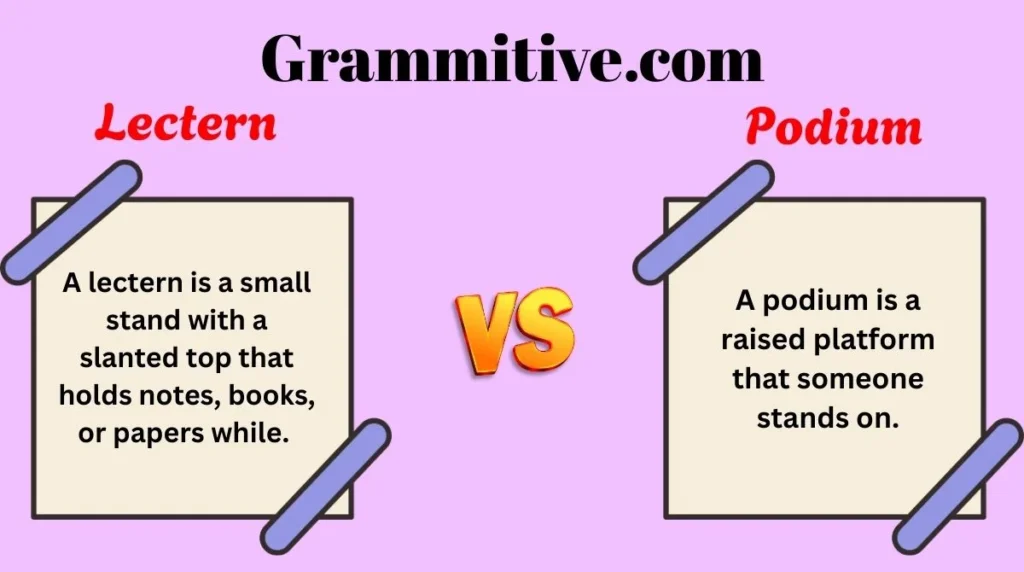
A lectern is a small stand with a slanted top that holds notes, books, or papers while someone reads or speaks.
It usually has:
- a thin stand
- a flat or angled surface
- space for papers or a laptop
The speaker stands behind it, not on it.
When to use it
Use lectern when:
- a teacher gives a lecture
- someone reads from notes
- a presenter speaks at a conference
- there is a small reading stand
It is common in:
- classrooms
- lecture halls
- conferences
- churches (sometimes)
Grammar rule
It is a countable noun.
You can say:
- a lectern
- the lectern
- two lecterns
Never use it as a verb.
Example sentences
- The professor placed his notes on the lectern.
- She stood behind the lectern and started her speech.
- There is a wooden lectern in every classroom.
- Please bring the lectern to the front of the hall.
- The speaker adjusted the microphone on the lectern.
- He leaned on the lectern while explaining the chart.
- The church has an old stone lectern.
- The student walked up to the lectern nervously.
Common learner confusion
Many students call this a podium. That is the biggest mistake.
If you stand behind it, it is usually a lectern, not a podium.
What Does “Podium” Mean?
Simple definition
A podium is a raised platform that someone stands on.
You stand on top of it, not behind it.
Think of it like a small stage.
When to use it
Use podium when:
- athletes receive medals
- someone stands higher than others
- there is a raised platform for speaking
Common places:
- sports events
- award ceremonies
- competitions
- political events
Grammar rule
It is also a countable noun.
You can say:
- a podium
- the podium
- three podiums
Example sentences
- She stepped onto the podium to receive her gold medal.
- The winner stood proudly on the podium.
- The host climbed the podium to address the crowd.
- The podium was decorated with flowers.
- Only the top three athletes stood on the podium.
- The mayor spoke from a raised podium.
- Cameras focused on the podium during the ceremony.
- The singer performed on a small podium.
Common learner confusion
People often say:
❌ “The teacher stood at the podium.”
But the teacher usually stands behind a lectern, not on a platform.
So this is incorrect in many situations.
What Does “Pulpit” Mean?
Simple definition
A pulpit is a raised stand in a church where a priest, pastor, or religious leader gives a sermon.
It is connected mainly with religion.
When to use it
Use pulpit when talking about:
- churches
- sermons
- religious speeches
- pastors or priests
It is not used in schools or offices.
Grammar rule
Countable noun:
- a pulpit
- the pulpit
Often used with: from the pulpit
Example sentences
- The priest spoke from the pulpit.
- The pulpit was made of dark wood.
- She walked up to the pulpit to read the Bible.
- The pastor delivered a strong message from the pulpit.
- The church pulpit is very old.
- The pulpit stands near the altar.
- He returned to the pulpit after the hymn.
- Many famous speeches were given from that pulpit.
Common learner confusion
Students sometimes use lectern or podium for church settings. But when it is a religious speaking place, pulpit is the correct word.
What Does “Rostrum” Mean?
Simple definition
A rostrum is a raised platform or stage where someone makes a formal speech.
It is more formal and old-fashioned.
You may hear it in:
- politics
- official ceremonies
- academic events
When to use it
Use rostrum in:
- formal writing
- news reports
- historical or official contexts
It is not common in daily conversation.
Grammar rule
Countable noun:
- a rostrum
- the rostrum
Example sentences
- The senator walked to the rostrum to speak.
- The rostrum stood at the center of the hall.
- The speaker addressed the audience from the rostrum.
- A microphone was fixed on the rostrum.
- She waited near the rostrum for her turn.
- The chairman climbed the rostrum confidently.
- The rostrum was covered with red cloth.
- His speech from the rostrum was powerful.
Common learner confusion
Many learners never hear this word, so they replace it with podium. That is fine in casual English, but in formal or historical writing, rostrum is more correct.
Difference Between Lectern and Podium (Detailed)
These two words cause the most confusion. Let’s compare them clearly.
Comparison Table
| Feature | Lectern | Podium |
|---|---|---|
| Position | Behind it | On it |
| Purpose | Holds notes/books | Raises the speaker |
| Shape | Stand with top | Platform |
| Common place | Classrooms | Sports events |
| Function | Reading/speaking support | Height and visibility |
| Typical use | Lectures | Award ceremonies |
Usage difference
If the object holds papers → lectern
If you stand on top → podium
Grammar logic
- “behind the lectern” sounds natural
- “on the podium” sounds natural
Prepositions help you choose the right word.
Sentence structure difference
✔ He stood behind the lectern.
✔ She stood on the podium.
❌ He stood on the lectern.
❌ She stood behind the podium. (usually wrong)
Meaning comparison
A lectern supports your notes.
A podium supports your body.
Simple!
Grammar Rules You Must Remember
Rule #1 – Use “behind” with lectern
He stood behind the lectern to teach.
Rule #2 – Use “on” with podium
She stood on the podium to receive her medal.
Rule #3 – Use “from the pulpit” for church speeches
The priest spoke from the pulpit.
Rule #4 – Use rostrum for formal or official writing
The president addressed the nation from the rostrum.
Common Mistakes Students Make
Why mistakes happen
Because:
- they look similar
- movies use “podium” for everything
- dictionaries do not show real-life usage
- native speakers sometimes mix them up too
Wrong vs Correct examples
❌ The teacher stood on the podium.
✔ The teacher stood behind the lectern.
❌ He read the Bible from the lectern.
✔ He read the Bible from the pulpit.
❌ The athlete stepped behind the podium.
✔ The athlete stepped onto the podium.
❌ The president used a lectern in the official ceremony.
✔ The president spoke from the rostrum. (formal)
Easy correction tips
Ask yourself:
- Am I standing on it? → podium
- Am I reading from it? → lectern
- Is it church? → pulpit
- Is it very formal/political? → rostrum
Easy Trick to Remember the Difference
Here is a fun memory trick.
Think of letters
Lectern → Lecture
Teachers lecture from it.
Podium → Pod (platform)
You stand on it.
Pulpit → Pastor
Both start with P.
Rostrum → Royal/formal
Sounds serious and official.
When you connect words like this, your brain remembers faster.
Daily Life Examples
These sound like real conversations.
- “The professor is already at the lectern.”
- “Please put your notes on the lectern.”
- “Wow, she’s standing on the podium with the gold medal!”
- “Only first place gets the top of the podium.”
- “The pastor walked up to the pulpit.”
- “His voice echoed from the pulpit.”
- “The senator moved toward the rostrum.”
- “Reporters waited near the rostrum.”
- “Can you move the lectern closer to the screen?”
- “The winners smiled on the podium for photos.”
Practice Section
Choose the correct word: lectern, podium, pulpit, or rostrum.
- The priest spoke from the ______.
- The gold medal winner stood on the ______.
- The teacher kept her laptop on the ______.
- The president addressed the parliament from the ______.
- Please stand behind the ______ and read your speech.
Answers
- pulpit
- podium
- lectern
- rostrum
- lectern
FAQs
What is the difference between lectern and podium?
A lectern holds notes and you stand behind it. A podium is a platform and you stand on it. The purpose and position are different.
Can we use podium for classroom speaking?
In casual speech, yes. But technically, the correct word is lectern. Podium is not the best choice for formal or academic English.
Is pulpit only for churches?
Yes. It is almost always connected to religious settings and sermons. It sounds strange in other places.
Is rostrum common in daily English?
Not really. It sounds formal and is used in politics or official events. In normal conversation, people often say podium instead.
Which word is most common in modern English?
Lectern and podium are most common. Pulpit is common in churches. Rostrum is less common.
Can native speakers mix these words?
Yes. Many native speakers say podium for everything. But correct usage helps you sound more educated and precise.
Final Conclusion
These four words may look similar at first, but each has its own clear role. A lectern helps you read or teach. A podium lifts you higher.
A pulpit belongs to the church. A rostrum fits formal or official speeches. Once you understand the purpose of each object, choosing the right word becomes easy.
Good English is not about big vocabulary. It is about using the correct word at the right time. Small differences like these make your speech sound natural and confident.
Try to notice these words when you watch news, sports events, or speeches. Say them out loud. Make your own sentences. Practice helps more than memorizing.
Soon, you will use these terms without thinking — just like native speakers do.

I am Lucas Bennett, a digital content creator passionate about social media trends and online growth strategies.
I share practical insights and guides to help users better understand and navigate the digital world.