

Many English learners stop for a second when they want to say something like, “I ___ the books on the table.”
Should it be layed out or laid out?
Both look possible. Both sound similar. And spell check sometimes doesn’t help much. So it’s easy to feel unsure.
This confusion happens because English has many tricky verb forms. Some verbs change their spelling in strange ways.
Others follow simple rules. The verb lay is one of those “tricky” ones. It doesn’t behave like regular verbs such as played, cleaned, or jumped.
And here’s the problem: “layed” feels correct… but it’s actually wrong.
This mistake appears everywhere — in homework, emails, social media posts, and even business writing. So learning the correct form is very important for daily English.
Using the wrong word can make your writing look less natural or less professional.
After reading this guide, you will clearly understand:
- Which form is correct
- Why one spelling is wrong
- How the grammar works
- Easy ways to remember it
- How native speakers use it in real life
By the end, you won’t have to guess anymore. You’ll know the answer with confidence.
What Does “Layed” Mean?
Here’s the simple truth first:
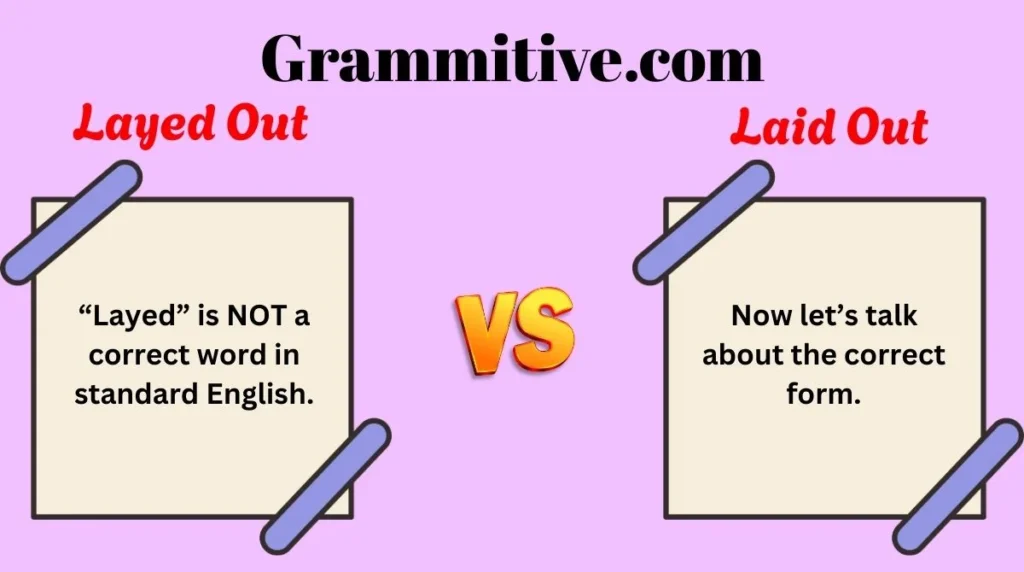
“Layed” is NOT a correct word in standard English.
Yes, really.
It may look right, but “layed” does not exist as the past tense of lay. It’s a common spelling mistake.
Why do learners think “layed” is correct?
Because most regular verbs in English add -ed:
- play → played
- clean → cleaned
- walk → walked
So naturally, many people think:
- lay → layed
But English doesn’t work that way here.
The verb lay is irregular, not regular.
That means it does not follow the -ed rule.
Grammar fact
❌ layed → incorrect
✅ laid → correct past tense and past participle
Examples people often write (but shouldn’t)
These are wrong:
- I layed the clothes on the bed.
- She layed the baby down.
- We layed out the plan yesterday.
- He layed the phone on the desk.
- They layed the carpet.
- The teacher layed the papers out.
All of these should use laid, not layed.
Common learner confusion
Many students say:
“But I saw someone write ‘layed’ online!”
Yes, it appears a lot on the internet. But that doesn’t make it correct. Native speakers also make grammar mistakes.
Think of it like this: popular does not mean correct.
So remember:
👉 “Layed” = spelling mistake
What Does “Laid Out” Mean?
Now let’s talk about the correct form.
Simple definition
Laid out is the past tense of lay out.
It means:
- to place something carefully
- to arrange something
- to spread something
- to organize something clearly
Grammar rule
Base verb: lay out
Past tense: laid out
Past participle: laid out
Structure
Subject + laid out + object
Examples
- I laid out my clothes for tomorrow.
- She laid out the books on the table.
- We laid out the picnic blanket.
- The teacher laid out the rules clearly.
- He laid out the plan step by step.
- They laid out the tools on the floor.
- The chef laid out all the ingredients.
- The designer laid out the website pages.
Notice something?
Every sentence uses laid, not layed.
Common learner confusion
Students often mix up:
- lay
- lie
- laid
- layed
These verbs are famous for causing headaches.
But for lay out, just remember:
👉 past = laid out
Always.
Difference Between Layed and Laid (Detailed)
This part is simple but very important.
Quick truth
There isn’t really a “difference” in meaning because layed is incorrect.
But let’s compare to make it crystal clear.
Comparison Table
| Word | Is it correct? | Meaning | Usage |
|---|---|---|---|
| layed out | ❌ No | None | spelling mistake |
| laid out | ✅ Yes | placed, arranged, organized | correct past tense |
Usage difference
- “layed out” → should never be used
- “laid out” → always correct form
Grammar logic
The verb lay is irregular.
Irregular verbs change form:
- say → said
- pay → paid
- lay → laid
See the pattern?
ay → aid
So:
- pay → paid
- lay → laid
Not payed
Not layed
Sentence structure difference
Wrong:
❌ I layed out the books.
Correct:
✅ I laid out the books.
Meaning comparison
Both try to express the same idea, but only one is grammatically right.
So choose laid every time.
Grammar Rules You Must Remember
These four rules will save you from many mistakes.
Rule #1: Lay is irregular
Lay does NOT take -ed.
Example:
✅ She laid the baby down.
Rule #2: Past tense = laid
Always change lay → laid.
Example:
✅ I laid the keys on the table.
Rule #3: Lay needs an object
Lay means “put something somewhere,” so you need an object.
Example:
✅ He laid the book down.
❌ He laid down. (missing object unless using different meaning)
Rule #4: Never write layed
It is not standard English.
Example:
❌ We layed out the plan
✅ We laid out the plan
Common Mistakes Students Make
These errors happen for very normal reasons.
Mistake 1: Adding -ed automatically
Wrong:
❌ I layed the clothes out.
Correct:
✅ I laid the clothes out.
Tip: If the verb is irregular, don’t add -ed.
Mistake 2: Mixing lay and lie
Students confuse:
- lay (put something)
- lie (rest yourself)
Example:
❌ I laid on the bed.
✅ I lay on the bed. (past of lie)
Different verbs. Different meanings.
Mistake 3: Copying internet spelling
Blogs and comments often show “layed.”
Don’t trust random sources. Use dictionaries.
Easy correction tips
- Think of pay → paid
- Then lay → laid
- Never add -ed
Easy Trick to Remember the Difference
Here’s a simple memory trick my students love.
The money trick
Think:
pay → paid
lay → laid
Both change the same way.
If you wouldn’t write payed, don’t write layed.
Another idea:
LAID has the word “AID.”
It “helps” you remember the correct form.
So:
“I laid the books out.”
Feels natural after a few times.

Daily Life Examples
These sentences sound like real conversations.
- I laid out my clothes before sleeping.
- She laid out the snacks for the guests.
- Dad laid out the tools in the garage.
- Can you see how he laid out the design?
- The teacher laid out today’s lesson plan.
- I laid out everything on the table to check.
- They laid out the carpet this morning.
- She laid out the documents for the meeting.
- We laid out the food for the party.
- He carefully laid out the photos.
Notice how common this phrase is. Native speakers use it daily.
Practice Section
Choose the correct option.
1
I ____ the papers on the desk.
A) layed
B) laid
2
She ____ out the dress for the wedding.
A) laid
B) layed
3
We ____ the picnic blanket.
A) layed
B) laid
4
He ____ out the plan yesterday.
A) laid
B) layed
5
They ____ the tiles carefully.
A) laid
B) layed
Answers
1 – B
2 – A
3 – B
4 – A
5 – A
All answers use laid.
FAQs
What is the difference between layed out and laid out?
“Layed out” is incorrect spelling. “Laid out” is the correct past tense of “lay out.” Always use laid.
Is layed ever correct in English?
No. Standard English dictionaries do not accept “layed.” It’s a common mistake only.
Can we use laid out in questions?
Yes.
Example: “Did you lay out the clothes?” (base form after did)
Is laid out formal or informal?
It works in both. You can use it in daily speech and business writing.
Why does lay change to laid?
Because lay is an irregular verb. Irregular verbs change spelling instead of adding -ed.
How do I remember the correct form easily?
Think pay → paid. Then lay → laid. Same pattern.
Final Conclusion
English spelling rules are not always friendly. Some words follow simple patterns, while others surprise us. The verb lay belongs to the second group.
Even though “layed out” looks natural, it isn’t correct English. The only proper form is laid out.
Once you accept that lay is irregular, everything becomes easier. You stop guessing. You stop doubting yourself while writing. And your sentences sound more natural to native speakers.
Try using “laid out” in your daily speaking and writing. Practice helps it feel automatic. After a week or two, you won’t even think about it anymore.
Small grammar fixes like this make a big difference. They improve your confidence and make your English look clean and professional.
Keep learning step by step. That’s how real progress happens.

I am Lucas Bennett, a digital content creator passionate about social media trends and online growth strategies.
I share practical insights and guides to help users better understand and navigate the digital world.