
Many English learners feel confused when they see “later than” and “later then.”
At first glance, both phrases look almost the same.
Only one small letter is different — a and e. But that tiny change can completely break a sentence.
This kind of mistake is very common. Even good students sometimes write then when they mean than. It happens because both words sound similar when spoken fast.
Also, both words talk about time in some way. So the brain mixes them up.
But here’s the good news: the difference is actually simple.
Once you clearly understand what than and then mean, you will never confuse them again.
These two words appear everywhere in daily English. You use them when comparing times, making plans, telling stories, or giving instructions. So learning them correctly will improve both your speaking and writing.
By the end of this guide, you will:
- understand each word clearly
- know the grammar rules
- see many real-life examples
- avoid common mistakes
- feel confident using them in conversation
Step by step, everything will become easy and natural.
What Does “Than” Mean?
Simple definition
Than is used for comparison.
We use it when we compare:
- time
- size
- number
- people
- things
- ideas
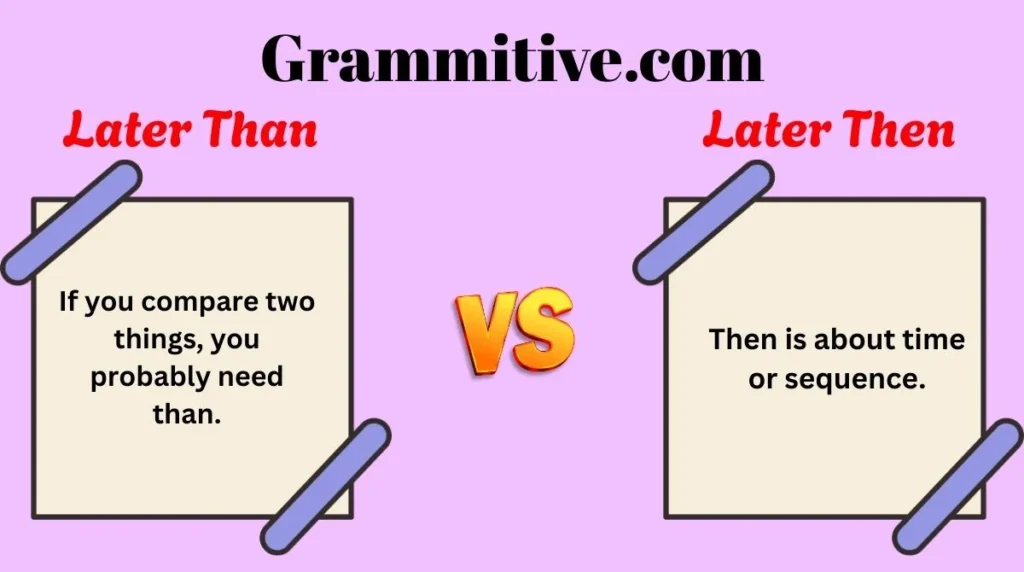
If you compare two things, you probably need than.
When to use it
Use than after:
- comparative adjectives (bigger, smaller, faster, later)
- comparative phrases (more than, less than, earlier than)
Grammar rule
Comparative word + than + second thing
Examples
- I arrived later than my sister.
- This movie is better than the last one.
- He is taller than me.
- We finished earlier than expected.
- Today is colder than yesterday.
- She speaks faster than her teacher.
- The bus came later than usual.
- My house is closer than yours.
Common learner confusion
Some students think than is related to time only. That’s not true.
It’s about comparison, not time itself.
Even in “later than,” the word than doesn’t mean time. It simply compares two times.
Example:
- later than 5 PM → comparing two times
So remember:
👉 If you are comparing, use than.
What Does “Then” Mean?
Simple definition
Then is about time or sequence.
It shows:
- what happens next
- what happened in the past
- what happens after something
It is not used for comparison.
When to use it
Use then when:
- telling a story
- giving instructions
- showing order
- talking about “at that time”
Grammar rule
Event 1 → then → Event 2
Examples
- I finished dinner, then I watched TV.
- First study, then relax.
- She was younger then.
- We went home and then slept.
- Mix the flour, then add the milk.
- Back then, life was simpler.
- Call me, then we’ll decide.
- He smiled and then left.
Common learner confusion
Some students think then means “after” or “later,” so they use it in comparisons. That is wrong.
Example:
❌ I arrived later then him
This is incorrect because you are comparing two people.
So remember:
👉 If you talk about order or time sequence, use then.
Difference Between Than and Then (Detailed)
This is where everything becomes clear.
Quick comparison table
| Feature | Than | Then |
|---|---|---|
| Meaning | Comparison | Time/sequence |
| Used for | Comparing two things | Showing what happens next |
| Grammar type | Conjunction | Adverb |
| Example | later than me | eat, then sleep |
| Question to ask | “Comparing?” | “What happens next?” |
Usage difference
Than → compares
Then → orders events
Compare:
- I came later than Tom. (comparison)
- I came home, then I cooked. (sequence)
Grammar logic
Than connects two ideas to show difference.
Then shows time movement.
If you try switching them, the sentence breaks.
Wrong:
- I am taller then you ❌
Correct:
- I am taller than you ✔️
Wrong:
- First wash your hands, than eat ❌
Correct:
- First wash your hands, then eat ✔️
Sentence structure difference
Later than + person/time
- later than 8 PM
- later than me
Action, then + action
- eat, then sleep
- study, then play
Meaning comparison
- than → difference
- then → order
Short version:
👉 Compare = than
👉 Next step = then
Grammar Rules You Must Remember
Rule #1 — Comparatives need “than”
After words like:
- later
- bigger
- faster
- better
- more
Always use than.
Example:
She arrived later than us.
Rule #2 — Steps or instructions need “then”
When giving directions, use then.
Example:
Turn left, then go straight.
Rule #3 — Stories use “then”
When telling what happened next.
Example:
He opened the door, then he ran away.
Rule #4 — Never use “then” for comparison
If you are comparing, then is always wrong.
Example:
❌ My car is faster then yours
✔️ My car is faster than yours
Common Mistakes Students Make
Why mistakes happen
There are three main reasons:
- Both words sound similar
- Spelling difference is small
- Both relate to time sometimes
So the brain mixes them up.
Wrong vs Correct examples
❌ I woke up later then you
✔️ I woke up later than you
❌ She is smarter then me
✔️ She is smarter than me
❌ Finish homework than watch TV
✔️ Finish homework then watch TV
❌ Back than, we had no phones
✔️ Back then, we had no phones
Easy correction tips
- See a comparison → use than
- See steps/time order → use then
- Say the sentence slowly
- Ask: “Am I comparing or sequencing?”
This small question fixes most mistakes instantly.
Easy Trick to Remember the Difference
Here’s a simple memory trick that students love.
The “A vs E” trick
Than = A = Compare
Think:
👉 A for compare
Then = E = Event
Think:
👉 E for event or next event
So:
- comparing → A → than
- next event → E → then
Super easy.
Another trick:
If you can replace it with “next”, use then.
Example:
Eat dinner, then sleep
Eat dinner, next sleep ✔️ works
But:
later than me
later next me ❌ doesn’t work
So use than.
Daily Life Examples (Very Important)
These sentences sound like real conversations.
- I’ll arrive later than you today.
- Finish your coffee, then we’ll leave.
- This phone is cheaper than that one.
- Call me then, okay?
- She came home later than usual.
- First take a shower, then eat breakfast.
- My brother is older than me.
- Back then, we played outside every day.
- This test was easier than the last one.
- Pack your bag, then go to bed.
These examples show how common these words are in everyday life.
You probably use them many times each day without noticing.
Practice Section
Choose than or then.
- She finished earlier ___ me.
- Eat your lunch, ___ go outside.
- This book is better ___ that one.
- We talked and ___ went home.
- He arrived later ___ expected.
Answers
- than
- then
- than
- then
- than
If you got all correct, great job. If not, read again and try once more.
Practice helps memory stick.
FAQs
What is the difference between later than and later then?
“Later than” compares two times and is correct grammar. “Later then” is usually wrong because “then” does not show comparison.
Can we use then for comparison?
No. “Then” is never used for comparison. Only “than” works after comparative words like better, bigger, or later.
Is than formal or informal?
“Than” is used in both formal and informal English. It’s a normal grammar word for comparisons everywhere.
Is then only about the future?
No. “Then” can talk about past, present, or future. It simply shows order or time sequence.
Example: Back then (past), then we will go (future).
Why do native speakers mix them up too?
Because they sound similar in fast speech. It’s a spelling mistake, not a grammar problem. Even native speakers sometimes type the wrong one.
How can I remember the difference quickly?
Use the trick: A = compare = than, E = event = then. Or ask yourself: “Am I comparing or showing what happens next?”
Final Conclusion
Small grammar words often cause big problems. “Than” and “then” are perfect examples. They look similar, sound similar, and both appear in daily English. That’s why learners mix them up so easily.
But now the difference should feel simple and clear.
Use than when comparing two things.
Use then when talking about time or what happens next.
That’s it. No complicated rules.
Keep practicing with real sentences. Listen to conversations. Write your own examples. The more you use these words, the more natural they will feel.
Soon, you won’t even have to think. You’ll choose the correct word automatically.
Little improvements like this make your English sound clean, correct, and confident.

I am Lucas Bennett, a digital content creator passionate about social media trends and online growth strategies.
I share practical insights and guides to help users better understand and navigate the digital world.