
Many English learners feel confused when they hear sentences like “I’ve added your name” and “I added your name.”
Both sound almost the same. Both talk about the past. Both use the verb add. So why do native speakers sometimes choose one and not the other?
This small change — just adding ’ve — can change the meaning more than you think.
In daily English, people use these forms all the time:
- at work
- in emails
- in messages
- during phone calls
- in casual conversations
If you choose the wrong one, your sentence may sound unnatural or unclear. Sometimes the time meaning becomes confusing.
Students often ask:
“Teacher, aren’t they both past tense?”
“Why can’t I just use ‘added’ every time?”
“When should I use ‘have added’?”
These are very good questions.
After reading this full guide, you will clearly understand:
- what I’ve added means
- what I added means
- when to use each one
- the grammar rules behind them
- common mistakes
- and an easy memory trick
By the end, you’ll feel confident using both forms naturally — just like a native speaker.
What Does “I’ve Added” Mean?
Simple definition
“I’ve added” = I have added
It is the present perfect tense.
It talks about:
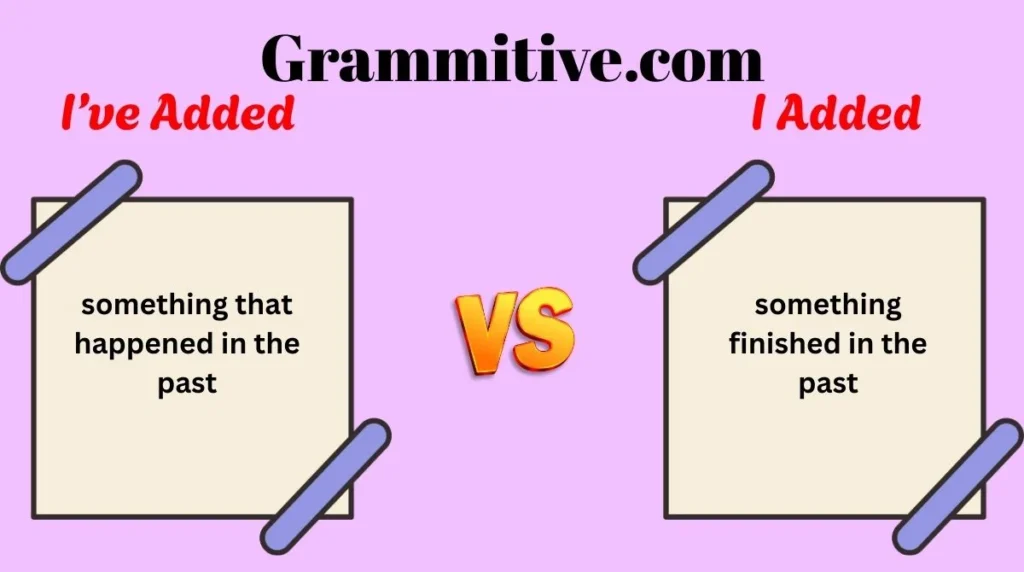
- something that happened in the past
- but is still important now
- or has a result now
The action is connected to the present moment.
Grammar rule
Structure:
Subject + have/has + past participle
So:
I + have + added
→ I’ve added
“Added” is the past participle of “add.”
When to use it
Use I’ve added when:
- the time is not important
- the result matters now
- the action is recent
- you talk about life experience
- the action affects the present situation
Examples
- I’ve added your email to the list.
- I’ve added some sugar to your tea.
- I’ve added three new photos to Instagram.
- I’ve already added the file.
- I’ve just added your name.
- I’ve added more chairs, so everyone can sit.
- I’ve added the notes you asked for.
- I’ve added you to the group chat.
Notice something:
These sentences focus on the result now, not the exact time.
For example:
“I’ve added your name.”
This means:
👉 Your name is on the list now.
The present result is important.
Common learner confusion
Many students think:
“I’ve added” = “I added”
But they are not always the same.
If you say:
❌ I’ve added your name yesterday.
This is wrong.
Why?
Because present perfect does NOT use specific past time words like:
- yesterday
- last night
- two days ago
- in 2023
That’s a big clue.
What Does “I Added” Mean?
Simple definition
“I added” is the simple past tense.
It talks about:
- something finished in the past
- a completed action
- often with a clear time
The action is done. Finished. Over.
Grammar rule
Structure:
Subject + past tense verb
I + added
→ I added
Very simple.
When to use it
Use I added when:
- you mention a specific time
- the action is completely finished
- you tell a story
- you talk about the past only
Examples
- I added your name yesterday.
- I added sugar this morning.
- I added him to the group last week.
- I added two spoons of salt by mistake.
- I added the wrong file earlier.
- I added her number after the meeting.
- I added some money to my bank account.
- I added the details in 2024.
Here, the time is clear.
We know when it happened.
Common learner confusion
Students sometimes say:
“I added your name.”
But they really mean:
“It’s added now.”
In this case, native speakers usually say:
“I’ve added your name.”
Because the result matters now.
So the difference is about time focus vs present result.
Difference Between I’ve Added and I Added (Detailed)
This is where things become clearer.
Quick comparison table
| Feature | I’ve Added | I Added |
|---|---|---|
| Tense | Present Perfect | Simple Past |
| Time | Not specific | Specific or finished |
| Focus | Result now | Past action |
| Connection to present | Yes | No |
| Time words allowed | just, already, yet | yesterday, last week, ago |
| Feeling | recent/relevant | completed story |
Usage difference
I’ve added
→ Important now
I added
→ Only past event
Example:
“I’ve added your name.”
Meaning: It’s on the list now.
“I added your name yesterday.”
Meaning: Just telling what happened yesterday.
Grammar logic
Present perfect = past + present connection
Simple past = only past
Think of present perfect like a bridge from past → now.
Simple past cuts that bridge.
Sentence structure difference
Present perfect:
I + have + added
Simple past:
I + added
The helper verb have changes everything.
Meaning comparison
Let’s compare side by side:
“I’ve added milk.”
👉 The milk is in the coffee now.
“I added milk.”
👉 I did it earlier. Maybe it’s gone now. Maybe not.
The first sentence feels more connected to the current moment.
Grammar Rules You Must Remember
Rule #1: Don’t use time words with present perfect
❌ I’ve added it yesterday
✅ I added it yesterday
Example:
I added the file last night.
Rule #2: Use present perfect for recent actions
Example:
I’ve just added your name.
“Just” works perfectly with present perfect.
Rule #3: Use simple past for stories
Example:
I added the file, sent the email, and left the office.
This is a past story.
Rule #4: Use present perfect for results that matter now
Example:
I’ve added more chairs, so everyone can sit.
The result is important now.
Common Mistakes Students Make
Why mistakes happen
Because both forms talk about the past, learners mix them.
Also, many languages don’t have present perfect, so students translate directly.
Mistake 1
❌ I’ve added him last week
✅ I added him last week
Tip: If you see a past time → use simple past.
Mistake 2
❌ I added your name. (but result matters now)
Better: I’ve added your name.
Tip: If someone is waiting for the result → use present perfect.
Mistake 3
❌ Have you added it yesterday?
✅ Did you add it yesterday?
Questions also follow the same rule.
Easy correction tips
Ask yourself:
- Is the time clear? → Simple past
- Is the result important now? → Present perfect
Easy Trick to Remember the Difference
Here’s a simple classroom trick students love.
The “Now Test”
Ask:
👉 “Does this affect NOW?”
If YES → use I’ve added
If NO → use I added
Examples:
Does it affect now?
“I’ve added you to the group.” → Yes
Does it affect now?
“I added you last year.” → No
Very easy.
Think:
Present perfect = NOW feeling
Simple past = PAST only
Daily Life Examples (Very Important)
These sound natural in real conversations.
- I’ve added you on Facebook. Check your request.
- I added you yesterday, but you didn’t accept.
- I’ve added more salt. Taste it now.
- I added too much salt earlier. Sorry.
- I’ve added the link in the email.
- I added the link last night.
- I’ve added your name to the guest list. You’re in.
- I added him after the meeting finished.
- I’ve added some notes for you to read.
- I added those notes during class.
See how native speakers naturally switch depending on time and result.
Practice Section
Choose the correct option:
1
I ___ the file yesterday.
(a) have added
(b) added
2
I ___ your number. Check your phone.
(a) have added
(b) added
3
I ___ three photos last night.
(a) have added
(b) added
4
I ___ just ___ the details.
(a) have added
(b) added
5
I ___ him two years ago.
(a) have added
(b) added
Answers
1 → b
2 → a
3 → b
4 → a
5 → b
FAQs
What is the difference between I’ve added and I added?
“I’ve added” connects the action to the present. The result matters now.
“I added” talks only about a finished past action with a clear time.
Can we use I’ve added with yesterday?
No. Present perfect never goes with finished past time words like yesterday, last week, or ago.
Is I’ve added formal or informal?
It’s normal in both spoken and written English. You’ll hear it often in emails and daily conversations.
Why do native speakers prefer I’ve added in emails?
Because emails often focus on current results. For example: “I’ve added the document” means it’s ready now.
Can both forms be correct sometimes?
Yes. Sometimes both work, but the meaning changes slightly depending on whether you focus on time or result.
Which one is easier for beginners?
Simple past is easier to learn first. But present perfect is very common, so it’s important to practice it too.
Final Conclusion
Small grammar points can make a big difference in English. The contrast between I’ve added and I added is a perfect example. Both talk about the past, yet their feeling is not the same.
One focuses on a finished time in the past. The other connects the action to the present moment. That connection is what many learners miss.
The good news is that the rule is not complicated. Just remember the simple questions:
Is the time specific? Or does the result matter now?
With practice, your brain will start choosing the correct form automatically. Listen to native speakers. Read emails. Notice how often present perfect appears when talking about recent actions.
Keep making your own sentences every day. That’s the fastest way to build confidence.
Soon, saying “I’ve added” or “I added” will feel completely natural — like second nature.

I am Lucas Bennett, a digital content creator passionate about social media trends and online growth strategies.
I share practical insights and guides to help users better understand and navigate the digital world.