
Many English learners feel confused when they see “is equal to” and “equals.”
Both phrases talk about things having the same value or the same meaning.
Both often appear in math, science, and even normal daily speech. So it’s easy to think they are exactly the same.
But here’s the problem.
Sometimes only “is equal to” sounds right.
Sometimes only “equals” is correct.
And sometimes both work — but the sentence structure changes.
This small difference makes students nervous. They stop mid-sentence and think, “Which one should I use?” That hesitation can slow down speaking and writing.
Understanding these two forms clearly helps you:
- speak more naturally
- write correct sentences
- sound more confident in school and exams
- avoid small grammar mistakes that teachers notice
By the end, the difference will feel simple and logical. You’ll know when to use each one without overthinking. It will feel natural — like tying your shoes.
What Does “Is Equal To” Mean?
Simple definition
“Is equal to” means:
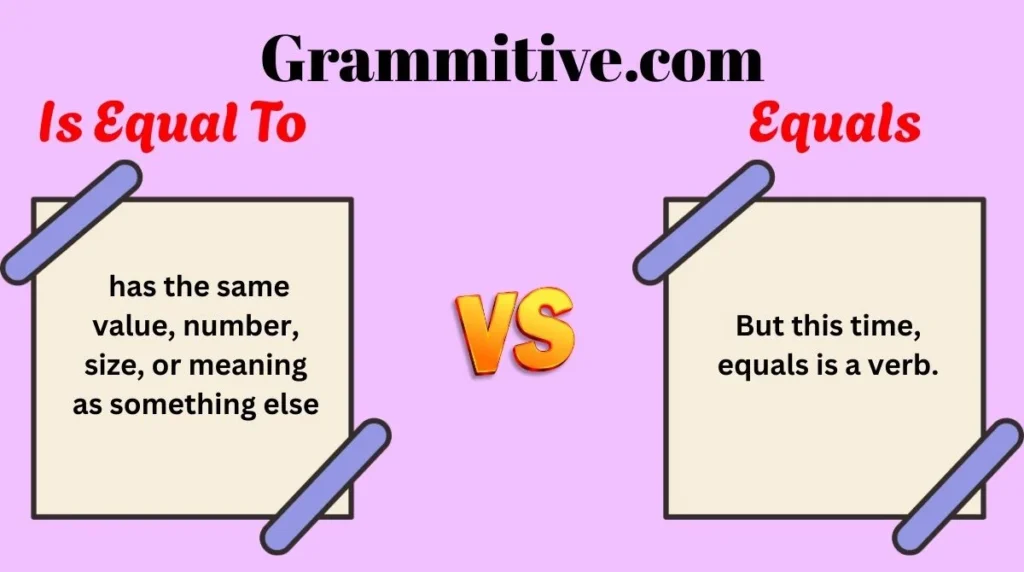
👉 has the same value, number, size, or meaning as something else
It is a verb phrase:
- is (verb “be”)
- equal (adjective)
- to (preposition)
So grammatically, “equal” is an adjective, not a verb.
When to use it
Use “is equal to” when:
- talking about math or numbers
- comparing values
- explaining relationships
- writing more formally
- describing something (because “equal” is an adjective)
It often sounds slightly more formal or descriptive.
Grammar rule
Structure:
Subject + is/are + equal to + noun/number
Examples:
- 5 is equal to 3 + 2
- The cost is equal to the price
- One hour is equal to 60 minutes
Notice: you must use a form of be (is/are/was/were) before “equal.”
Example sentences (6–8)
- Ten is equal to five plus five.
- One dollar is equal to one hundred cents.
- His score is equal to mine.
- The sides are equal to each other.
- This year’s sales are equal to last year’s numbers.
- One kilogram is equal to 1,000 grams.
- Their responsibilities are equal to ours.
- The time spent is equal to two hours.
Common learner confusion
Many learners think “equal” is a verb, so they say:
❌ Five equal three plus two.
That’s wrong because equal is not a verb here. You need is/are.
Correct:
✅ Five is equal to three plus two.
If you remember that equal describes something, the grammar becomes easier.
What Does “Equals” Mean?
Simple definition
“Equals” means:
👉 is the same as / gives the result of
But this time, equals is a verb.
It comes from the verb to equal.
So unlike “is equal to,” this one is one word and works as the main verb in the sentence.
When to use it
Use “equals” when:
- writing equations
- stating results
- speaking casually about numbers
- giving quick calculations
- wanting shorter sentences
It sounds faster, simpler, and more direct.
Grammar rule
Structure:
Subject + equals + noun/number
No “is.” No “to.”
Because equals is already the verb.
Example sentences (6–8)
- Two plus two equals four.
- Three times three equals nine.
- One hundred divided by ten equals ten.
- Hard work equals success.
- Practice equals improvement.
- Five minus two equals three.
- The total equals fifty dollars.
- Speed equals distance divided by time.
Common learner confusion
Students sometimes add extra words:
❌ Two plus two is equals four.
❌ Two plus two equals to four.
Both are wrong.
Correct:
✅ Two plus two equals four.
Because equals already includes the verb idea, nothing extra is needed.
Difference Between “Is Equal To” and “Equals” (Detailed)
Both talk about sameness, but their grammar structure is different.
That’s the key point.
Comparison table
| Feature | Is equal to | Equals |
|---|---|---|
| Word type | Verb phrase (be + adjective) | Single verb |
| Length | Longer | Shorter |
| Formality | Slightly formal | Simple/direct |
| Structure | is/are + equal to | equals |
| Common in | descriptions, explanations | equations, quick math |
| Example | 5 is equal to 2 + 3 | 5 equals 2 + 3 |
Usage difference
Is equal to
- more descriptive
- explains relationships
- used in formal writing or textbooks
Equals
- quicker
- common in math class or speech
- sounds natural in short equations
Grammar logic
Think like this:
- “equal” = adjective (needs a helper verb)
- “equals” = full verb (works alone)
So:
- He is happy (happy = adjective)
- He runs (runs = verb)
Same pattern:
- Five is equal to three plus two
- Five equals three plus two
Sentence structure difference
Structure A
Subject + be + equal + to + object
→ The length is equal to 10 meters.
Structure B
Subject + equals + object
→ The length equals 10 meters.
Both mean the same thing. Structure changes only.
Meaning comparison
Meaning = almost identical.
Difference = style and grammar.
So it’s not about right or wrong. It’s about sentence design.
Grammar Rules You Must Remember
Rule #1 – “Equal” needs a form of BE
Because it’s an adjective.
✅ The result is equal to ten.
❌ The result equal to ten.
Always add is/are/was/were.
Rule #2 – “Equals” stands alone
Don’t add extra verbs or prepositions.
✅ Six plus one equals seven.
❌ Six plus one is equals seven.
❌ Six plus one equals to seven.
Rule #3 – Use plural form when needed
If subject is plural, use are equal to.
✅ These numbers are equal to each other.
❌ These numbers is equal to each other.
Rule #4 – Use “equals” mostly for quick statements
Short math or logical statements sound smoother with “equals.”
✅ Time equals money.
Not: Time is equal to money (sounds heavy)
Choose the natural style.
Common Mistakes Students Make
Why mistakes happen
Students mix them because:
- both mean the same
- both appear in math
- grammar looks similar
- translations from other languages confuse things
Wrong vs correct examples
❌ Two plus two is equals four
✅ Two plus two equals four
❌ This number equal to mine
✅ This number is equal to mine
❌ Five equals to ten minus five
✅ Five equals ten minus five
❌ The values is equal to each other
✅ The values are equal to each other
Easy correction tips
Ask yourself:
- Is “equal” acting like an adjective? → use is/are
- Is it a quick equation? → use equals
This quick check saves time.
Easy Trick to Remember the Difference
Here’s a simple classroom trick many students like.
Think of clothes
“Equal” is like a shirt.
It needs help — you must “wear” it with is/are.
So:
👉 is + equal + to
But “equals” is fully dressed already.
It’s ready to go alone.
So:
👉 equals (no extra words)
Another memory idea:
S in equals = Single verb
One word. One verb. Done.
That small “s” reminds you it works by itself.
Daily Life Examples (Very Important)
These sound like normal spoken English.
- Two coffees equals ten dollars.
- One hour of exercise is equal to about 300 calories.
- Five days equals one work week.
- My score is equal to yours.
- Time spent studying equals better results.
- One mile is equal to about 1.6 kilometers.
- Four quarters equals one dollar.
- The bill is equal to last month’s bill.
- Ten percent equals a small discount.
- His effort equals success in the long run.
Notice how math or quick ideas use equals, while comparisons often use is equal to.
That’s how native speakers naturally choose.
Practice Section
Choose the correct option.
Questions
- Three plus five ______ eight. (equals / is equal to)
- The height ______ the width. (equals / is equal to)
- One kilogram ______ 1000 grams. (equals / is equal to)
- These two lines ______ each other. (equals / are equal to)
- Hard work ______ success. (equals / is equal to)
Answers
- equals
- is equal to
- equals (both possible, but equals sounds more natural)
- are equal to
- equals
FAQs
What is the difference between “is equal to” and “equals”?
Both show sameness. “Is equal to” uses an adjective and needs “is/are.” “Equals” is a single verb. The meaning is almost the same, but the grammar form changes.
Can we use “equals” in questions?
Yes.
Example: What equals ten?
But this sounds formal or mathematical. In daily speech, people rarely ask this way.
Is “is equal to” more formal?
Yes, slightly. It often appears in textbooks, academic writing, and explanations. “Equals” sounds quicker and more conversational.
Can both be correct in the same sentence?
Sometimes, yes.
Five equals two plus three.
Five is equal to two plus three.
Both are correct. Style choice only.
Why can’t we say “equals to”?
Because “equals” is already a verb. It doesn’t need “to.” Adding “to” breaks the grammar structure.
Which one do native speakers use more?
For quick math or ideas, “equals” is more common. For descriptions or formal comparisons, “is equal to” appears more often.
Final Conclusion
Small grammar differences can feel big when you’re learning English. “Is equal to” and “equals” are a perfect example. The meanings match, but the sentence structure changes. That tiny shift can confuse anyone at first.
The good news is that the rule is simple.
If you see equal as an adjective, use is/are + equal to.
If you want a short verb, use equals.
After a little practice, your brain will choose automatically. Try reading math sentences out loud. Write your own examples. Notice how teachers and books use them. The more you see them, the more natural they feel.
Soon you won’t stop to think. You’ll just speak and write smoothly — like a confident English user.

I am Lucas Bennett, a digital content creator passionate about social media trends and online growth strategies.
I share practical insights and guides to help users better understand and navigate the digital world.