

English looks simple at first. But when you start speaking with real people, small phrases can suddenly feel confusing.
One very common question learners ask is about “you all” and “all of you.”
Both seem to mean the same thing. Both talk about more than one person. Both are used in daily speech. So naturally, many students wonder:
Are they interchangeable?
Do they follow the same grammar?
Is one more polite or formal?
Which one sounds more natural?
These questions matter because this type of phrase appears everywhere — in classrooms, offices, families, meetings, emails, and even movies. You will hear it almost every day.
Imagine saying, “I want to thank you all,” or “I want to thank all of you.” They feel similar, but the tone and use can change a little. Native speakers choose one or the other without thinking. Learners, however, often pause and feel unsure.
By the end of this guide, everything will feel clear. You will understand the meaning, grammar, differences, rules, mistakes, and many real-life examples. You’ll also get simple tricks to remember which one to use.
Think of this like a friendly classroom lesson. Slow, clear, and practical.
What Does “You All” Mean?
Simple definition
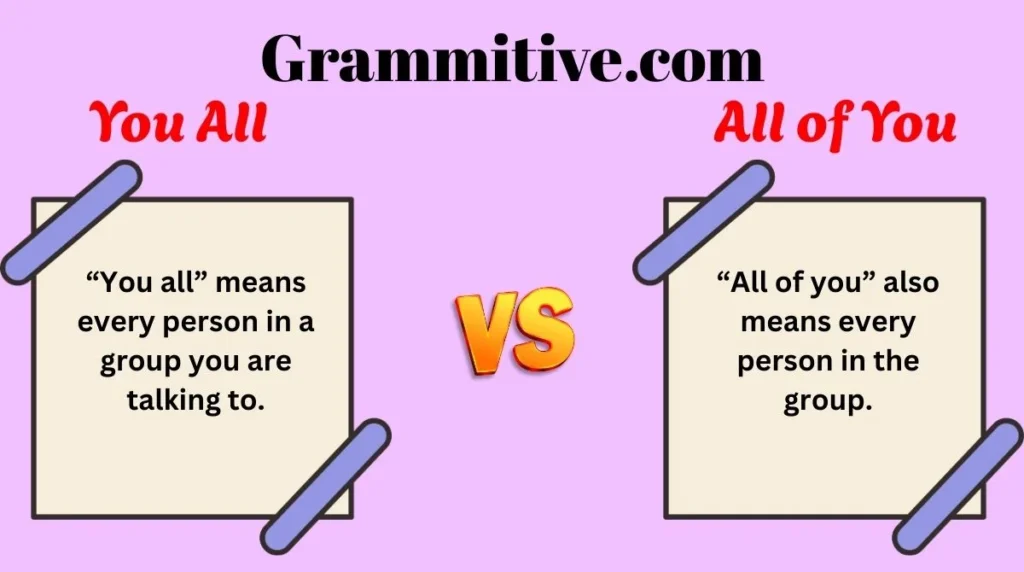
“You all” means every person in a group you are talking to.
It is simply a plural form of “you.”
Because English uses the same word “you” for both singular and plural, sometimes we add “all” to make it clear that we mean more than one person.
When to use it
“You all” is common when:
- speaking to a group
- giving instructions
- talking casually
- using friendly or conversational English
- speaking in American English (especially Southern regions)
It often sounds warm, relaxed, and direct.
Grammar rule
Structure:
You all + verb
“You all” works like a normal subject.
Examples:
- You all are ready.
- You all need to listen.
It does not need “of.”
Example sentences (6–8)
- You all did a great job today.
- I hope you all understand the lesson.
- Are you all coming to the party?
- You all look tired.
- Thank you all for helping me.
- You all should try this cake.
- Can you all hear me clearly?
- I miss you all.
Common learner confusion
Many students think “you all” is wrong or slang. It’s not wrong at all. It is completely correct grammar.
However, it is more casual. So in very formal writing (business letters, academic essays), “all of you” may sound better.
Another confusion: some learners accidentally say “you all of”, which is incorrect.
What Does “All of You” Mean?
Simple definition
“All of you” also means every person in the group.
It has the same basic meaning as “you all,” but it sounds a bit more standard and formal.
When to use it
“All of you” is common when:
- speaking politely
- giving speeches
- writing emails
- talking formally
- emphasizing every person strongly
It often sounds clearer and slightly more serious.
Grammar rule
Structure:
All of you + verb
Here, “of” is necessary. You cannot remove it.
Incorrect: All you are here
Correct: All of you are here
Example sentences (6–8)
- I appreciate all of you.
- All of you must complete the form.
- I invited all of you to dinner.
- All of you look amazing tonight.
- Can all of you stay after class?
- I want to thank all of you for your support.
- All of you need to listen carefully.
- I trust all of you.
Common learner confusion
Some students drop “of” and say “all you.” That sounds unnatural and grammatically incorrect.
Also, learners sometimes think this phrase is only formal. That’s not true. It’s used in daily speech too — just a little more neutral or polite.
Difference Between You All and All of You (Detailed)
At first, both phrases look identical in meaning. But there are small differences in tone, grammar, and style.
Comparison Table
| Feature | You all | All of you |
|---|---|---|
| Meaning | Entire group | Entire group |
| Formality | Casual | Neutral/Formal |
| Common in speech | Very common | Common |
| Common in writing | Less common | More common |
| Grammar pattern | Subject phrase | Quantifier phrase |
| Emphasis | Friendly tone | Stronger emphasis |
Usage difference
“You all” feels conversational. Teachers, friends, and family use it naturally.
“All of you” sounds clearer when you want to stress the whole group or speak more politely.
For example:
Teacher speaking warmly:
→ You all did great today.
Principal speaking formally:
→ I am proud of all of you.
Both are correct. The feeling is slightly different.
Grammar logic
“You all” = pronoun + intensifier
“All of you” = quantifier + pronoun
This is why the structure changes.
“You all” behaves like “you.”
“All of you” behaves like “all.”
So the grammar follows different patterns.
Sentence structure difference
You all → starts directly with “you”
- You all finished early.
All of you → starts with “all”
- All of you finished early.
Same meaning. Different structure.
Meaning comparison
Meaning is almost identical. The only difference is:
- tone
- emphasis
- formality
Native speakers choose based on feeling, not strict grammar rules.
Grammar Rules You Must Remember
Rule #1: “You all” does NOT use “of”
Correct: You all are late
Wrong: You all of are late
Example:
You all need to hurry.
Rule #2: “All of you” MUST use “of”
Correct: All of you are here
Wrong: All you are here
Example:
All of you did excellent work.
Rule #3: Both take plural verbs
Because they refer to many people, use plural verbs.
Correct:
- You all are happy
- All of you are happy
Wrong:
- You all is happy
Rule #4: Choose based on tone
Casual → you all
Formal/polite → all of you
Example:
- Casual: You all coming tonight?
- Formal: I appreciate all of you for attending.
Common Mistakes Students Make
Why mistakes happen
The main problem is that English uses one word “you” for both singular and plural. Many languages have different forms, so learners try to add words incorrectly.
Another issue is mixing both phrases together.
Wrong vs Correct examples
Wrong: You all of should listen
Correct: You all should listen
Wrong: All you must come
Correct: All of you must come
Wrong: You all is ready
Correct: You all are ready
Wrong: All of you is late
Correct: All of you are late
Easy correction tips
- If you start with “you,” don’t add “of.”
- If you start with “all,” add “of.”
- Always use plural verbs.
Simple checks save many mistakes.

Easy Trick to Remember the Difference
Here’s a small memory trick students love.
Think like this:
“You all” = talking TO people
“All of you” = talking ABOUT the whole group
Imagine pointing with your hand.
When you point directly:
“You all, come here!”
When you speak more generally:
“I want to thank all of you.”
So:
Direct & friendly → you all
General & polite → all of you
This isn’t a strict rule, but it helps your brain choose faster.
Daily Life Examples (Very Important)
These are sentences you might hear every day.
- You all ready to order?
- Thank you all for coming tonight.
- Can all of you sign this paper?
- I’m proud of all of you.
- You all did amazing in the game.
- I hope you all sleep well.
- All of you need to wear masks.
- I love you all so much.
- Are all of you coming by bus?
- You all look so happy today.
Notice how natural both phrases sound in conversation.
Practice Section
Choose the correct option.
- _____ are invited to the wedding.
(a) You all
(b) All of you - Thank _____ for your help.
(a) you all
(b) all of you - _____ must submit homework today.
(a) All of you
(b) You all of - I miss _____ guys.
(a) you all
(b) all you - _____ coming with me?
(a) You all
(b) All of you are
Answers
- Both correct
- Both correct
- All of you
- you all
- You all
FAQs
What is the difference between you all and all of you?
Both mean the whole group. “You all” sounds casual and friendly. “All of you” sounds more formal or polite. Grammar structure is different, but meaning is the same.
Can we use you all in questions?
Yes. It is very common.
Example:
Are you all ready?
Did you all finish?
It sounds natural in everyday speech.
Is all of you formal?
It is slightly more formal, but still normal in daily conversations. It’s safe for emails, presentations, and polite speech.
Which one is more common in American English?
“You all” is very common in American speech, especially in the South. “All of you” is common everywhere.
Can I use them interchangeably?
Most of the time, yes. Just change the structure correctly. The meaning stays almost the same.
Is “y’all” the same as “you all”?
Yes. “Y’all” is just a shorter, informal spelling of “you all.” It’s used mostly in spoken English and casual writing.
Final Conclusion
Small phrases can cause big confusion, especially when they look almost the same. “You all” and “all of you” are perfect examples. The good news is that the difference is not difficult once you understand the tone and structure.
Both phrases talk about every person in a group. One sounds more relaxed and friendly. The other sounds a bit more polite and formal.
Grammar rules are simple: no “of” with “you all,” and always “of” with “all of you.” Add plural verbs, and you’re safe.
The best way to master this is practice. Listen to conversations, read dialogues, and try using both forms when you speak. After some time, your ears will naturally choose the right one.
Language grows through use, not memorization. So speak often, make small mistakes, and keep learning. That’s how real fluency happens.

I am Lucas Bennett, a digital content creator passionate about social media trends and online growth strategies.
I share practical insights and guides to help users better understand and navigate the digital world.