
Many English learners feel confused when they see sentences like:
“This movie was inspired by a true story.”
but also
“Her design was inspired from nature.”
One sounds right. The other sounds strange. But why?
The problem is small words. Tiny prepositions like by and from can change the meaning of a sentence. These small words are easy to mix up, especially for non-native speakers.
Even intermediate students often guess. And guessing usually leads to mistakes.
The phrase “inspired by” is very common in books, movies, music, and daily speech. You hear it everywhere.
But some learners also use “inspired from”, thinking both mean the same thing. In most cases, they do not.
If you use the wrong one, your English may sound unnatural or grammatically incorrect. Native speakers may understand you, but it won’t sound smooth or professional.
After reading this guide, you will clearly understand:
- what inspired means
- how by works
- how from works
- which one sounds natural with “inspired”
- grammar rules and patterns
- common mistakes
- and easy memory tricks
By the end, choosing the correct form will feel simple and automatic.
What Does “Inspired” Mean?
Simple definition
Inspired means:
👉 to feel motivated, influenced, or given an idea by something or someone.
It often describes creativity, emotion, or action.
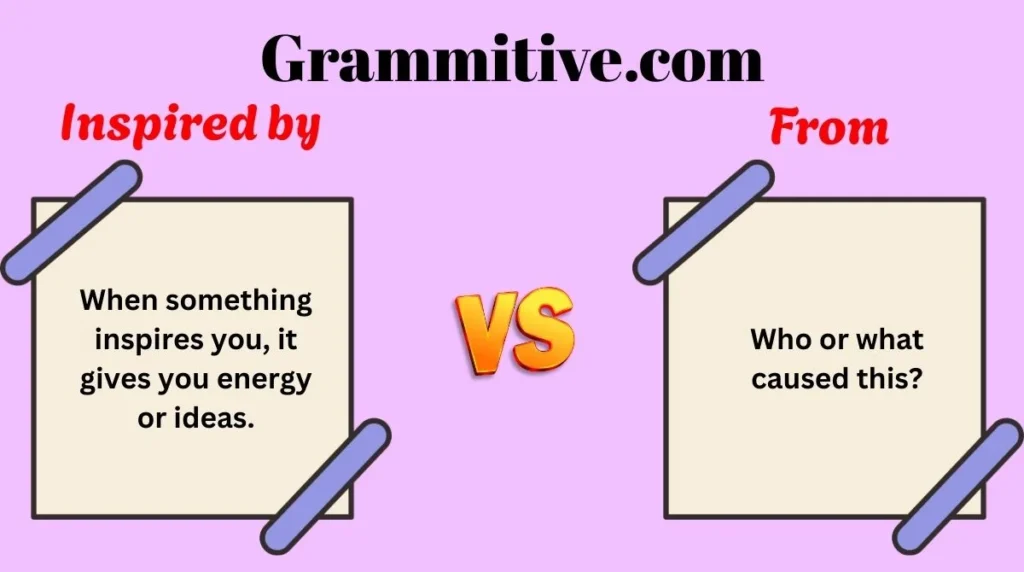
When something inspires you, it gives you energy or ideas.
When to use it
Use inspired when talking about:
- art
- music
- writing
- ideas
- feelings
- motivation
- success stories
It is often used in passive voice:
be + inspired + preposition
Basic grammar rule
be inspired + by + source
This is the most natural and correct structure.
Example sentences
- I was inspired by my teacher.
- This song is inspired by real events.
- She felt inspired by nature.
- The movie was inspired by a true story.
- He was inspired by his father’s hard work.
- The painting was inspired by the ocean.
- I feel inspired by your kindness.
- Her speech inspired many students.
Common learner confusion
Many students think:
- inspired = copy
- inspired = same as
But inspired does NOT mean copying.
It means:
👉 influenced or motivated, not exactly the same.
For example:
❌ This movie copied Titanic.
✅ This movie was inspired by Titanic.
“Inspired” sounds softer and more creative.
What Does “By” Mean?
Simple definition
By often means:
👉 the cause, source, or agent of an action.
It answers the question:
Who or what caused this?
When to use it
Use by when you talk about:
- the person who did something
- the reason something happened
- the source of influence
Very common in passive voice sentences.
Grammar rule
passive verb + by + doer/cause/source
Example sentences
- The book was written by John.
- The cake was made by my mom.
- She was helped by a friend.
- The window was broken by the wind.
- I was inspired by my coach.
- The design was created by a student.
- He was shocked by the news.
- The team was supported by fans.
Common learner confusion
Students sometimes mix by and with or from.
Remember:
- by = cause or source
- with = tool
- from = origin or starting point
Example:
✅ Cut the bread with a knife. (tool)
✅ Inspired by a movie. (source of idea)
What Does “From” Mean?
Simple definition
From usually means:
👉 a starting point, origin, or place something comes out of.
It shows movement or separation.
When to use it
Use from for:
- place of origin
- time start
- separation
- removal
- source of physical movement
Grammar rule
verb + from + origin/start
Example sentences
- I am from Canada.
- She came from school.
- This gift is from my aunt.
- Water comes from the tap.
- He borrowed money from me.
- The train leaves from platform 2.
- Smoke came from the kitchen.
- I learned English from my brother.
Common learner confusion
Learners sometimes think:
“source” = always “from”.
But English is tricky.
Some verbs prefer by, not from.
For example:
❌ inspired from
❌ shocked from
❌ surprised from
These sound unnatural.
Instead:
✅ inspired by
✅ shocked by
✅ surprised by
Difference Between Inspired by and Inspired from (Detailed)
Here is the most important part.
Quick answer
👉 Inspired by = correct and natural
👉 Inspired from = usually incorrect
Comparison table
| Feature | Inspired by | Inspired from |
|---|---|---|
| Natural English | ✅ Yes | ❌ Rare/unnatural |
| Grammar type | passive source | origin movement |
| Used by natives | very common | almost never |
| Sounds fluent | yes | sounds strange |
| Example | inspired by a story | ❌ inspired from a story |
Usage difference
Inspired by → influence or motivation
From → physical or starting origin
“Inspiration” is not movement, so we do not use “from”.
Ideas don’t move physically. They influence us.
That’s why English uses by.
Grammar logic
Think about passive voice:
- written by
- created by
- influenced by
- inspired by
Same pattern.
Because someone or something causes the inspiration.
Sentence structure difference
Correct:
be + inspired + by + noun
Example:
She was inspired by her grandmother.
Incorrect:
❌ be inspired from + noun
Meaning comparison
Let’s see the difference:
✅ The design was inspired by nature.
= Nature influenced the design.
❌ The design was inspired from nature.
= Sounds grammatically wrong.
Native speakers immediately feel something is off.
Grammar Rules You Must Remember
Rule #1: Use “by” after inspired
✅ I was inspired by her story.
❌ inspired from her story
Always choose by.
Rule #2: Use passive structure
Most sentences use:
be + inspired
✅ He was inspired by music.
Not:
❌ Music inspired from him.
Rule #3: Use a noun or person after “by”
After by, use:
- person
- event
- thing
- idea
Examples:
✅ inspired by teachers
✅ inspired by history
✅ inspired by love
Rule #4: Don’t translate directly from your language
Some languages use “from”. English does not.
Trust English patterns, not translation.
Common Mistakes Students Make
Why mistakes happen
- direct translation
- guessing
- confusing “source” with “origin”
- hearing incorrect English online
Wrong vs correct examples
❌ I was inspired from my friend.
✅ I was inspired by my friend.
❌ This movie is inspired from real life.
✅ This movie is inspired by real life.
❌ She got inspiration from her teacher.
✅ She was inspired by her teacher.
(Note: “inspiration from” is OK, but “inspired from” is not common.)
Easy correction tips
When you say “inspired”, immediately think:
👉 BY
Train your brain like a fixed pair:
inspired + by
Like:
- afraid of
- interested in
- good at
Just memorize it as one unit.
Easy Trick to Remember the Difference
Here’s a simple memory trick.
Think:
👉 BY = beside you, influencing you
When something inspires you, it’s like standing next to you and pushing you forward.
So:
Inspired by someone.
Another trick:
Most passive verbs use by.
- made by
- built by
- written by
- inspired by
Same family. Same rule.
Easy.
Daily Life Examples (Very Important)
These sound natural in conversations.
- I was inspired by that movie last night.
- She’s inspired by her mom’s strength.
- This recipe is inspired by Italian food.
- His speech really inspired me.
- The app was inspired by a real problem.
- I feel inspired by your progress.
- That painting is inspired by nature.
- She started her business inspired by her dad.
- I get inspired by travel photos.
- The song was inspired by childhood memories.
Notice something?
Every sentence uses by. Never from.
That’s how real English sounds.
Practice Section
Choose the correct option.
Questions
- This book was inspired ___ a true story.
a) by
b) from - She was inspired ___ her teacher.
a) by
b) from - The design is inspired ___ nature.
a) by
b) from - I got this gift ___ my cousin.
a) by
b) from - He was inspired ___ music.
a) by
b) from
Answers
1 → by
2 → by
3 → by
4 → from
5 → by
FAQs
1. What is the difference between inspired by and inspired from?
“Inspired by” is correct and natural. It shows influence or motivation. “Inspired from” sounds unnatural in modern English and is rarely used by native speakers.
2. Can we ever say inspired from?
In standard English, it is not recommended. Some people say it informally, but it sounds wrong to most native speakers. Use “inspired by” instead.
3. Is inspired by formal or informal?
It works in both. You can use it in daily speech, essays, books, movies, and business writing. It’s completely normal everywhere.
4. Can inspired be used without by?
Yes, sometimes. Example: “I feel inspired today.” But when you mention the source, use “by.”
5. What preposition usually follows inspired?
Almost always “by.” It is the fixed and accepted collocation in English grammar.
6. Why do learners say inspired from?
Because many languages translate it that way. But English prepositions don’t always match other languages. Memorizing patterns helps more than translating.
Final Conclusion
Small grammar points often create big confusion. “Inspired by or from” looks like a tiny difference, but it changes how natural your English sounds.
Native speakers almost always say inspired by, because inspiration comes from influence, not physical movement.
The safest habit is simple: treat inspired by as one fixed phrase. Don’t separate them. Don’t overthink. Just remember the pattern the same way you remember “interested in” or “afraid of.”
Read, listen, and notice real English around you. Movies, books, and songs will all show the same structure. With practice, it becomes automatic.
Soon you won’t stop to think. You’ll just say it correctly.
And that’s the goal of good grammar — speaking smoothly and naturally without stress.

I am Lucas Bennett, a digital content creator passionate about social media trends and online growth strategies.
I share practical insights and guides to help users better understand and navigate the digital world.