
English spelling can feel tricky sometimes.
Just when you think you’ve learned a word, you see another version that looks almost the same.
That is exactly what happens with indorsement and endorsement.
Many learners stop and think:
“Are these two different words?”
“Is one wrong?”
“Which one should I use in exams or writing?”
Even native speakers get confused when they see indorsement in old books or legal papers. It looks like a spelling mistake. But surprisingly, it isn’t.
This small spelling difference can cause big problems. If you use the wrong form in school essays, emails, or professional writing, it may look outdated or incorrect.
On the other hand, understanding both forms helps you read legal documents, bank papers, and historical texts more easily.
After reading this guide, everything will feel simple.
You will clearly understand:
- What indorsement means
- What endorsement means
- Which one is modern
- Which one you should actually use
- Real-life examples
- Easy tricks to remember
By the end, you won’t hesitate for even one second when choosing the correct spelling.
What Does “Indorsement” Mean?
Simple definition
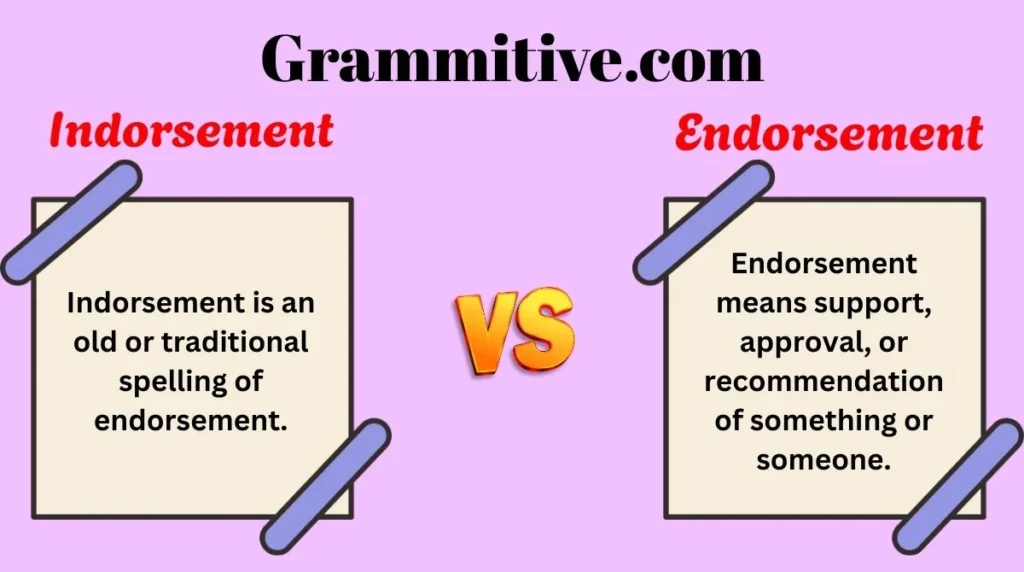
Indorsement is an old or traditional spelling of endorsement.
It means approval, support, or a signature written on the back of a document, especially a check or legal paper.
Today, this spelling is rarely used in everyday English.
When to use it
You usually see indorsement:
- In old legal documents
- In banking or financial laws
- In historical books
- In formal or traditional writing
In normal conversation or modern writing, people do not use this spelling.
Grammar rule
It is a noun.
It comes from the verb indorse (old spelling of endorse).
Structure:
- indorse (verb)
- indorsement (noun)
Example sentences
- The check needs your indorsement on the back.
- The lawyer asked for written indorsement of the contract.
- The bank refused the check without proper indorsement.
- His indorsement made the document valid.
- The old law book mentions indorsement many times.
- The policy requires the indorsement of both parties.
- She added her indorsement before submitting the file.
- The clerk checked every indorsement carefully.
Common learner confusion
Many students think:
- “Is this a typo?”
- “Did someone spell endorsement wrong?”
But no — it’s just old-fashioned English.
Still, using it today can make your writing look strange or outdated.
So remember:
Correct but rare. Not modern.
What Does “Endorsement” Mean?
Simple definition
Endorsement means support, approval, or recommendation of something or someone.
It can also mean signing the back of a check or document.
This is the modern and standard spelling used everywhere today.
When to use it
Use endorsement:
- In everyday English
- In business writing
- In school essays
- In news articles
- In marketing and advertising
- In spoken English
Basically, this is the spelling you should always choose.
Grammar rule
It is a noun from the verb endorse.
Structure:
- endorse (verb)
- endorsement (noun)
Example sentences
- The teacher gave her endorsement to my project.
- The actor signed an endorsement deal with the brand.
- His endorsement helped the product sell faster.
- I need your endorsement before submitting the form.
- The bank requires your endorsement on the check.
- The company received government endorsement.
- Her endorsement increased trust among customers.
- The doctor’s endorsement made the medicine popular.
Common learner confusion
Students sometimes wonder:
- Does endorsement only mean advertising?
- Is it only for celebrities?
No.
It simply means approval or support.
Advertising is just one special case.
Difference Between Indorsement and Endorsement (Detailed)
These two words mean the same thing, but they are used differently today.
Quick comparison table
| Feature | Indorsement | Endorsement |
|---|---|---|
| Spelling style | Old | Modern |
| Common today? | Rare | Very common |
| Used in speech? | Almost never | Yes |
| Used in writing? | Legal/historical only | Everywhere |
| Meaning | Approval/support | Approval/support |
| Recommended for students | No | Yes |
Usage difference
- Indorsement → mainly old legal or banking texts
- Endorsement → everyday English
If you use indorsement in an email or essay, people may think it’s a spelling mistake.
Grammar logic
Both come from French roots.
Older English sometimes used “in-” instead of “en-”.
Over time, English standardized the spelling to endorse and endorsement.
Language changes naturally.
Modern spelling wins.
Sentence structure difference
Actually, there is no structure difference.
Both work like this:
- get + endorsement
- give + endorsement
- need + endorsement
Same pattern for indorsement, but rarely used.
Meaning comparison
Meanings are identical:
- approval
- support
- signature
Only spelling and modern usage differ.
Grammar Rules You Must Remember
Rule #1: Use “endorsement” in modern writing
✔ Correct: I need your endorsement.
❌ Wrong: I need your indorsement.
Always choose endorsement for emails, exams, blogs, and reports.
Rule #2: Both are nouns
They name a thing (approval/support), not an action.
✔ Her endorsement helped me.
❌ She endorsement me.
Use the verb endorse, not endorsement.
Rule #3: Use the verb “endorse,” not “indorse”
✔ The bank endorsed the check.
❌ The bank indorsed the check.
Modern English prefers endorse.
Rule #4: Don’t mix spellings
Keep consistency.
❌ The endorsement requires your indorsement.
✔ The endorsement requires your endorsement.
Stick to one — and that one should be endorsement.
Common Mistakes Students Make
Why mistakes happen
- They see both spellings online
- Legal documents use indorsement
- They think one has a different meaning
- Spellcheck sometimes confuses them
Wrong vs Correct examples
❌ Please give your indorsement to this email.
✔ Please give your endorsement to this email.
❌ The celebrity signed an indorsement deal.
✔ The celebrity signed an endorsement deal.
❌ Teacher indorsed my homework.
✔ Teacher endorsed my homework.
Easy correction tips
- Think: modern English → endorsement
- If writing for school or work, never use indorsement
- Let your spellchecker guide you
Easy Trick to Remember the Difference
Here’s a simple memory trick.
Think of the word:
END
Endorsement starts with END.
Modern English uses END.
Old English uses IN.
So:
- END → new → endorsement
- IN → old → indorsement
Also, look around.
All ads say “celebrity endorsement,” not “indorsement.”
Your brain will quickly remember which one sounds normal.
Daily Life Examples (Very Important)
These are natural, spoken English sentences you might hear every day.
- Can you give your endorsement for my leave request?
- The doctor’s endorsement made me trust the medicine.
- This phone got a lot of celebrity endorsements.
- I need your endorsement on the back of the check.
- My manager gave full endorsement to the plan.
- The school needs parent endorsement for the trip.
- His public endorsement changed people’s opinions.
- Without your endorsement, the form isn’t valid.
- The brand paid millions for her endorsement.
- Thanks for your endorsement — it means a lot.
Notice something?
Every sentence uses endorsement, not indorsement.
That’s how real English works.
Practice Section
Choose the correct option.
- I need your ______ on this check.
a) indorsement
b) endorsement - The actor signed an ______ deal.
a) endorsement
b) indorsement - Old law books sometimes use ______.
a) endorsement
b) indorsement - Please ______ the form.
a) endorse
b) indorse - Her ______ helped the campaign.
a) endorsement
b) indorsement
Answers
1 → b
2 → a
3 → b
4 → a
5 → a
FAQs
What is the difference between indorsement and endorsement?
Both mean approval or support. The only difference is spelling. Indorsement is old-fashioned, while endorsement is modern and widely used.
Which spelling is correct today?
Endorsement is the correct and standard spelling in modern English. Schools, businesses, and media all use this form.
Is indorsement wrong?
No, it isn’t wrong. It’s just outdated. You may see it in legal or historical texts, but it’s not common today.
Can we use endorsement in questions?
Yes. It works like any noun. For example: “Do you have your manager’s endorsement?”
Is endorsement formal or informal?
It works in both. It’s fine for casual speech and also perfect for formal writing, business, and legal documents.
Why do banks sometimes use indorsement?
Some old banking laws kept the traditional spelling. That’s why it still appears in certain official papers.
Final Conclusion
Small spelling differences can feel confusing at first, especially when both words look correct. But this pair is actually simple once you see the pattern.
Indorsement belongs to older English. You might meet it in law books or historical documents.
Endorsement is the modern spelling used everywhere today — in speech, writing, business, and school.
So whenever you need to talk about approval, support, or signing a check, choose endorsement without worry.
Language becomes easier when you notice these small details. Practice reading real sentences, say them out loud, and use the word in daily conversation. Soon, it will feel natural.
Keep learning step by step. English gets clearer every day.

I am Lucas Bennett, a digital content creator passionate about social media trends and online growth strategies.
I share practical insights and guides to help users better understand and navigate the digital world.