

Many English learners feel confused when they talk about time and days.
You may hear someone say, “I finished it in the same day.
” Another person says, “I met her on the same day.” Then someone else says, “at the same day,” and suddenly everything feels mixed up.
So which one is right?
The problem comes from small words called prepositions — in, on, at. These tiny words look simple, but they change the meaning of a sentence.
They are also different in every language. That’s why learners often translate from their own language and make mistakes.
But here’s the good news. Once you understand the logic behind time prepositions, everything becomes much easier. There is a clear pattern. And after you see it, you won’t forget it.
By the time you finish reading, you will clearly know:
- When to use in the same day
- When to use on the same day
- Why at the same day is usually wrong
- How native speakers use these in daily life
- How to avoid common mistakes
Think of this like a friendly classroom talk. Simple English. Clear examples. No stress.
What Does “In the Same Day” Mean?
Simple definition
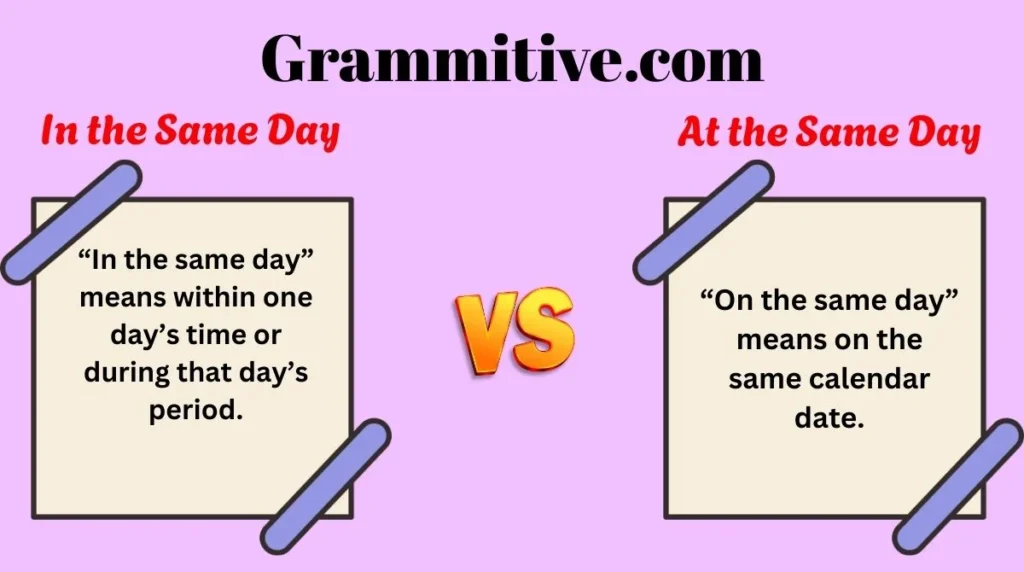
“In the same day” means within one day’s time or during that day’s period.
It focuses on duration or completion inside a time limit, not the exact calendar date.
When to use it
Use in when you talk about:
- Time periods
- Length of time
- Something finished within a day
- Something happening during the day’s span
Grammar rule
in + period of time
Examples:
- in a day
- in two hours
- in a week
- in the same day
Notice: “in” talks about how long something takes, not which date.
Examples
- I finished the project in the same day.
- She replied to all emails in the same day.
- We moved houses in the same day.
- He repaired the car in the same day.
- The package arrived in the same day.
- They completed the test in the same day.
- The doctor called me back in the same day.
- We planned and booked everything in the same day.
What is the feeling here?
You are not talking about Monday or Tuesday.
You are saying: it didn’t take more than one day.
Time length → not calendar date.
Common learner confusion
Many students use in when they actually mean a date.
❌ I met her in the same day.
(This sounds strange because meeting someone is about a specific day, not a duration.)
Better:
✅ I met her on the same day.
So remember: “in” = within a period of time.
What Does “On the Same Day” Mean?
Simple definition
“On the same day” means on the same calendar date.
It focuses on which day, not how long something takes.
When to use it
Use on when talking about:
- Specific days
- Dates
- Named days (Monday, Friday)
- Special days (birthday, wedding day)
Grammar rule
on + day/date
Examples:
- on Monday
- on July 10
- on my birthday
- on the same day
So if you are pointing to a particular date, use on.
Examples
- We arrived on the same day.
- My sister was born on the same day as me.
- They got married on the same day.
- The exam and the party were on the same day.
- I submitted the form on the same day I received it.
- Both meetings happened on the same day.
- He called me back on the same day.
- The accident happened on the same day as the storm.
What is the feeling here?
You are talking about the exact day, like a date on a calendar.
Calendar focus → not duration.
Common learner confusion
Students often say:
❌ I finished it on the same day.
This is not wrong, but the meaning changes.
- on the same day → same date
- in the same day → finished within 24 hours
Sometimes both work, but the meaning is slightly different.
Difference Between “In the Same Day” and “On the Same Day”
This is where most learners struggle. So let’s slow down and compare clearly.
Quick Comparison Table
| Feature | In the same day | On the same day |
|---|---|---|
| Focus | Duration | Calendar date |
| Meaning | Within one day | On that specific day |
| Grammar type | Time period | Day/date |
| Common use | Completion time | Events/dates |
| Question type | How long? | Which day? |
Usage difference explained simply
If you can ask:
“How long did it take?”
→ Use in
If you can ask:
“Which day did it happen?”
→ Use on
Grammar logic
Prepositions follow a time pattern in English:
- at → exact time (5 pm)
- on → day/date
- in → month/year/period
So “in the same day” fits the period idea, and “on the same day” fits the day idea.
Sentence structure difference
- We completed it in the same day. (time needed)
- We met on the same day. (date)
Meaning comparison
Look at this pair:
Sentence A:
We finished the work in the same day.
→ It took less than one day.
Sentence B:
We finished the work on the same day.
→ It happened on that date (maybe Monday).
Small difference, big meaning change.
Grammar Rules You Must Remember
Rule #1 — Use “in” for time periods
Example:
I wrote the report in two hours.
So:
I wrote the report in the same day.
Rule #2 — Use “on” for days and dates
Example:
I met him on Monday.
So:
I met him on the same day.
Rule #3 — Never use “at” with days
❌ at Monday
❌ at the same day
This sounds unnatural.
Use at only for exact clock times.
Example:
at 5 pm
at midnight
Rule #4 — Think: period vs date
Period → in
Date → on
Example:
She answered in one day.
She answered on Tuesday.
Common Mistakes Students Make
Why mistakes happen
Most languages do not use prepositions the same way English does.
So learners translate directly and choose the wrong one.
Also, “in” and “on” both feel similar, so confusion happens.
Wrong vs correct examples
❌ I saw him in the same day.
✅ I saw him on the same day.
❌ I finished the book on the same day (if meaning duration).
✅ I finished the book in the same day.
❌ We met at the same day.
✅ We met on the same day.
❌ She replied at the same day.
✅ She replied on the same day.
Easy correction tips
- Ask: how long? → in
- Ask: which day? → on
- Never use “at” with days
Simple questions fix most mistakes.
Easy Trick to Remember the Difference
Here’s a small memory trick students love.
Think about a calendar.
Days sit on the calendar.
So:
ON the day
Now think about a container.
Time periods feel like you are inside them.
So:
IN the period
It’s like being inside a box of time.
- inside → in
- calendar → on
This little picture makes it very easy to remember.
Daily Life Examples (Very Important)
These are natural, spoken English sentences you might hear every day.
- I finished all my homework in the same day.
- We had two exams on the same day.
- She booked the tickets in the same day.
- The wedding and the birthday party were on the same day.
- He fixed my laptop in the same day.
- I got the job offer on the same day as the interview.
- They packed and moved in the same day.
- Our flight and meeting are on the same day.
- She answered every message in the same day.
- We met again on the same day last year.
These sound natural because native speakers think about duration vs date automatically.
Practice Section
Choose the correct option: in / on
- I finished the project ___ the same day.
- The party and the test were ___ the same day.
- She replied ___ the same day.
- We met ___ the same day last year.
- He repaired everything ___ the same day.
Answers
- in
- on
- in
- on
- in
FAQs
1. What is the difference between “in the same day” and “on the same day”?
“In the same day” talks about how long something takes.
“On the same day” talks about which calendar date something happens.
Duration vs date is the key difference.
2. Can we say “at the same day”?
No. This is not correct in standard English.
“At” is for clock time, not days.
Use “on the same day” instead.
3. Which one is more common in daily speech?
“On the same day” is more common because we often talk about dates.
But “in the same day” is also natural when talking about finishing tasks quickly.
4. Can both ever be correct in one situation?
Yes, but the meaning changes slightly.
“In” shows completion time.
“On” shows the date.
Context decides which one you need.
5. Is “in the same day” formal or informal?
It works in both formal and informal English.
You can use it in emails, work reports, or daily conversation.
6. How can I stop confusing prepositions?
Practice with real sentences.
Ask yourself simple questions like “how long?” or “which day?”
Over time, it becomes automatic.
Final Conclusion
Prepositions may look small, but they carry big meaning. A tiny word like in or on can completely change your sentence.
That’s why this topic feels tricky at first. But once you understand the logic, it becomes simple and natural.
Just remember the core idea: “in” for time periods, “on” for days and dates, and never “at” for days. When you think about duration, choose “in.”
When you point to a day on the calendar, choose “on.” This pattern works almost every time.
Don’t worry if you make mistakes at first. Even advanced learners sometimes mix these up. The key is practice. Read sentences out loud. Notice how native speakers talk. Try writing your own examples every day.
Soon, you won’t need to think about the rule. It will just feel right. And that’s when real fluency begins.

I am Lucas Bennett, a digital content creator passionate about social media trends and online growth strategies.
I share practical insights and guides to help users better understand and navigate the digital world.