

Many English learners stop for a second when they write dates.
Should it be in May?
Or on May?
Both sound possible. Both look correct. But only one works in most situations.
This small choice confuses beginners, students, and even intermediate learners. You might say:
❌ I was born on May.
❌ We travel in May 5th.
These sentences feel almost right… but they are not natural English.
Prepositions like in, on, and at are tiny words. Still, they cause big problems. Native speakers use them without thinking, but learners often guess. And guessing leads to mistakes.
Understanding time prepositions is very important in daily life. You need them to talk about birthdays, meetings, exams, holidays, deadlines, and plans.
Without the correct preposition, your English sounds strange or unclear.
The good news is this topic is actually simple. Once you see the pattern, everything becomes easy to remember.
By the end of this guide, you will clearly understand:
- when to use in May
- when to use on + date in May
- why the grammar changes
- common mistakes to avoid
- and easy tricks to remember forever
Let’s start with the first word: in.
What Does “In” Mean?
Simple meaning
In is used for long or big periods of time.
Think of months, years, seasons, centuries.
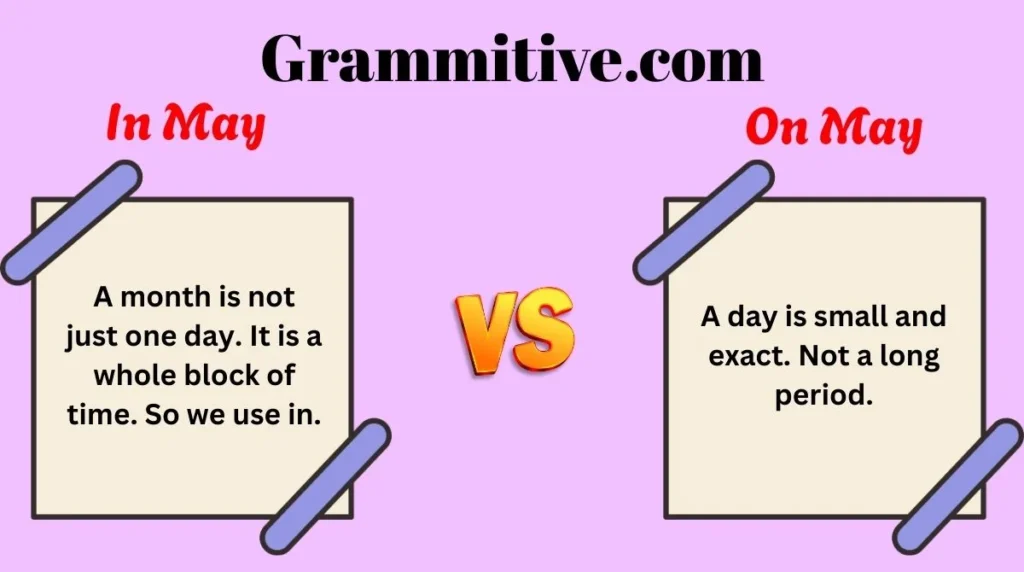
A month is not just one day. It is a whole block of time. So we use in.
So we say:
👉 in May
👉 in 2026
👉 in summer
Grammar rule
Use in + month / year / season / long time period
Structure:
in + time period
Examples with “in May”
Here are some easy examples:
- My birthday is in May.
- Flowers bloom in May.
- We travel to Spain in May every year.
- School ends in May.
- It gets warmer in May.
- I started my new job in May.
- Many weddings happen in May.
- The exams begin in May.
Notice something important:
We are talking about the whole month, not a specific day.
That is why in feels natural.
Common learner confusion
Many students think:
“May is a date, so maybe we use ‘on’.”
But May is NOT a day. It is a month. And months always use in.
Think of it like a box.
The month is a big box. Everything happens inside that box.
So we use in.
What Does “On” Mean?
Simple meaning
On is used for specific days and dates.
A day is small and exact. Not a long period.
So we use on when we talk about:
- days (Monday, Tuesday)
- dates (May 5, June 10)
- special days (my birthday, Christmas Day)
Grammar rule
Use on + day / date
Structure:
on + specific day
Examples with May dates
Now look at these:
- I was born on May 12.
- The party is on May 5th.
- We have a test on May 20.
- She arrived on May 1.
- The meeting is on May 14.
- My exam starts on May 9.
- He left on May 30.
- The concert is on May 25th.
Notice the difference:
Here, we talk about one exact day, not the whole month.
That’s why we use on, not in.
Common learner confusion
Some students say:
❌ My birthday is in May 10.
This sounds wrong because May 10 is a date (a day).
So we must say:
✅ My birthday is on May 10.
Remember:
If there is a number (5th, 12th, 20th), it usually needs on.
Difference Between In and On (Detailed)
This part clears everything up.
Quick comparison table
| Preposition | Used for | Example | Time size |
|---|---|---|---|
| in | months, years, seasons | in May | big |
| on | days, dates | on May 10 | small |
Usage difference
- In May → any time during the month
- On May 10 → one exact day only
Grammar logic
Think about size:
Big time → in
Small time → on
A month has 30 or 31 days. That’s big.
A day is only 24 hours. That’s small.
English uses this size logic.
Sentence structure difference
In structure:
Subject + verb + in + month
👉 We travel in May.
On structure:
Subject + verb + on + date
👉 We travel on May 10.
Meaning comparison
Compare these:
- I will visit you in May. → Any day in May
- I will visit you on May 10. → Only that day
The second one is more exact.
Grammar Rules You Must Remember
Rule #1 — Use “in” for months
✅ We moved here in May.
❌ We moved here on May.
Months always take in.
Rule #2 — Use “on” for dates
✅ The show is on May 15.
❌ The show is in May 15.
Dates need on.
Rule #3 — If there is a number, use “on”
If you see: 5th, 10th, 21st → choose on
✅ on May 3
✅ on May 18
Numbers mean specific days.
Rule #4 — If it’s general, use “in”
If you mean “sometime during the month,” choose in
✅ I’ll call you in May. (not sure when)
Common Mistakes Students Make
Why mistakes happen
There are three main reasons:
- Direct translation from native language
- Guessing the preposition
- Not noticing the difference between month and date
Let’s fix them.
Wrong vs correct
❌ I was born on May.
✅ I was born in May.
❌ The exam is in May 10.
✅ The exam is on May 10.
❌ We met in May 5.
✅ We met on May 5.
❌ She will travel on May month.
✅ She will travel in May.
Easy correction tips
- Month only → in
- Month + number → on
- Ask yourself: “Is it one day or many days?”
Easy Trick to Remember the Difference
Here’s a simple memory trick many students love.
The “box” trick
Imagine time like boxes.
- Year = big box
- Month = medium box
- Day = tiny box
You are inside big boxes → use in
You are on the calendar square → use on
When you look at a calendar, each day is a small square. You point on it.
So:
📅 on May 5
📦 in May
This visual idea helps your brain remember fast.

Daily Life Examples (Very Important)
These sound like real conversations.
- I’m going on vacation in May.
- My sister is getting married in May.
- Let’s meet on May 3.
- The rent is due on May 1.
- The weather is nice in May.
- Our final exam is on May 25.
- I started learning English in May.
- The train leaves on May 14.
- We usually plant flowers in May.
- The party is on May 8 at 7 pm.
These are the kinds of sentences native speakers use every day.
Practice Section
Choose the correct option: in or on
- My birthday is ___ May.
- The test is ___ May 12.
- We travel ___ May every year.
- The concert is ___ May 30.
- School ends ___ May.
Answers
- in
- on
- in
- on
- in
FAQs
1. What is the difference between in May and on May?
“In May” talks about the whole month. “On May” must be followed by a date, like May 5. Without a date, “on May” sounds wrong.
2. Can we say “on May” alone?
No. It is incomplete. You need a specific day. Say “on May 10,” not just “on May.”
3. Is “in May” formal or informal?
It works in both. You can use it in daily conversation and formal writing. It is standard English.
4. Why do months use “in”?
Months are longer time periods. English uses “in” for big time blocks like months, years, and seasons.
5. Do we always use “on” with dates?
Yes. If you mention a specific calendar day, always use “on.” For example, on June 5, on December 25.
6. What about “at” with time?
“At” is for exact times like hours: at 5 pm, at noon, at midnight. It is not used with months or dates.
Final Conclusion
Small words like in and on may look easy, but they create many problems for English learners. The difference becomes simple when you think about time size.
Use in for months like May because you are talking about a longer period. Use on for exact dates because you are pointing to one specific day on the calendar.
Once you see this pattern, you don’t have to memorize many rules. Just ask yourself: “Is it the whole month or one day?”
Practice by making your own sentences. Talk about birthdays, holidays, and plans. The more you use these prepositions in real life, the more natural they will feel.
Soon, you won’t even think about it. You’ll just say the correct one automatically.
And that’s the goal of good grammar — simple, clear, and easy.

I am Lucas Bennett, a digital content creator passionate about social media trends and online growth strategies.
I share practical insights and guides to help users better understand and navigate the digital world.