
Small English phrases can cause big confusion.
“If so” and “if yes” look very similar. Both talk about a condition. Both seem to mean the same thing. And both appear in questions or answers.
So many learners think they are interchangeable.
But here’s the problem: they are not used the same way.
Sometimes “if yes” sounds unnatural. Sometimes “if so” sounds strange. And sometimes one is correct while the other is completely wrong. That’s why students often say things like:
❌ If yes, I will call you.
❌ If so you like coffee, try this.
These sentences feel awkward to native speakers.
In daily English—at work, in emails, in exams, and in conversations—choosing the right phrase makes you sound more natural and confident. It also helps you understand books, movies, and spoken English much better.
After reading this lesson carefully, you will clearly understand:
- what “if so” really means
- what “if yes” means
- when each one is correct
- when you must NOT use them
- simple grammar rules
- easy tricks to remember
- lots of real-life examples
By the end, you won’t hesitate anymore. You’ll know exactly which one to use.
What Does “If So” Mean?
Simple definition
“If so” means: if that is true.
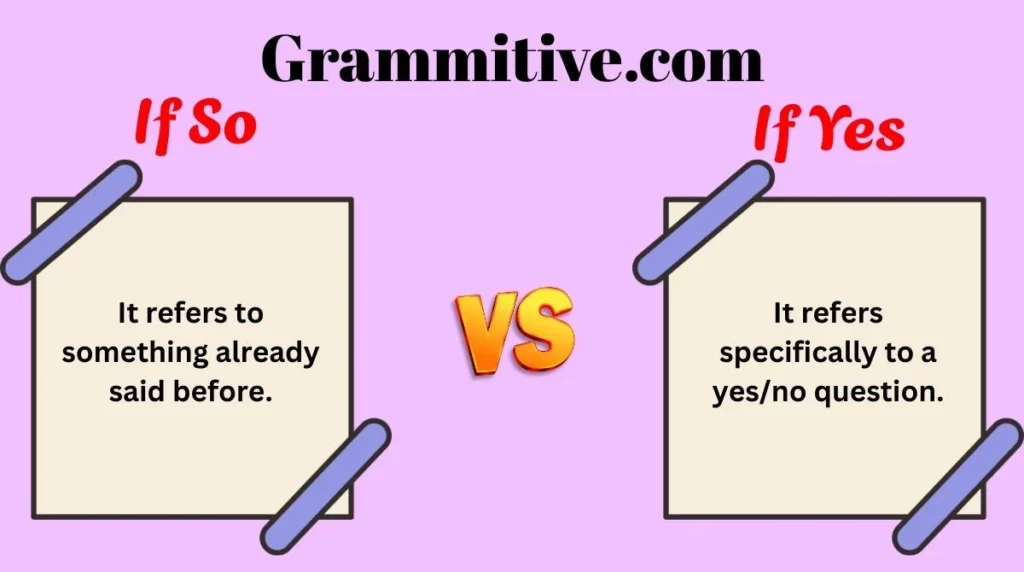
It refers to something already said before.
It connects two ideas.
Think of it like:
👉 If that is true, then…
When to use it
Use “if so” when:
- You are talking about a previous statement
- The condition is already known
- You want to avoid repeating the whole sentence
It helps make English shorter and smoother.
Native speakers love using it because it sounds natural and clean.
Grammar rule
Structure:
👉 Statement or question + If so, + result
“so” replaces the whole idea before it.
Examples
- Are you tired? If so, take a break.
- He may be late. If so, we’ll start without him.
- Did you finish the report? If so, email it to me.
- She might call tonight. If so, answer politely.
- Are they interested? If so, we can offer a discount.
- Is it raining? If so, bring an umbrella.
- Do you feel sick? If so, go home.
- Has the package arrived? If so, sign for it.
Common learner confusion
Many learners think “if so” means “yes.”
But it doesn’t exactly mean “yes.”
It means:
👉 if that situation is true
Not just a simple yes/no answer.
That’s the key difference.
What Does “If Yes” Mean?
Simple definition
“If yes” means: if the answer is yes.
It refers specifically to a yes/no question.
So it focuses only on the answer “yes,” not the whole situation.
When to use it
Use “if yes” when:
- You ask a direct yes/no question
- You want instructions based on the answer “yes”
- It’s often used in forms, surveys, and instructions
It is more common in formal or written English, not casual speaking.
Grammar rule
Structure:
👉 Yes/No question + If yes, + instruction
It connects directly to the answer “yes.”
Examples
- Do you agree? If yes, sign here.
- Are you over 18? If yes, continue.
- Did you receive the email? If yes, reply today.
- Do you need help? If yes, call this number.
- Have you paid the fee? If yes, show your receipt.
- Do you accept the terms? If yes, click submit.
- Is this your first visit? If yes, fill out this form.
- Did the system restart? If yes, log in again.
Common learner confusion
Students often use “if yes” in conversation:
❌ If yes, I’m tired.
This sounds robotic and unnatural.
Native speakers usually say:
✅ If so, I’m tired.
or
✅ Yes, I am.
So remember: “if yes” is less common in everyday speech.
Difference Between If So and If Yes (Detailed)
Here’s where things become clearer.
Comparison table
| Feature | If So | If Yes |
|---|---|---|
| Meaning | If that is true | If the answer is yes |
| Refers to | Whole situation | Only yes answer |
| Common in speech | Yes | Not much |
| Common in forms | Sometimes | Very common |
| Sounds natural in conversation | Yes | Often robotic |
| Grammar focus | Condition | Answer |
Usage difference
If so replaces an idea.
If yes reacts to a yes/no answer.
Compare:
👉 Are you free tomorrow? If so, let’s meet.
(If you are free…)
👉 Are you free tomorrow? If yes, choose a time.
(focus on yes answer)
Both are possible, but “if so” sounds more natural in speaking.
Grammar logic
“If so” uses reference substitution.
“So” stands for the entire previous clause.
“If yes” uses answer logic.
It only cares about the word “yes.”
Sentence structure difference
“If so” = flexible
“If yes” = limited
“If so” works with many sentences:
- statements
- possibilities
- conditions
“If yes” mostly works only after questions.
Meaning comparison
Think like this:
- If so → situation
- If yes → answer
This one idea solves 90% of confusion.
Grammar Rules You Must Remember
Rule #1: Use “if so” to avoid repetition
Instead of repeating the whole sentence, use “if so.”
❌ If you are busy, if you are busy call me later.
✅ If you are busy, if so, call me later.
Rule #2: Use “if yes” only with yes/no questions
❌ He might come. If yes, prepare food.
✅ He might come. If so, prepare food.
Rule #3: In conversation, prefer “if so”
Native speakers almost always choose “if so.”
✅ Are you hungry? If so, let’s eat.
Sounds smooth and natural.
Rule #4: In forms or instructions, “if yes” is common
Official or written instructions often use it.
✅ Are you employed? If yes, state your job title.
Common Mistakes Students Make
Why mistakes happen
The problem is translation.
In many languages, one phrase works for both meanings.
But English separates them.
So learners mix them.
Mistake 1
❌ If yes, I will go to sleep.
Why wrong?
This is not a yes/no answer situation.
✅ If so, I will go to sleep.
Mistake 2
❌ If so you agree, sign here.
Grammar problem. Word order is wrong.
✅ If you agree, sign here.
or
✅ If yes, sign here.
Mistake 3
❌ Are you coming? If so yes.
Too repetitive.
✅ Are you coming? Yes.
or
✅ If so, great!
Easy correction tips
Ask yourself:
👉 Am I talking about the situation? → use “if so”
👉 Am I talking about the answer yes? → use “if yes”
Simple.
Easy Trick to Remember the Difference
Here’s a memory trick students love.
The “S vs Y” trick
S = Situation → So
Y = Yes answer → Yes
If you think about the situation, choose so.
If you think about the yes answer, choose yes.
Short and sweet.
Also notice:
“So” sounds softer and more natural in speech.
“Yes” sounds formal and instructional.
This matches real-life usage.
Daily Life Examples (Very Important)
These are natural spoken sentences you might hear every day.
- Are you free tonight? If so, let’s watch a movie.
- Do you feel cold? If so, take my jacket.
- Did you finish homework? If so, relax.
- Do you need help? If yes, press the button.
- Are you the manager? If yes, please sign here.
- Is the baby sleeping? If so, be quiet.
- Have you been here before? If yes, skip the tour.
- Are they still waiting? If so, tell them I’m coming.
- Did you lock the door? If so, we’re safe.
- Do you accept cookies? If yes, click OK.
Notice something?
Conversation → mostly “if so”
Instructions/forms → often “if yes”
Practice Section
Choose the correct option: if so or if yes
Questions
- Are you allergic to nuts? ___, tell the waiter.
- She might join us. ___, we need extra chairs.
- Did you submit the form? ___, check your email.
- Are you interested in the job? ___, apply online.
- It could rain later. ___, cancel the picnic.
Answers
- If yes
- If so
- If so
- If yes
- If so
FAQs
What is the difference between if so and if yes?
“If so” refers to a whole situation or condition.
“If yes” refers only to the answer “yes.”
“If so” is more natural in speaking.
“If yes” is common in forms or instructions.
Can we use “if yes” in normal conversation?
You can, but it often sounds stiff or formal.
Native speakers usually say “if so” instead.
Use “if yes” mainly in written instructions.
Is “if so” informal?
No. It works in both formal and informal English.
It’s very flexible and common in speech and writing.
Can “if so” replace a full sentence?
Yes. That’s its main purpose.
It replaces the previous idea to avoid repetition.
It makes sentences shorter and smoother.
Which is more common in daily English?
“If so” is much more common.
You’ll hear it often in conversations, movies, and books.
Are they interchangeable?
Sometimes, but not always.
If you focus on a “yes” answer, use “if yes.”
If you focus on the situation, use “if so.”
Final Conclusion
Tiny phrases like these can quietly change how natural your English sounds. “If so” and “if yes” look similar, but they serve different jobs.
One talks about a whole situation. The other talks only about a yes answer. Once you see that difference, everything becomes easier.
In everyday speaking, “if so” will be your best friend. It sounds smooth and relaxed. Save “if yes” for forms, instructions, and direct yes/no responses.
Try using both phrases in your own sentences today. Notice them in movies or books. The more you hear them, the more natural they feel.
Little grammar points like this slowly build strong, confident English. Keep practicing, and soon you won’t even need to think about it—you’ll just know which one sounds right.

I am Lucas Bennett, a digital content creator passionate about social media trends and online growth strategies.
I share practical insights and guides to help users better understand and navigate the digital world.