
Small English words can cause big confusion.
Words like totally and completely look easy. Both mean “100%.” Both show strong agreement. So many learners think they are exactly the same.
But when you listen to real English conversations, something feels different.
Native speakers say:
- “I totally agree with you.”
- “I completely agree with you.”
Both are correct. Yet one sounds more natural in daily speech. The other sounds a little more formal and serious.
This tiny difference can make your English sound either relaxed and friendly… or stiff and textbook-like.
That’s why many students ask:
“Which one should I use?”
“Are they interchangeable?”
“Do they have the same grammar?”
“Which sounds more natural?”
These are smart questions.
Understanding this topic helps you speak more naturally, write better emails, and sound like a real English speaker instead of a learner.
By the end, you will clearly know:
- what totally means
- what completely means
- how they are different
- when to use each one
- which sounds more casual or formal
- and how native speakers really use them every day
Step by step, everything will feel simple.
What Does “Totally” Mean?
Simple definition
Totally = 100%, fully, very strongly
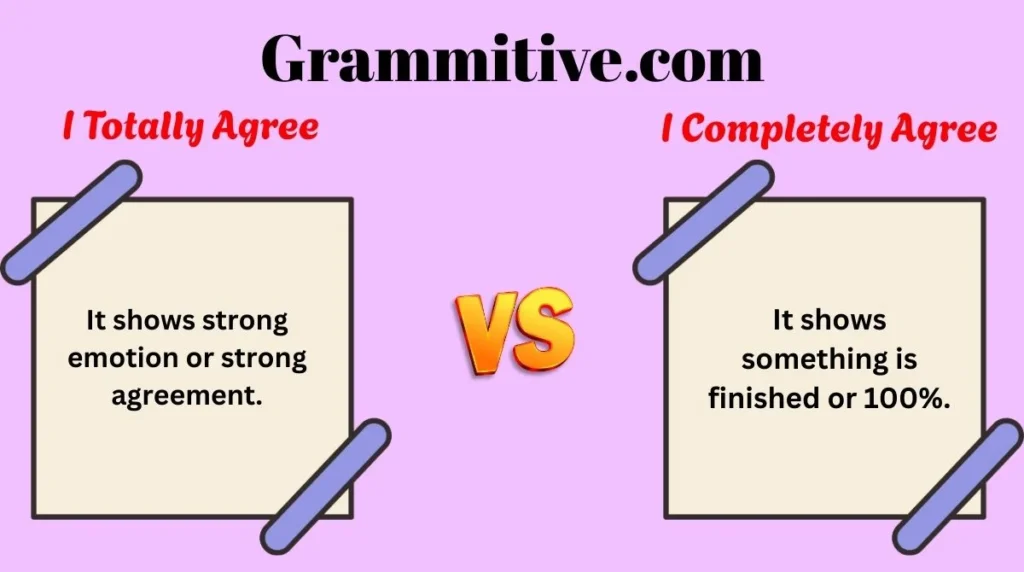
It shows strong emotion or strong agreement.
It often sounds casual, friendly, and spoken.
People use it a lot in everyday conversations.
When to use it
Use totally when:
- you strongly agree
- you want to sound relaxed
- you speak with friends
- you talk in informal situations
- you show excitement or emotion
It feels warm and natural.
Grammar rule
Totally = adverb
It usually comes:
👉 before adjectives
👉 before verbs
👉 before phrases like “agree,” “understand,” “support”
Structure:
Subject + totally + verb/adjective
Example:
✔ I totally agree.
Example sentences
- I totally agree with you.
- She totally understands the problem.
- That movie was totally amazing.
- We totally forgot about the meeting.
- He totally supports the idea.
- This phone is totally useless.
- I totally get what you mean.
- They totally messed up the plan.
Notice something?
These sentences sound like spoken English, not formal writing.
Common learner confusion
Many students think totally is only for young people or slang.
That’s not true.
It is informal but still normal English. Adults use it every day.
However, it may sound too casual in:
- business reports
- academic writing
- formal emails
In those cases, completely is often better.
What Does “Completely” Mean?
Simple definition
Completely = fully, entirely, without anything missing
It shows something is finished or 100%.
It sounds more formal and serious than totally.
When to use it
Use completely when:
- you want to sound polite or professional
- you write emails
- you speak in meetings
- you want a calm tone
- you describe facts, not emotions
It feels neutral and careful.
Grammar rule
Completely = adverb
It usually comes:
👉 before adjectives
👉 before verbs
👉 before past participles
Structure:
Subject + completely + verb/adjective
Example:
✔ I completely agree.
Example sentences
- I completely agree with your suggestion.
- The room is completely empty.
- She completely finished the project.
- He completely forgot my birthday.
- The road is completely blocked.
- They completely understand the rules.
- The glass is completely broken.
- I am completely satisfied.
These sound calmer and more formal.
Common learner confusion
Students often think completely always sounds better or “more correct.”
Not true.
Sometimes it sounds too serious in friendly conversations.
Imagine saying:
“My pizza is completely amazing.”
It sounds strange, right?
Totally amazing feels more natural.
Difference Between Totally and Completely (Detailed)
Even though both mean “100%,” their feeling, tone, and usage are different.
Quick comparison table
| Feature | Totally | Completely |
|---|---|---|
| Tone | Casual | Formal/neutral |
| Feeling | Emotional | Logical |
| Spoken English | Very common | Common but calmer |
| Writing | Less formal | More suitable |
| Energy | Strong/excited | Calm/serious |
| Example | I totally agree | I completely agree |
Usage difference
Totally → emotions, opinions, excitement
- I totally love this song!
- I totally agree with you!
Completely → facts, situations, descriptions
- The tank is completely empty.
- I completely understand the rules.
Grammar logic
Both are adverbs.
Both modify verbs or adjectives.
But tone changes the meaning.
Think of it like this:
- totally = heart ❤️
- completely = brain 🧠
One feels emotional. The other feels logical.
Sentence structure difference
Grammatically, there is almost no difference.
Both follow:
Subject + adverb + verb/adjective
Examples:
- I totally agree.
- I completely agree.
Structure is the same. Only style changes.
Meaning comparison
When you say:
“I totally agree”
It sounds like:
👉 “Yes! 100%! I feel the same!”
When you say:
“I completely agree”
It sounds like:
👉 “Yes. I agree fully.”
Less emotion. More professional.
Grammar Rules You Must Remember
Rule #1: Both are adverbs
They describe verbs or adjectives.
✔ I totally agree
✔ I completely understand
Never use them as nouns.
❌ I am a totally
❌ He is a completely
Rule #2: Place before the verb
✔ I totally forgot
✔ She completely finished
Not:
❌ I forgot totally
Rule #3: Don’t overuse in formal writing
Formal email:
✔ I completely agree with your proposal
❌ I totally agree with your proposal
Rule #4: Match the tone to the situation
Friends → totally
Business → completely
Example:
Friend: “That game was fun!”
✔ Totally!
Meeting: “The data supports this idea.”
✔ I completely agree.
Common Mistakes Students Make
Why mistakes happen
Students often:
- translate directly from their language
- think both words are identical
- use totally in formal writing
- put adverbs in wrong position
Wrong vs correct examples
❌ I agree totally with you
✔ I totally agree with you
❌ I totally appreciate your professional email
✔ I completely appreciate your professional email
❌ The box is totally empty (sounds casual)
✔ The box is completely empty
❌ I completely love this pizza (too serious)
✔ I totally love this pizza
Easy correction tips
Ask yourself:
👉 Is this casual or formal?
👉 Am I speaking or writing?
👉 Am I emotional or factual?
Your answer tells you which word to choose.
Easy Trick to Remember the Difference
Here’s a simple memory trick students love.
Think:
Totally = Talking with friends
Completely = Company or office
Both start with the same letter:
T → Talk → Totally
C → Company → Completely
So:
Friends → totally
Work → completely
Very easy to remember.
Daily Life Examples (Very Important)
These sound natural in real conversations.
- “You’re right. I totally agree with you.”
- “That movie was totally awesome!”
- “I totally forgot my keys at home.”
- “Don’t worry. I completely understand.”
- “The bottle is completely empty.”
- “I completely agree with your plan for the project.”
- “That joke was totally funny.”
- “The system is completely broken.”
- “I totally get what you’re saying.”
- “She completely finished her homework.”
Try reading them aloud. You’ll hear the difference.
Practice Section
Choose totally or completely.
- I ______ agree with your idea in the meeting.
- The street is ______ quiet at night.
- That concert was ______ amazing!
- I ______ understand the instructions.
- We ______ forgot about the party.
Answers
- completely
- completely
- totally
- completely
- totally
FAQs
1. What is the difference between totally and completely?
Both mean 100%, but totally sounds casual and emotional. Completely sounds formal and neutral. The choice depends on tone and situation.
2. Can we use totally and completely with “agree”?
Yes. Both are correct grammatically. However, “totally agree” is more common in conversation, while “completely agree” is more professional.
3. Is totally informal?
It is semi-informal. It’s perfect for daily speech but may sound too relaxed in academic or business writing.
4. Is completely more formal?
Yes. It sounds more careful and professional. It fits emails, reports, and presentations better.
5. Can they be used interchangeably?
Sometimes, yes. But not always. The tone may feel strange if you choose the wrong one.
Example:
“totally amazing” sounds natural
“completely amazing” sounds odd
6. Which one do native speakers use more?
In everyday conversation, native speakers often use totally. In writing or formal speech, completely is more common.
Final Conclusion
Small words often create big confusion in English, and totally and completely are perfect examples. Both mean “100 percent,” but they carry different feelings.
One sounds friendly, relaxed, and emotional. The other sounds calm, careful, and professional.
So the choice isn’t really about grammar. It’s about tone.
If you’re chatting with friends, sharing opinions, or speaking casually, totally feels natural and warm. If you’re writing emails, attending meetings, or explaining facts, completely fits better.
The good news is that the grammar is simple. Just place the adverb before the verb and match the situation.
Keep listening to native speakers. Notice how they use these words in real life. Practice speaking aloud. Soon, choosing the right one will feel automatic.
Little changes like this make your English sound smooth and confident.

I am Lucas Bennett, a digital content creator passionate about social media trends and online growth strategies.
I share practical insights and guides to help users better understand and navigate the digital world.