
Many English learners feel nervous when they talk about the past.
Not because vocabulary is hard… but because tenses change the meaning.
You write an email to your boss. Later someone asks:
“Did you send the email?”
Now your brain freezes.
Should you say:
- I sent the email
- I have sent the email
- I had sent the email
All three sound similar. All three talk about the past.
So… what’s the difference?
This small change in grammar can change the time, feeling, and situation of your sentence.
Sometimes the action is finished.
Sometimes the result is important now.
Sometimes it happened before another past action.
If you use the wrong tense, people may misunderstand you. For example, your manager might think you didn’t send the email yet!
That’s why this topic is very important in daily English. You use these forms at work, at school, in messages, and in conversations every day.
By the end of this guide, you will clearly understand:
- when to say I sent
- when to say I have sent
- when to say I had sent
- how native speakers choose naturally
- and how to avoid common mistakes
Everything will be explained in simple, friendly English. Step by step.
What Does “I Sent” Mean?
Simple definition
“I sent” is the simple past tense.
It means the action happened in the past and is finished.
The time is usually clear or already known.
Think of it like this:
👉 Finished action. Finished time.
When to use it
Use I sent when:
- you say exactly when it happened
- the time is yesterday / last night / this morning / two hours ago
- the action is completely done
- you are telling a story about the past
Grammar rule
Subject + past verb (sent)
- send → sent
Structure:
I + sent + object
Example:
I sent the email.
Example sentences
- I sent the email yesterday.
- I sent it at 9 a.m.
- I sent the report last night.
- I sent the message before dinner.
- I sent her a reminder two hours ago.
- I sent the documents by mistake.
- I sent the wrong file earlier.
- I sent everything before the meeting.
Common learner confusion
Many students think simple past sounds weak or old.
They feel present perfect sounds “better”.
But native speakers use simple past all the time when time is clear.
❌ I have sent the email yesterday
✅ I sent the email yesterday
If you say “yesterday,” you must use sent, not have sent.
Remember:
Specific past time = simple past.
What Does “I Have Sent” Mean?
Simple definition
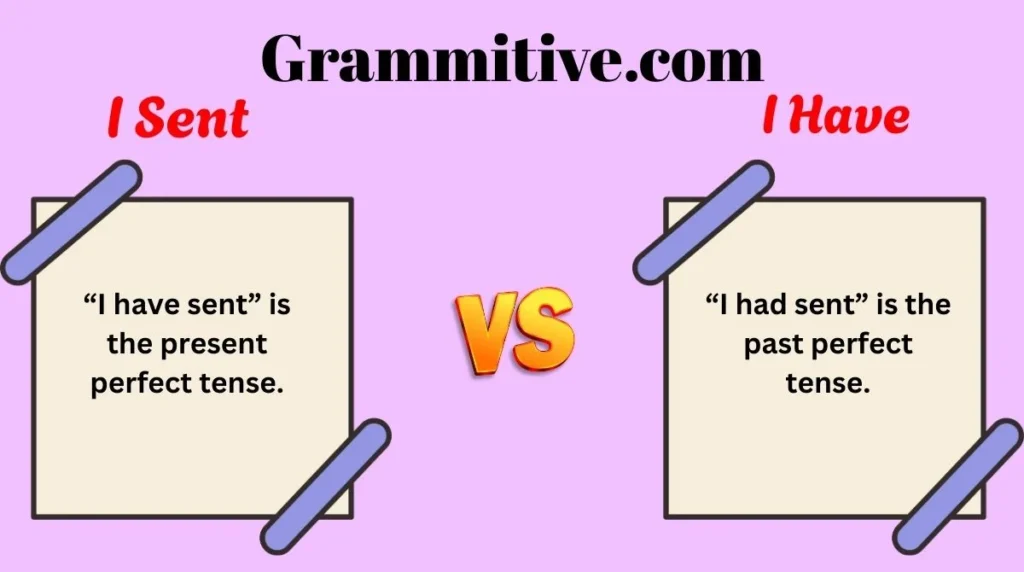
“I have sent” is the present perfect tense.
It means:
The action happened in the past, but it is connected to now.
The result is important at this moment.
Think:
👉 Past action + present result
When to use it
Use I have sent when:
- the exact time is not important
- you care about the result now
- you are informing someone
- you are giving updates
- the action affects the present situation
Common with:
- already
- just
- yet
- recently
- so far
Grammar rule
Subject + have/has + past participle
send → sent → sent
Structure:
I + have + sent + object
Example:
I have sent the email.
Example sentences
- I have sent the email. Please check.
- I have already sent the file.
- I have just sent the documents.
- I have sent everything you asked for.
- I have sent the invitation today.
- I have sent three emails so far.
- I have sent the report but got no reply.
- I have sent it twice already.
Common learner confusion
Students often ask:
“Isn’t this the same as ‘I sent’?”
Not exactly.
Compare:
👉 I sent the email yesterday.
(time is finished)
👉 I have sent the email.
(result matters now — maybe you are waiting for a reply)
Present perfect focuses on current importance, not time.
What Does “I Had Sent” Mean?
Simple definition
“I had sent” is the past perfect tense.
It means:
The action happened before another past action.
So there are two past times.
One happened first.
Think:
👉 Past before past
When to use it
Use I had sent when:
- you are telling a story about the past
- you mention two past actions
- one action happened earlier
Grammar rule
Subject + had + past participle
Structure:
I + had + sent + object
Example:
I had sent the email before the meeting started.
Example sentences
- I had sent the email before he called me.
- I had sent the report earlier that day.
- I had already sent the file when she asked.
- I had sent the wrong document by mistake.
- I had sent the message, but he didn’t receive it.
- I had sent everything before the deadline.
- I had sent the invoice long before the payment came.
- I had sent it, so I didn’t send it again.
Common learner confusion
Students sometimes use past perfect alone:
❌ I had sent the email. (and stop)
This sounds incomplete.
Past perfect usually needs another past action.
Better:
✅ I had sent the email before the meeting.
Difference Between “I Sent” and “I Have Sent” and “I Had Sent”
Quick comparison table
| Tense | Time focus | Use when | Example |
|---|---|---|---|
| I sent | finished past | specific time | I sent it yesterday |
| I have sent | past + now | result important now | I have sent it |
| I had sent | past before past | earlier past action | I had sent it before he called |
Usage difference
I sent → just past fact
I have sent → update or result
I had sent → story about earlier past
Grammar logic
- simple past = one past time
- present perfect = past connected to now
- past perfect = two past times
Sentence structure difference
- I sent the email yesterday.
- I have sent the email already.
- I had sent the email before lunch.
Notice how time words change.
Meaning comparison
Imagine this situation:
Boss asks: “Where is the report?”
You could say:
I sent it yesterday.
→ explains when
I have sent it.
→ tells boss it’s done now
I had sent it before the system crashed.
→ explaining earlier action in a story
Same verb. Different meaning.
Grammar Rules You Must Remember
Rule #1 – Specific time → simple past
I sent the email at 10 a.m.
Never use present perfect with yesterday, last week, etc.
Rule #2 – Result now → present perfect
I have sent the documents. Please check.
The focus is the result.
Rule #3 – Two past actions → past perfect
I had sent the email before he arrived.
Earlier action = had sent.
Rule #4 – Past perfect rarely stands alone
Wrong: I had sent the email.
Better: I had sent the email before the meeting.
Always give a second past event.
Common Mistakes Students Make
Why mistakes happen
Because all three talk about the past.
So learners guess.
But English is very sensitive to time.
Mistake 1
❌ I have sent it yesterday
✅ I sent it yesterday
Tip: yesterday → simple past only
Mistake 2
❌ I had sent it yesterday
✅ I sent it yesterday
Past perfect needs another past action.
Mistake 3
❌ I sent it already
✅ I have sent it already
“Already” usually works better with present perfect.
Mistake 4
❌ I have sent it before he came
✅ I had sent it before he came
Two past actions → past perfect
Easy correction tip
Check the time:
- specific time → sent
- result now → have sent
- earlier past → had sent
Just ask yourself these three questions.
Easy Trick to Remember the Difference
Here’s a simple memory trick students love.
Think of three clocks.
Clock 1 – Past only
👉 I sent
The clock is finished.
Clock 2 – Past + now
👉 I have sent
The clock connects to now.
Clock 3 – Past before past
👉 I had sent
Two clocks. One earlier.
If you imagine time like a movie, it becomes very easy.
One action? Simple past.
Now important? Present perfect.
Two past actions? Past perfect.
Daily Life Examples (Very Important)
These are natural sentences you may hear every day.
- I sent you the file this morning.
- I have sent the invoice. Please confirm.
- I had sent the message before my phone died.
- I sent her a text last night.
- I have just sent the email.
- I had already sent the package when they canceled.
- I sent it two minutes ago.
- I have sent everything you asked for.
- I had sent the wrong address by mistake.
- I sent the report after lunch.
Try saying them aloud. They sound very natural.
Practice Section
Choose the correct option.
1
I ___ the email yesterday.
(a) have sent
(b) sent
2
I ___ the file. Please check now.
(a) have sent
(b) had sent
3
I ___ the message before he arrived.
(a) sent
(b) had sent
4
I ___ three emails so far today.
(a) have sent
(b) sent
5
I ___ it last night at 11 p.m.
(a) had sent
(b) sent
Answers
1 → sent
2 → have sent
3 → had sent
4 → have sent
5 → sent
FAQs
What is the difference between “I sent” and “I have sent”?
“I sent” talks about a finished time in the past.
“I have sent” connects the action to the present.
Use present perfect when the result matters now.
When should I use “I had sent”?
Use it when you describe two past actions.
It shows which action happened first.
It often appears in stories or explanations.
Can we use present perfect with yesterday?
No.
Yesterday is a finished time.
Use simple past instead.
Is “I have sent” formal or informal?
It works in both.
Very common in emails and office communication.
It sounds polite and professional.
Why does past perfect feel difficult?
Because it needs two past actions.
Students forget the second event.
Just remember: earlier past → had sent.
Which tense is most common in daily English?
Simple past is the most common.
Present perfect is next.
Past perfect is less frequent and used in storytelling.
Final Conclusion
These three forms may look small, but they carry different meanings.
“I sent” is simple and talks about a finished past time.
“I have sent” connects the past to the present and focuses on results.
“I had sent” goes one step deeper into the past and shows which action happened first.
Once you start noticing time words like yesterday, already, before, things become much easier.
English grammar is really about time logic, not memorizing rules.
Try using these sentences in your daily conversations and emails. Practice makes everything natural.
After some time, you won’t even think. Your brain will choose the correct tense automatically.
Keep practicing a little every day, and these forms will feel completely normal.

I am Lucas Bennett, a digital content creator passionate about social media trends and online growth strategies.
I share practical insights and guides to help users better understand and navigate the digital world.