
Many English learners feel confused when they hear questions like:
“What do you think?”
“How do you think?”
Both sentences look very similar. Only one small word changes. But the meaning can change a lot.
This tiny difference often causes big problems.
Students ask:
- Are both correct?
- Do they mean the same thing?
- When should I use each one?
- Why does “how do you think?” sometimes sound strange?
If you choose the wrong one, your sentence may sound unnatural or even incorrect. Native speakers might understand you, but it won’t sound smooth or fluent.
And here’s the tricky part: “What do you think?” is extremely common, but “How do you think?” is rare and used in special situations only.
So many learners mix them up.
This topic is important because we use these questions every day in conversations — at school, at work, with friends, and online. You ask for opinions all the time.
After reading this guide, you will clearly understand:
- the meaning of each question
- when to use each one
- grammar rules
- real-life examples
- common mistakes
- and an easy trick to remember forever
By the end, you’ll feel confident choosing the correct sentence naturally, without stopping to think.
What Does “What Do You Think” Mean?
Simple meaning
“What do you think?” = asking for someone’s opinion or idea
You want to know their thoughts.
You are not asking about the process.
You are asking about their answer, feeling, or opinion.
When to use it
Use this question when you want:
- opinions
- suggestions
- ideas
- decisions
- judgments
It is one of the most common questions in English.
Native speakers use it daily.
Grammar rule
Structure:
What + do/does + subject + think (+ about + topic)?
Examples:
- What do you think?
- What do you think about this movie?
- What does she think of my idea?
Example sentences (6–8)
- What do you think about this dress?
- What do you think of my plan?
- What do you think we should do now?
- What do you think about the new teacher?
- What does he think about the problem?
- What do they think of the game?
- What do you think will happen next?
- What do you think is the best choice?
Common learner confusion
Some learners think “what” means “which method.” That’s not correct here.
Here, “what” means “which opinion or idea.”
It asks for content, not process.
Think of it like:
👉 Tell me your thoughts.
What Does “How Do You Think” Mean?
Simple meaning
“How do you think?” = asking about the way or method of thinking
It focuses on the process, not the opinion.
It asks:
- In what way?
- By what method?
- Using what logic?
Because of this meaning, it is much less common.
Sometimes it even sounds strange alone.
When to use it
Use it only when talking about:
- thinking style
- thinking method
- mental process
- problem-solving approach
It is often used in longer sentences, not alone.
Grammar rule
Structure:
How + do/does + subject + think (+ about/when/if + situation)?
Usually you need more information after it.
Just saying “How do you think?” feels incomplete.
Example sentences (6–8)
- How do you think when solving math problems?
- How do you think about difficult decisions?
- How do you think creatively?
- How does she think under pressure?
- How do engineers think when designing bridges?
- How do you think differently from others?
- How do you think through a big problem?
- How do you think before speaking?
Common learner confusion
Many students use:
❌ How do you think about this movie?
This sounds unnatural.
Because movies need opinions, not thinking methods.
So we use:
✅ What do you think about this movie?
Remember: “how” = way/method.
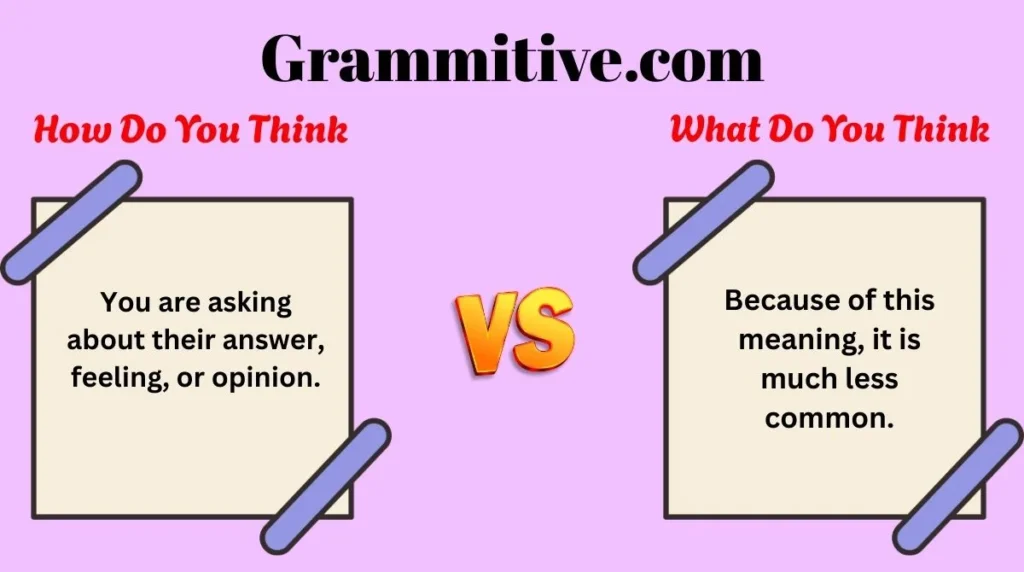
Difference Between “What Do You Think” and “How Do You Think”
This is where things become clear.
These two questions look similar but ask completely different things.
Quick comparison table
| Feature | What do you think | How do you think |
|---|---|---|
| Meaning | Opinion/idea | Method/process |
| Frequency | Very common | Rare |
| Sounds natural alone | Yes | Often no |
| Use for movies, food, people | Yes | No |
| Use for thinking style | No | Yes |
Usage difference
If you want someone’s opinion → use what
If you want someone’s thinking process → use how
Grammar logic
- What = information
- How = manner
So:
“What” asks the result of thinking
“How” asks the way of thinking
Sentence structure difference
Opinion:
- What do you think about my idea?
Method:
- How do you think through complex problems?
Meaning comparison
Compare these two:
What do you think about my plan?
👉 Do you like it or not?
How do you think about your plan?
👉 Sounds unnatural / unclear
But:
How do you think when planning big projects?
👉 Asking about strategy
Big difference.
Grammar Rules You Must Remember
Rule #1 — Use “what” for opinions
What do you think about my new phone?
If you can replace it with “What is your opinion?”, use “what.”
Rule #2 — Use “how” for methods
How do you think through difficult problems?
If you can replace it with “In what way?”, use “how.”
Rule #3 — “How do you think?” alone sounds incomplete
❌ How do you think?
Feels strange.
Add details:
✅ How do you think about this issue logically?
Rule #4 — For daily conversation, 95% of the time use “what”
In normal life, people usually want opinions.
So “what do you think” is the safe and natural choice.
Common Mistakes Students Make
Why mistakes happen
- Both sentences look similar
- “How” and “what” are both question words
- Direct translation from native language
- Overthinking grammar
Wrong vs correct examples
❌ How do you think about my dress?
✅ What do you think about my dress?
❌ How do you think of this food?
✅ What do you think of this food?
❌ How do you think the movie was?
✅ What do you think the movie was like?
Easy correction tips
Ask yourself:
Am I asking for an opinion?
Yes → use what
Am I asking about thinking style?
Yes → use how
That simple.
Easy Trick to Remember the Difference
Here’s a small memory trick my students love.
Think of it like this:
WHAT = RESULT
HOW = PROCESS
Imagine cooking.
“What did you cook?” → result
“How did you cook?” → method
Same logic.
Thinking works the same way.
“What do you think?” → your idea
“How do you think?” → your method
If you remember cooking, you’ll never forget this grammar point.

Daily Life Examples (Very Important)
These sound natural in real conversations.
- What do you think about my haircut?
- What do you think we should eat tonight?
- What do you think of this teacher?
- What do you think is better, tea or coffee?
- What do you think about the new policy?
- How do you think when you feel stressed?
- How do you think through problems at work?
- How do you think creatively for art projects?
- What do you think of my English?
- How do you think differently from others?
Notice something?
Most are what questions.
Only a few use how.
That’s real English.
Practice Section
Choose the correct option.
1
___ do you think about my new shoes?
A) What
B) How
2
___ do you think when solving puzzles?
A) What
B) How
3
___ do you think of this movie?
A) What
B) How
4
___ do you think through big decisions?
A) What
B) How
5
___ do you think we should do now?
A) What
B) How
Answers
1 — A
2 — B
3 — A
4 — B
5 — A
FAQs
What is the difference between “what do you think” and “how do you think”?
“What do you think” asks for opinions or ideas.
“How do you think” asks about the thinking process or method.
The first is very common. The second is rare and specific.
Can we use “how do you think” in normal questions?
Usually no. It sounds strange when asking for opinions.
Use it only when talking about problem-solving or thinking style.
Is “what do you think” formal or informal?
It works in both.
You can use it with friends, teachers, coworkers, or in meetings.
It is very natural and safe.
Why does “how do you think about this movie” sound wrong?
Because movies need opinions, not thinking methods.
So English uses “what” instead of “how.”
Can both ever be correct in the same topic?
Sometimes yes, but meanings change.
“What do you think about the problem?” = opinion
“How do you think about the problem?” = thinking method
Which one should beginners use more?
Use “what do you think” most of the time.
It covers almost all daily situations.
It’s safer and more natural.
Final Conclusion
Small words can create big confusion in English. “What” and “how” look simple, but they change meaning in important ways.
When asking for someone’s opinion, idea, or suggestion, “what do you think” is your best friend. It sounds natural, polite, and fluent. Native speakers use it all the time.
“How do you think” is different. It talks about the method of thinking. Because of that, it appears less often and needs more context.
So don’t worry too much. Keep it simple. In daily life, choose “what” for opinions. Use “how” only when you really mean process or strategy.
Practice with real conversations. Notice how native speakers speak. Soon, you won’t even need to think about it — the correct form will come out automatically.
And that’s the goal: easy, natural English.

I am Lucas Bennett, a digital content creator passionate about social media trends and online growth strategies.
I share practical insights and guides to help users better understand and navigate the digital world.