
Many English learners feel confused when they hear simple greetings like “How are you?” and “How are you doing today?”
At first, they sound the same. Both ask about someone’s condition. Both are used in daily conversation. And both often get the same answer: “I’m fine.”
So why do we have two forms?
Students often ask:
- Is one more polite?
- Is one more formal?
- Do they mean different things?
- Can I use them in the same situations?
These small questions create big confusion. Some learners avoid speaking because they worry about choosing the wrong phrase.
But greetings are the first thing people hear from you. They shape your first impression. So understanding them clearly is very important.
The good news is this topic is not hard. Once you learn the meaning, grammar, and feeling behind each phrase, everything becomes simple and natural.
By the end, you will:
- know exactly what each phrase means
- understand when to use each one
- speak more naturally
- avoid common mistakes
- sound more like a native speaker
Think of this as a friendly classroom lesson, not a complicated grammar lecture.
What Does “How Are You?” Mean?
Simple definition
“How are you?” is a basic greeting.
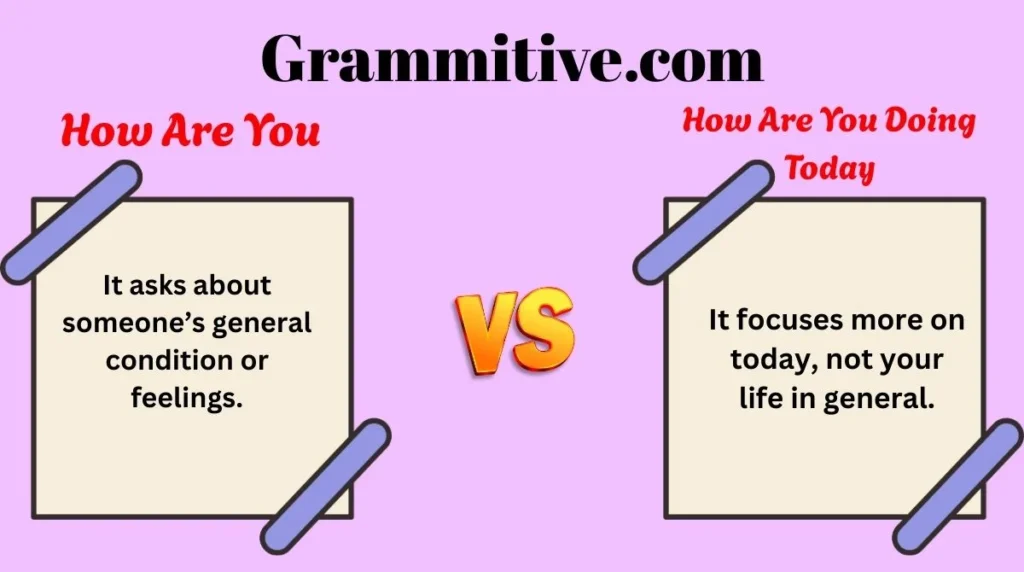
It asks about someone’s general condition or feelings.
It usually means:
👉 “Are you okay?”
👉 “How is life going?”
👉 “How do you feel?”
But here’s something important:
In many situations, it’s just a polite greeting, not a deep question.
People often say it automatically.
When to use it
Use it:
- when meeting someone
- when starting a conversation
- with friends, coworkers, or strangers
- in both formal and informal situations
It is safe everywhere.
Grammar rule
Structure:
How + are + you
- How → question word
- are → verb “to be”
- you → subject
This uses present simple (be verb).
It asks about your state or condition.
Example sentences
- How are you today?
- Hi Sarah, how are you?
- Good morning, sir. How are you?
- I haven’t seen you in months. How are you?
- Hello! How are you feeling now?
- Hey Tom, how are you after the exam?
- How are you these days?
- How are you, my friend?
Common learner confusion
Many learners think:
❌ “I must give a long answer.”
No. Usually short answers are enough.
Native speakers often say:
- I’m good.
- I’m fine.
- Not bad.
- Pretty good.
It’s more social than serious.
What Does “How Are You Doing Today?” Mean?
Simple definition
“How are you doing today?” asks about:
👉 your current activity
👉 your present situation
👉 your day right now
It focuses more on today, not your life in general.
It feels warmer and more personal.
When to use it
Use it:
- when you want to sound friendly
- when checking on someone’s day
- at work, school, or customer service
- when you truly care about the answer
It is common in American English.
Grammar rule
Structure:
How + are + you + doing + today
This uses:
- present continuous (are doing)
It asks about actions or progress, not only condition.
So it’s more active.
Example sentences
- How are you doing today?
- Hey, how are you doing today at work?
- How are you doing today after your trip?
- How are you doing today, Mom?
- How are you doing today with the new project?
- How are you doing today, feeling better?
- How are you doing today at school?
- How are you doing today so far?
Common learner confusion
Some students think it means:
❌ “What are you doing right now?”
Not exactly.
It means:
👉 “How is your day going?”
👉 “Are things okay today?”
It’s about experience, not specific actions.
Difference Between “How Are You” and “How Are You Doing Today” (Detailed)
Both are greetings, but they feel slightly different.
Here’s a clear comparison:
| Feature | How are you? | How are you doing today? |
|---|---|---|
| Type | general greeting | personal check-in |
| Grammar | simple present | present continuous |
| Focus | condition/state | day/activity |
| Feeling | neutral | warmer |
| Formality | formal & informal | mostly informal/semi-formal |
| Length | short | longer |
| Common reply | “Fine” | “Pretty good, busy today” |
Usage difference
“How are you?”
→ quick, polite, automatic
“How are you doing today?”
→ shows interest, expects more detail
Grammar logic
- are → state
- are doing → action/progress
So the second one suggests something is happening.
Sentence structure difference
State question:
👉 How are you?
Action/progress question:
👉 How are you doing?
Adding today limits the time to now.
Meaning comparison
If you meet a shop worker:
“How are you?” → normal greeting
“How are you doing today?” → more friendly, conversational
Small difference, but it changes the feeling.
Grammar Rules You Must Remember
Rule #1 – “Be” verb = state
Use “are” for feelings or conditions.
Example:
How are you today?
I am tired.
Rule #2 – “Doing” = activity or progress
Use “doing” for how things are going.
Example:
How are you doing today?
I’m doing great.
Rule #3 – Add time words for clarity
Words like:
- today
- lately
- these days
Example:
How are you doing these days?
Rule #4 – Short answers are normal
Do not over-explain unless needed.
Example:
How are you?
I’m good, thanks.
Common Mistakes Students Make
Why mistakes happen
Learners:
- translate from their language
- overthink grammar
- expect deep answers
But English greetings are often simple and automatic.
Wrong vs Correct
❌ How you are?
✅ How are you?
❌ How are you do?
✅ How are you doing?
❌ I am fine thank you and you how are your family everything good life is busy
✅ I’m fine, thanks. And you?
❌ How are you doing today? → I am doing my homework
✅ I’m doing well / It’s going well
Easy correction tips
- Keep answers short
- Don’t translate word-by-word
- Listen to native speakers
- Practice speaking aloud
Easy Trick to Remember the Difference
Here’s a simple memory trick.
Think like this:
“Are” = who you are
“Doing” = what you’re doing
So:
How are you? → your condition
How are you doing? → your day’s progress
Another easy way:
Short question = quick greeting
Long question = friendly interest
This logic works almost every time.
Daily Life Examples (Very Important)
These sound natural in real conversations.
- Hi Jake! How are you?
- Good morning, teacher. How are you today?
- Hey Anna, how are you doing today?
- How are you doing today at the office? Busy?
- I called to see how you’re doing today.
- Long time no see! How are you?
- How are you doing today after the test?
- Hi Grandma, how are you doing today?
- Hey buddy, how are you? Everything okay?
- How are you doing today so far?
Notice how casual and friendly these sound.
Practice Section
Choose the correct option.
- ______ you today? (How are / How do)
- How are you ______ today? (doing / do)
- I’m fine. And ______? (you / your)
- How are you ______ these days? (doing / are)
- ______ you? I haven’t seen you. (How are / What are)
Answers
- How are
- doing
- you
- doing
- How are
FAQs
What is the difference between “how are you” and “how are you doing today”?
The first is a general greeting. The second asks about your day or current situation. The second sounds more personal and friendly.
Can we use “how are you doing today” in formal situations?
Yes, but it is more common in semi-formal or casual settings. In very formal situations, “How are you?” sounds safer.
Is “how are you” too simple or old-fashioned?
Not at all. It’s still the most common greeting in English worldwide.
Do people expect real answers?
Usually no. Short answers like “fine” or “good” are normal. But close friends may expect more detail.
Can I say “how are you doing” without “today”?
Yes. “How are you doing?” is very common and natural.
Which one sounds more friendly?
“How are you doing today?” sounds warmer and shows more care.
Final Conclusion
Small phrases often cause big confusion in English. Greetings are a perfect example. Both “How are you?” and “How are you doing today?” are correct, polite, and natural. The difference is mainly in feeling, not strict grammar.
The shorter form works everywhere and is safe for any situation. The longer form sounds warmer and more personal. It shows interest in someone’s day.
Once you understand this, speaking becomes easier. You don’t need to think too much. Choose the one that matches the situation and your relationship with the person.
Try using both in daily life. Greet friends, classmates, or coworkers. Practice out loud. The more you use them, the more natural they feel.
English greetings should feel friendly, not stressful.
Keep it simple. Keep it real. And just ask with a smile.

I am Lucas Bennett, a digital content creator passionate about social media trends and online growth strategies.
I share practical insights and guides to help users better understand and navigate the digital world.