
English looks simple at first. But then small words start causing big headaches.
Prepositions are often the problem.
Many learners feel confused when they hear sentences like:
- “This book is helpful to me.”
- “This book is helpful for students.”
Both sound correct. Both use the same adjective. So what’s the difference?
This tiny change — to or for — can completely change the meaning of a sentence. And because both are common in daily English, mistakes happen all the time.
Even intermediate students mix them up when speaking fast.
You might ask yourself:
“Which one should I use?”
“Are they the same?”
“Can I use both?”
The good news is that the difference is actually very logical once you see the pattern. There is a clear reason native speakers choose one or the other.
After reading this guide, you will:
- understand the real meaning of each preposition
- know the grammar rule behind them
- see many real-life examples
- avoid common mistakes
- feel more confident when speaking and writing
By the end, choosing the correct form will feel natural — not confusing.
What Does “To” Mean?
Simple definition
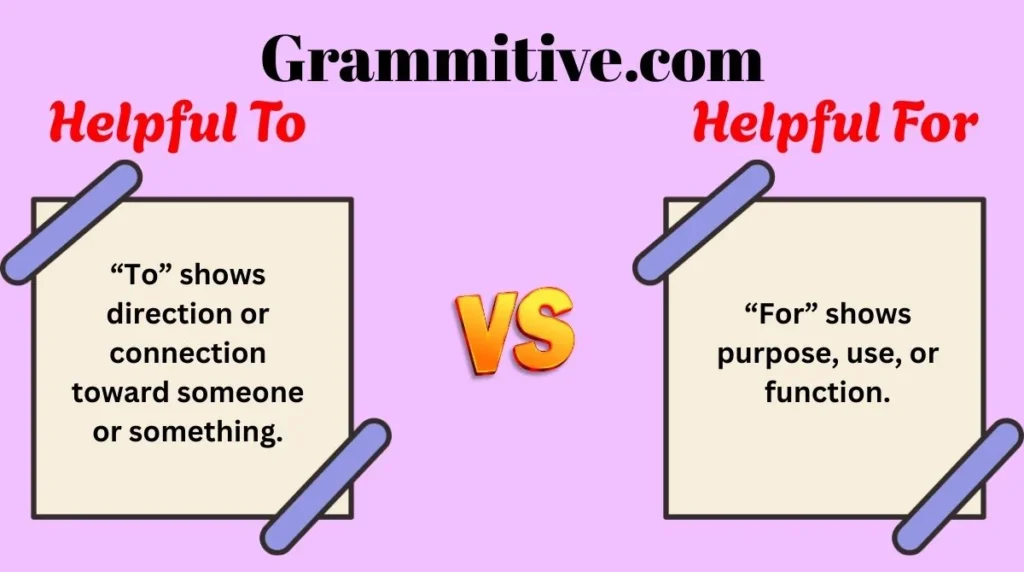
“To” shows direction or connection toward someone or something.
Think of it like an arrow.
Something goes → to → a person or object.
When we say helpful to, we usually mean:
👉 Someone receives the help.
When to use it
Use helpful to when you talk about:
- a person
- a group
- someone who benefits directly
It answers the question:
Helpful to WHO?
Grammar rule
Structure:
helpful + to + person / people / pronoun
Examples:
- helpful to me
- helpful to her
- helpful to students
- helpful to the team
Example sentences
- Your advice was helpful to me.
- The nurse was very helpful to the old man.
- This teacher is always helpful to students.
- The guide was helpful to tourists.
- That video is helpful to beginners.
- His explanation was helpful to everyone.
- She gave tips that were helpful to her sister.
- The manager is helpful to new workers.
Common learner confusion
Many students think “to” means purpose, but that’s not correct here.
It is not about why something helps.
It is about who receives the help.
So focus on the person.
If you can replace it with “helps someone”, then use to.
Example:
- This book helps me → helpful to me
That connection makes it easier to remember.
What Does “For” Mean?
Simple definition
“For” shows purpose, use, or function.
Think of it like:
👉 This thing is designed for something.
When we say helpful for, we usually talk about:
- an activity
- a goal
- a situation
- a purpose
It answers:
Helpful for WHAT?
When to use it
Use helpful for when talking about:
- studying
- learning
- improving something
- solving a problem
- completing a task
Grammar rule
Structure:
helpful + for + noun / gerund (-ing verb) / purpose
Examples:
- helpful for studying
- helpful for beginners
- helpful for learning English
- helpful for health
Example sentences
- This app is helpful for learning vocabulary.
- These notes are helpful for the exam.
- Walking is helpful for your health.
- The chart is helpful for understanding grammar.
- This guide is helpful for new teachers.
- Water is helpful for staying hydrated.
- The map is helpful for finding the station.
- This video is helpful for pronunciation practice.
Common learner confusion
Students often use for people, like:
❌ This is helpful for me.
Sometimes native speakers say it, but usually it sounds less natural. English prefers to me for people.
Remember:
- for = purpose
- not the receiver
If you can say “useful for doing something”, then use for.
Difference Between To and For (Detailed)
Now the important part. The two prepositions may look similar, but they serve different roles.
Here is a clear comparison.
Comparison table
| Feature | Helpful to | Helpful for |
|---|---|---|
| Focus | Person | Purpose/Activity |
| Question | To who? | For what? |
| Meaning | Someone receives help | Something is useful for a task |
| Grammar | to + person | for + noun/verb-ing |
| Example | helpful to me | helpful for studying |
Usage difference
Helpful to = benefit goes directly to a person
Helpful for = benefit helps a task or goal
Compare:
- This guide is helpful to students. (students benefit)
- This guide is helpful for studying. (helps the activity)
Both can appear in one sentence:
👉 This guide is helpful to students for studying.
See? Each preposition has a job.
Grammar logic
Think of this:
to = receiver
for = purpose
It’s almost mathematical.
Help → goes → to someone
Help → used → for something
Sentence structure difference
Helpful to:
- helpful to me
- helpful to her
- helpful to beginners
Helpful for:
- helpful for learning
- helpful for exams
- helpful for cooking
Notice:
After for, you often see -ing verbs.
After to, you see people or pronouns.
Meaning comparison
Small change, big difference:
- This medicine is helpful to children.
(children feel better) - This medicine is helpful for fever.
(it treats fever)
The focus changes completely.
Grammar Rules You Must Remember
Rule #1 – Use “to” with people
✔ This advice is helpful to me.
✔ The coach was helpful to the team.
Never forget: people = to
Rule #2 – Use “for” with actions or goals
✔ helpful for cooking
✔ helpful for learning
✔ helpful for sleep
If you see a verb with -ing, choose for.
Rule #3 – You can use both in one sentence
✔ This app is helpful to students for revision.
This is very natural and correct.
Rule #4 – Don’t mix structure
❌ helpful to studying
❌ helpful for me (less natural in many contexts)
Keep the patterns clean.
Common Mistakes Students Make
Why mistakes happen
The problem comes from translation.
In many languages, one preposition covers both meanings. English separates them.
So learners guess. And guessing causes errors.
Wrong vs correct examples
❌ This book is helpful for me.
✔ This book is helpful to me.
❌ These tips are helpful to improving writing.
✔ These tips are helpful for improving writing.
❌ Water is helpful to health.
✔ Water is helpful for health.
❌ The teacher is helpful for students.
✔ The teacher is helpful to students.
Easy correction tips
Ask yourself:
- Is it a person? → use to
- Is it an action/goal? → use for
If unsure, replace with:
- helps someone → to
- useful for doing → for
This trick almost always works.
Easy Trick to Remember the Difference
Here’s a simple memory trick students love.
Think:
TO = person’s face
FOR = function
Imagine giving help with your hand.
When you give something to someone, your hand goes toward their face → to
When something has a job or purpose, it works for something → for
Examples:
- gift to a friend
- tool for cutting
Same idea with helpful.
It’s not grammar magic. It’s just logic.
Daily Life Examples (Very Important)
These sound natural in everyday English conversations.
- Thanks, your message was really helpful to me.
- This chair is helpful for my back pain.
- She was helpful to the kids during class.
- These notes are helpful for homework.
- The receptionist was helpful to us.
- This website is helpful for beginners.
- His advice was helpful to my brother.
- Exercise is helpful for stress.
- That checklist is helpful for packing.
- The staff were helpful to the customers.
Notice how natural each one feels when the rule is correct.
Practice Section
Choose to or for.
- This guide is helpful ___ new students.
- These shoes are helpful ___ walking long distances.
- She was very helpful ___ me yesterday.
- This app is helpful ___ tracking calories.
- His tips were helpful ___ the team.
Answers
- to
- for
- to
- for
- to
FAQs
What is the difference between helpful to and helpful for?
Helpful to focuses on a person receiving help. Helpful for focuses on purpose or use. One shows the receiver, the other shows the function.
Can both be correct in one sentence?
Yes. For example: “This book is helpful to students for exam preparation.” Each preposition has a different job.
Can we use helpful for people?
Sometimes native speakers say it, but it’s less common. Helpful to people usually sounds more natural and correct.
Is one more formal than the other?
No. Both are normal in daily speech and writing. The difference is grammar and meaning, not formality.
Can I use helpful with gerunds (-ing verbs)?
Yes, but only with for. Example: helpful for learning, helpful for saving time.
Why do learners mix them up?
Because both show benefit and many languages use only one preposition. English separates person and purpose, which feels strange at first.
Final Conclusion
Small grammar points often cause the biggest confusion. “Helpful to” and “helpful for” look almost the same, yet they do very different jobs.
The key idea is simple.
If the help goes to a person, use to.
If something has a purpose or activity, use for.
Once you start thinking about receiver versus function, your sentences become clear and natural. You won’t need to guess anymore.
Try listening to native speakers. Notice how often they follow this exact pattern. Then practice writing your own examples. Say them out loud. Use them in real life.
After some time, choosing the right word will feel automatic.
And that’s when grammar stops feeling like a rulebook and starts feeling like real English.

I am Lucas Bennett, a digital content creator passionate about social media trends and online growth strategies.
I share practical insights and guides to help users better understand and navigate the digital world.