
Many English learners feel confused when they see sentences like “I will help you do this” and “I will help you to do this.” Both sound correct. So which one should you use?
This small difference—help vs help to—can make learners stop and think. It feels tricky because sometimes the word “to” is there, and sometimes it is not.
But the meaning stays almost the same. That makes it even more confusing.
In daily English, people use “help” all the time. You hear it in conversations, at work, in school, and even in movies.
If you don’t understand how to use it correctly, your sentences may sound unnatural or too formal.
The good news is that this topic is not difficult once you understand the pattern. With a few simple rules and examples, you can master it easily.
By the end, you will clearly understand:
- When to use help
- When to use help to
- Which one sounds more natural
- How native speakers actually use it
Everything will be explained in very simple English, just like a friendly classroom lesson.
What Does “Help” Mean?
The word help means to make something easier for someone or to assist someone in doing something.
It is a very common verb in English. You can use it in many situations—daily life, school, office, and casual conversation.
Basic Grammar Rule
When using help, you can follow it with:
- a person + base verb (without “to”)
👉 Structure:
help + someone + verb (base form)
Examples
- I will help you finish your homework.
- She helped me carry the bags.
- Can you help him fix the car?
- They helped us clean the room.
- He helped me understand the lesson.
- My friend helped me solve the problem.
- We helped her prepare dinner.
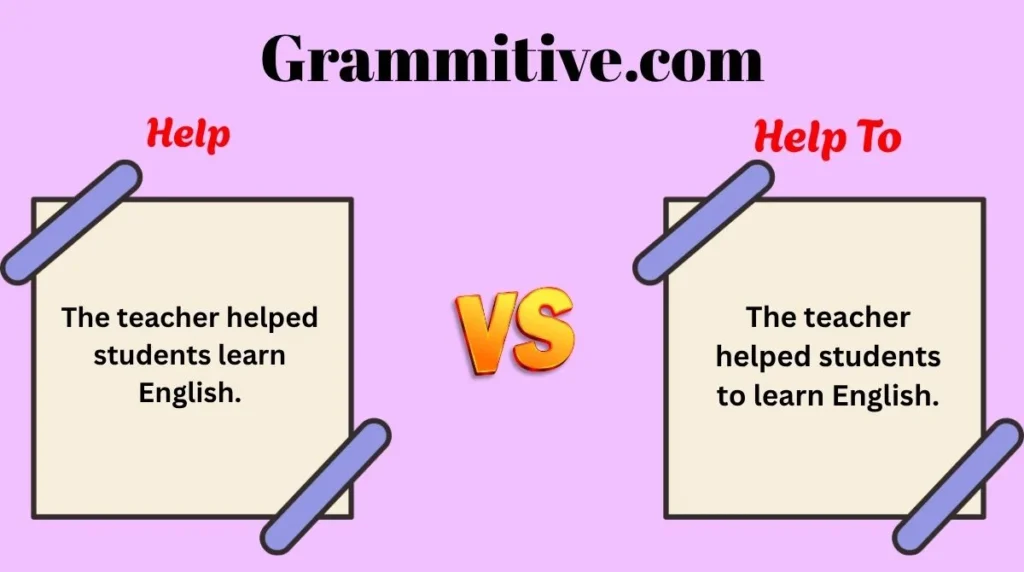
- The teacher helped students learn English.
When to Use “Help”
Use help when:
- You want to sound natural and simple
- You are speaking casually
- You want shorter sentences
This form is very common in spoken English.
Common Learner Confusion
Many learners think:
❌ “Without ‘to’, the sentence is wrong.”
That is not true.
Both forms are correct, but “help + verb” (without “to”) is more natural, especially in everyday speech.
What Does “Help To” Mean?
The phrase help to has the same basic meaning as “help.” It also means to assist someone in doing something.
The only difference is that it includes the word “to” before the verb.
Basic Grammar Rule
👉 Structure:
help + someone + to + verb
Examples
- I will help you to finish your homework.
- She helped me to carry the bags.
- Can you help him to fix the car?
- They helped us to clean the room.
- He helped me to understand the lesson.
- My friend helped me to solve the problem.
- We helped her to prepare dinner.
- The teacher helped students to learn English.
When to Use “Help To”
Use help to when:
- You want a slightly more formal tone
- You are writing (especially formal writing)
- You want to be more clear or careful
Common Learner Confusion
Some learners think:
❌ “We must always use ‘to’ after help.”
This is incorrect.
The truth:
✔ “Help” can be used with or without “to”
✔ Both are grammatically correct
Difference Between Help and Help To (Detailed)
Even though both forms are correct, there are small differences in usage, tone, and style.
Comparison Table
| Feature | Help | Help To |
|---|---|---|
| Structure | help + verb | help + to + verb |
| Meaning | Same | Same |
| Usage | More common | Less common |
| Style | Informal / natural | Slightly formal |
| Spoken English | Very common | Less common |
| Writing | Used often | Used in formal writing |
Usage Difference
In real life, people usually say:
✔ “I will help you do it.”
(Not: “I will help you to do it.”)
So, “help + verb” is more natural in speech.
Grammar Logic
Both follow correct grammar rules:
- “help” can take a bare infinitive (without “to”)
- or a full infinitive (with “to”)
That’s why both forms are acceptable.
Sentence Structure Difference
- Without “to”: shorter and quicker
- With “to”: slightly longer and formal
Compare:
✔ She helped me solve the problem.
✔ She helped me to solve the problem.
Both are correct, but the first one feels more natural.
Meaning Comparison
There is no difference in meaning.
Both sentences mean the same thing:
👉 Someone gives support or assistance.
Grammar Rules You Must Remember
Rule #1: “Help” can be used with or without “to”
✔ I helped him finish the work.
✔ I helped him to finish the work.
Both are correct.
Rule #2: In spoken English, “to” is often dropped
✔ She helped me carry the box. (more natural)
❗ She helped me to carry the box. (correct but formal)
Rule #3: Use “to” in formal writing if needed
✔ This program helps students to improve their skills.
This sounds slightly more formal.
Rule #4: After modal verbs, keep it simple
✔ I can help you do this.
❌ I can help you to do this (not wrong, but less natural)
Common Mistakes Students Make
Mistake #1: Thinking one form is wrong
❌ I will help you do it. (thinking it’s wrong)
✔ It is correct.
Mistake #2: Always adding “to”
❌ She helped me to carry the bag (always using “to”)
✔ Better: She helped me carry the bag.
Mistake #3: Mixing structure
❌ He helped to me finish the work.
✔ He helped me finish the work.
Mistake #4: Forgetting the object
❌ I helped finish the work. (incomplete)
✔ I helped him finish the work.
Easy Correction Tips
- Keep it simple
- Use “help + person + verb”
- Don’t worry too much about “to”
Easy Trick to Remember the Difference
Here is a simple trick:
👉 If you are speaking → don’t use “to”
👉 If you are writing formally → you can use “to”
Think like this:
- Talking = short and quick
- Writing = a little longer
Example:
Speaking:
✔ “I’ll help you fix it.”
Writing:
✔ “I will help you to fix it.”
Both are correct, but one sounds more natural depending on the situation.
Daily Life Examples (Very Important)
These are real-life spoken English sentences:
- I’ll help you carry this bag.
- Can you help me open this bottle?
- She helped me understand the question.
- My brother helped me fix my phone.
- Please help me find my keys.
- He helped us move the furniture.
- I helped my mom cook dinner.
- Can someone help me solve this problem?
- She helped her friend learn English.
- They helped us clean the house.
Now with “to”:
- I’ll help you to carry this bag.
- Can you help me to open this bottle?
Both versions are correct, but the first set sounds more natural.
Practice Section
Choose the correct option:
- She helped me ___ my homework.
a) do
b) to do - I will help you ___ this problem.
a) solve
b) to solve - He helped her ___ the room.
a) clean
b) to clean - Can you help me ___ this box?
a) carry
b) to carry - They helped us ___ dinner.
a) prepare
b) to prepare
Answers:
- a / b (both correct)
- a / b (both correct)
- a / b (both correct)
- a / b (both correct)
- a / b (both correct)
✔ Tip: Option “a” is more natural in speaking.
FAQs
1. What is the difference between help and help to?
There is no difference in meaning. Both mean to assist someone. The only difference is style. “Help” is more common in speaking, while “help to” sounds slightly more formal.
2. Can we use “help” without “to”?
Yes, absolutely. In fact, it is very common. Native speakers often say “help + verb” without using “to.”
3. Is “help to” more formal?
Yes, slightly. It is often used in writing or formal situations. But both forms are correct.
4. Which one should I use in speaking?
Use “help + verb” (without “to”). It sounds more natural and is used by native speakers in daily conversations.
5. Is it wrong to always use “to”?
No, it is not wrong. But it may sound a little formal or less natural in casual speaking.
6. Can “help” be used without a person?
Yes, sometimes.
Example:
✔ This book helps improve your English.
Here, no person is mentioned, but the sentence is still correct.
Final Conclusion
Understanding the difference between help and help to is easier than it looks. Both forms are correct, and both have the same meaning. The real difference is in style, not grammar.
In everyday English, people usually prefer the shorter version:
✔ “help + verb”
It sounds more natural and is widely used in speaking.
The longer form:
✔ “help + to + verb”
is also correct and can be used in formal writing or when you want to sound more careful.
The key is not to overthink it. Focus on clear communication. With practice, your sentences will start to feel natural.
Try to notice how native speakers use “help” in movies, conversations, and daily life. The more you listen and practice, the more confident you will become.
Keep practicing, and soon this topic will feel very easy.

I am Lucas Bennett, a digital content creator passionate about social media trends and online growth strategies.
I share practical insights and guides to help users better understand and navigate the digital world.