
English has many small grammar problems that confuse learners.
One of the most common ones is choosing between “he and I” and “he and me.”
Both sound correct. Both are used by native speakers. And both appear in books, movies, and daily conversations. So how do you know which one to use?
You may have heard sentences like:
- He and I went to the store.
- The teacher called he and me.
- This gift is for he and I.
Some sound natural. Others sound strange. But many students are not sure why.
This topic matters more than you think. These phrases appear in school writing, job emails, speaking exams, and everyday talk.
Using the wrong form can make your sentence sound awkward or ungrammatical. Even native speakers sometimes make mistakes here.
The good news is that the rule is actually simple. Once you understand how subject pronouns and object pronouns work, everything becomes clear.
By the end, you will know:
- when to say he and I
- when to say he and me
- easy tricks to decide fast
- how to avoid common mistakes
- and how to sound natural in real conversations
Step by step, everything will feel easy.
What Does “He and I” Mean?
Simple definition
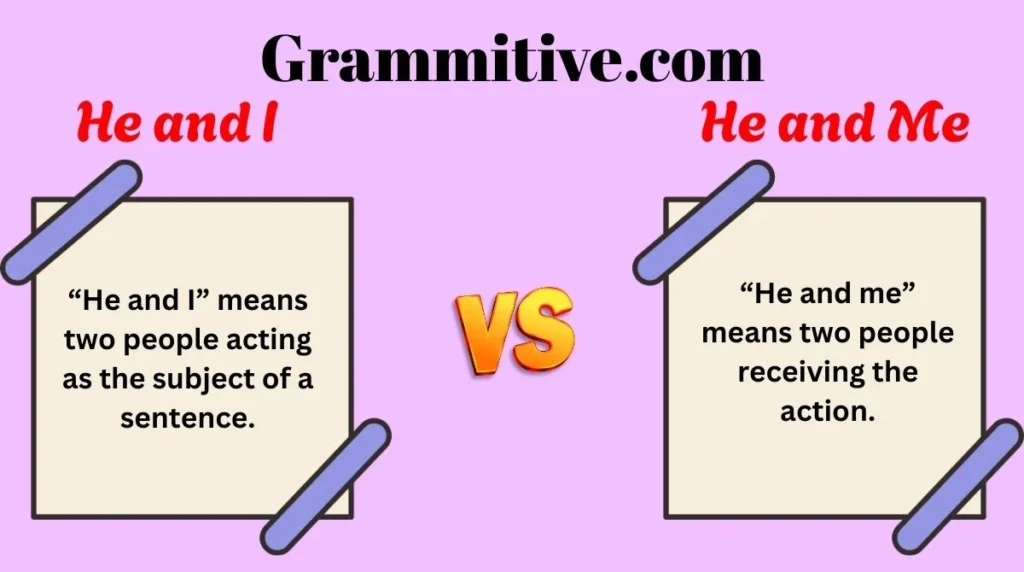
“He and I” means two people acting as the subject of a sentence.
It is used when both people are doing the action.
Here, I is a subject pronoun.
Subject pronouns include:
I, he, she, we, they
They usually come before the verb.
When to use it
Use he and I when:
- both people perform the action
- they are the subject
- they come before the verb
Think: Who is doing the action?
If the answer is “he and I,” this form is correct.
Grammar rule
If you would normally say “I” alone, then say “he and I” together.
Not me.
Example sentences
- He and I are classmates.
- He and I went to the library.
- He and I study English every day.
- He and I play soccer after school.
- He and I finished the project together.
- He and I live in the same building.
- He and I enjoy watching movies.
- He and I will call you later.
Notice something important.
If you remove he, the sentence still works:
- I went to the library.
- I play soccer.
- I finished the project.
That’s your clue.
Common learner confusion
Many students think “me” sounds more natural:
❌ He and me went to school.
But this sounds wrong because me cannot be a subject.
Only I can.
What Does “He and Me” Mean?
Simple definition
“He and me” means two people receiving the action.
It is used as the object of a sentence.
Here, me is an object pronoun.
Object pronouns include:
me, him, her, us, them
They usually come after the verb or preposition.
When to use it
Use he and me when:
- someone does something to both of you
- you are receiving the action
- you come after a verb or preposition
Think: Who gets the action?
Grammar rule
If you would normally say “me” alone, then say “he and me” together.
Example sentences
- She called he and me.
- The teacher gave homework to he and me.
- This gift is for he and me.
- They invited he and me to dinner.
- The coach spoke to he and me.
- The prize was shared between he and me.
- The manager thanked he and me.
- They sent emails to he and me.
Remove he, and it still works:
- She called me.
- The teacher gave homework to me.
- This gift is for me.
That shows me is correct.
Common learner confusion
Some students think “I” sounds more polite or formal, so they say:
❌ She called he and I.
But this is incorrect because I cannot be an object.
Difference Between He and I and He and Me (Detailed)
Here is a clear comparison.
| Feature | He and I | He and Me |
|---|---|---|
| Type | Subject | Object |
| Pronoun used | I | Me |
| Position | Before verb | After verb/preposition |
| Action | Doing action | Receiving action |
| Example | He and I went | She called he and me |
Usage difference
- He and I → do something
- He and me → something happens to us
Grammar logic
English sentences usually follow:
Subject → Verb → Object
Example:
She → called → me
So:
Subject = he and I
Object = he and me
Sentence structure difference
Subject position
He and I finished the work.
Object position
The boss thanked he and me.
Meaning comparison
He and I cleaned the room.
→ We did the cleaning.
The teacher praised he and me.
→ We received praise.
The meaning changes based on the role.
Grammar Rules You Must Remember
Rule #1 – Subjects use “I”
If you are doing the action, use I.
Example:
He and I play chess.
Rule #2 – Objects use “me”
If the action happens to you, use me.
Example:
They invited he and me.
Rule #3 – Remove the other person to check
Take out “he and”.
If the sentence sounds correct with I, use he and I.
If it sounds correct with me, use he and me.
Example:
She called ___
She called me ✓
So → she called he and me.
Rule #4 – After prepositions use “me”
After words like to, for, with, between, from, use me.
Example:
This is between he and me.
Never: between he and I.
Common Mistakes Students Make
Why mistakes happen
There are two main reasons:
- Students want to sound formal
- People hear wrong sentences in movies or daily talk
Sometimes native speakers also break the rules in casual speech. That makes learners confused.
Wrong vs correct examples
❌ Me and him went shopping.
✅ He and I went shopping.
❌ She talked to he and I.
✅ She talked to he and me.
❌ The teacher helped he and I.
✅ The teacher helped he and me.
❌ Him and me are friends.
✅ He and I are friends.
Easy correction tips
- Check the verb
- Remove the other person
- Test with I or me
- Trust the grammar rule, not your ears
Easy Trick to Remember the Difference
Here is a simple trick many teachers use.
The “remove the other person” trick
Take away “he”.
Then read the sentence.
Example:
The teacher called he and me.
Remove “he and” →
The teacher called me.
This sounds right. So he and me is correct.
Another:
He and I went home.
Remove “he and” →
I went home.
Correct. So he and I is correct.
This trick works almost every time.
It’s fast and perfect for exams.
Daily Life Examples (Very Important)
These sound like real conversation.
- He and I are working late today.
- Mom picked up he and me from school.
- He and I share the same desk.
- The coach spoke to he and me after practice.
- He and I forgot our keys.
- They sent the message to he and me.
- He and I are planning a trip.
- The gift is for he and me.
- He and I love this restaurant.
- The teacher asked he and me to stay.
Say them aloud. They feel natural.
Practice Section
Choose the correct option.
1
___ went to the market.
a) He and me
b) He and I
2
She invited ___ to dinner.
a) he and I
b) he and me
3
___ are best friends.
a) He and I
b) He and me
4
The prize was given to ___.
a) he and I
b) he and me
5
___ finished the homework early.
a) He and I
b) He and me
Answers
1 → b
2 → b
3 → a
4 → b
5 → a
FAQs
What is the difference between he and I and he and me?
“He and I” is used as the subject doing the action. “He and me” is the object receiving the action. It depends on sentence position and grammar role.
Can we use he and me in questions?
Yes. If it is the object, it’s fine.
Example: Did she call he and me?
Is he and I more formal?
Not really. It is simply grammatically correct for subjects. Both forms are neutral and common in everyday English.
Why do native speakers sometimes say it wrong?
Casual speech often ignores grammar rules. People speak fast and follow habits. But in writing or exams, correct grammar is important.
Can I say me and him instead?
In formal English, start with the other person first: “he and I” or “he and me.”
“Me and him” sounds informal or childish.
How can I remember quickly during an exam?
Remove the other person. Test with I or me. Choose the one that sounds right alone. This method rarely fails.
Final Conclusion
Small grammar points like this can feel confusing at first. Two short phrases. One tiny word change. Yet many students struggle for years.
The secret is understanding roles in a sentence. Subjects do the action. Objects receive it. Once you see that pattern, everything becomes clear.
When you speak or write, slow down for a moment. Remove the other person. Test the sentence with “I” or “me.” Your ear and your brain will guide you to the right answer.
Practice with real-life sentences. Notice how books and teachers use these forms. Soon you won’t need to think at all. The correct choice will feel natural.
Grammar is like muscle memory. The more you use it, the stronger it gets.
Keep practicing, and you’ll sound smooth and confident every day.

I am Lucas Bennett, a digital content creator passionate about social media trends and online growth strategies.
I share practical insights and guides to help users better understand and navigate the digital world.