
English has many small grammar points that look easy but quietly confuse learners.
One of them is having and having had.
At first, both look almost the same. They both use having. They both talk about actions in the past. And both often appear at the beginning of sentences. So it’s normal to stop and think:
“Which one should I use here?”
Even intermediate students mix them up. Some use having when they should use having had, and others avoid both because they feel unsure.
The problem is not vocabulary. It’s time and sequence of actions.
In daily English, we often talk about two actions:
- one happens first
- another happens after
English needs a clear way to show this order. That’s where these forms help.
When you understand this topic well, your sentences will sound:
- more natural
- more fluent
- more advanced
- closer to native speakers
By the end, you’ll clearly know:
- what having means
- what having had means
- when to use each one
- the difference in time
- and how to avoid common mistakes
Everything is explained in very simple English with many examples, just like in a friendly classroom.
What Does “Having” Mean?
✅ Simple definition
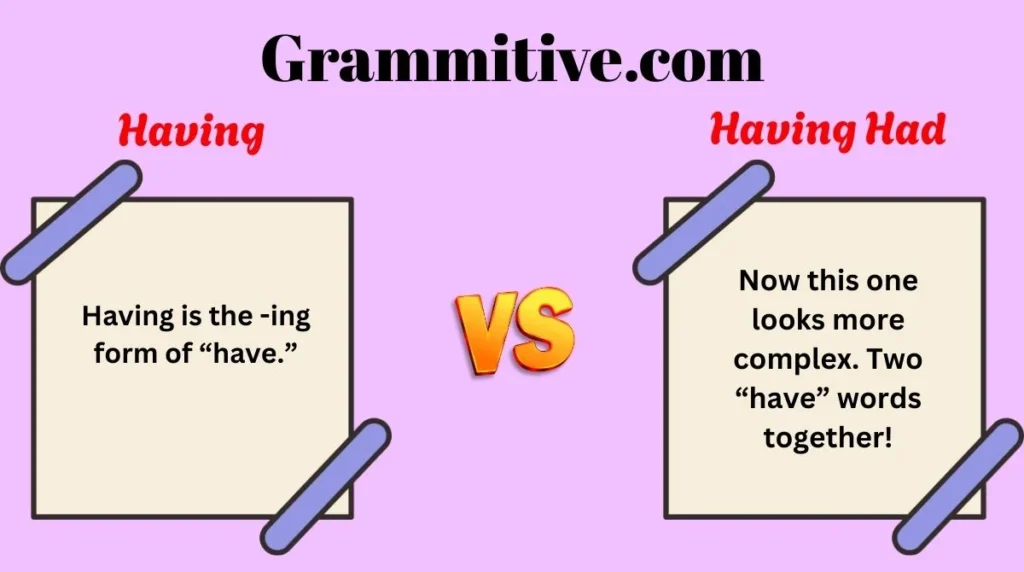
Having is the -ing form of “have.”
It usually means:
- owning something
- experiencing something
- doing something (like eating, sleeping, talking, etc.)
It can work as:
- a verb (continuous tense)
- or a participle clause
Here, we focus on having as a participle, which shows an action happening at the same time as another action.
✅ When to use it
Use having when:
- two actions happen at the same time, or
- one action is in progress, not finished before the second action
Think: during the action, not after finishing.
✅ Grammar rule
Structure:
Having + object/complement, main clause
Examples:
- Having lunch, I watched TV.
- Having a headache, she went home.
It describes the situation while something is happening.
✅ Example sentences (6–8)
- Having breakfast, I checked my phone.
- She called me while having dinner.
- Having a cold, he stayed in bed.
- They talked loudly, having a great time.
- Having problems at work, she felt stressed.
- He fell asleep having the TV on.
- Having guests at home, we cooked extra food.
- I slipped while having a shower.
✅ Common learner confusion
Many students think having = finished action.
But that’s wrong.
❌ Having eaten, I left. (This sounds incomplete or unnatural here.)
✅ Having eaten = action finished first (needs “having had” or “having + past participle”)
Remember:
having alone does NOT show completion.
It usually shows:
- now
- during
- same time
Not earlier.
What Does “Having Had” Mean?
Now this one looks more complex. Two “have” words together!
But it’s easier than it looks.
✅ Simple definition
Having had means:
👉 after finishing something with “have”
It shows:
- a completed action
- that happened before another action
It’s the perfect participle form.
✅ When to use it
Use having had when:
- something happened first
- then something else happened
It shows clear order in the past.
Action 1 → finished
Action 2 → happened next
✅ Grammar rule
Structure:
Having had + object, main clause
Formula:
Having had + noun + past result, subject + verb
It works like:
after + subject + had + object
✅ Example sentences (6–8)
- Having had lunch, I went back to work.
- Having had enough sleep, she felt fresh.
- Having had coffee, he felt better.
- Having had an argument, they stopped talking.
- Having had surgery, she stayed home.
- Having had a bad day, I didn’t want to talk.
- Having had experience, he got the job easily.
- Having had practice, the team played confidently.
✅ Common learner confusion
Students often write:
❌ Having lunch, I went back to work.
(But lunch was finished first)
It should be:
✅ Having had lunch, I went back to work.
Because:
- first: eat lunch
- then: go back to work
The action was completed.
So we need having had, not just having.
Difference Between Having and Having Had (Detailed)
This is where everything becomes clear.
Both look similar, but they show different time relationships.
📊 Comparison Table
| Feature | Having | Having Had |
|---|---|---|
| Time meaning | same time | earlier time |
| Completion | not finished | finished |
| Grammar type | present participle | perfect participle |
| Shows order? | no | yes |
| Sounds | simple | more advanced |
| Example | Having dinner, I watched TV | Having had dinner, I watched TV |
✅ Usage difference
Having
→ describes something happening during another action
Having had
→ describes something finished before another action
✅ Grammar logic
Think of it like this:
- having = happening
- having had = already happened
The extra had shows past completion.
Just like:
- I have lunch (present)
- I had lunch (past)
- having had lunch (past completed before something else)
✅ Sentence structure difference
Same time:
👉 Having coffee, she read the news.
First action finished:
👉 Having had coffee, she left the café.
✅ Meaning comparison
Look at these:
- Having dinner, he watched TV.
→ eating + watching at same time - Having had dinner, he watched TV.
→ first finished dinner, then watched TV
See how meaning changes completely?
Grammar Rules You Must Remember
✅ Rule #1: Use “having” for actions happening at the same time
Example:
Having music playing, she studied.
✅ Rule #2: Use “having had” for actions finished first
Example:
Having had breakfast, he left the house.
✅ Rule #3: Use it only when the subject is the same
❌ Having had lunch, the bus left.
(The bus didn’t eat lunch!)
✅ Having had lunch, I left.
✅ Rule #4: Don’t overuse in simple speech
In normal conversation, we often say:
After lunch, I left.
It’s simpler. Use participles mostly in:
- writing
- formal English
- exams
Common Mistakes Students Make
❌ Mistake 1: Using “having” for completed action
Wrong:
Having dinner, I went home.
Correct:
Having had dinner, I went home.
Tip: If finished → use had.
❌ Mistake 2: Wrong subject
Wrong:
Having had coffee, the meeting started.
Correct:
Having had coffee, we started the meeting.
❌ Mistake 3: Using both forms randomly
Students sometimes choose randomly because both “sound correct.”
But grammar needs logic, not guessing.
Always ask:
👉 Did it finish first?
✅ Easy correction tip
Ask yourself:
“Can I say ‘after’ here?”
If yes → use having had
After lunch → Having had lunch
Easy Trick to Remember the Difference
Here’s a simple classroom trick.
Think about “HAD = already done”
Whenever you see had, think:
👉 finished
👉 completed
👉 already done
So:
having → happening
having had → had already happened
Another easy memory idea:
More words = earlier action
“Having had” is longer, so it shows more time passed before the next action.
Students remember this very fast.
Daily Life Examples (Very Important)
These sound like real spoken English.
- Having a headache, I stayed home.
- Having guests over, we cleaned the house.
- Having music on, he worked faster.
- Having had breakfast, I skipped lunch.
- Having had a long day, she slept early.
- Having had enough money, they bought the car.
- Having problems with Wi-Fi, I called support.
- Having had an accident, he drove carefully.
- Having coffee, we chatted for hours.
- Having had coffee, we finally left.
Notice how the meaning changes each time.
Practice Section
Choose the correct option.
1
_____ lunch, she felt sleepy.
a) Having
b) Having had
2
_____ dinner, I watched TV at the same time.
a) Having
b) Having had
3
_____ a bad cold, he stayed home.
a) Having
b) Having had
4
_____ enough practice, they won the game.
a) Having
b) Having had
5
_____ music playing, she cleaned the room.
a) Having
b) Having had
✅ Answers
1 → b
2 → a
3 → a
4 → b
5 → a
FAQs
❓ What is the difference between having and having had?
Having shows an action happening at the same time.
Having had shows a finished action before another action.
The second one makes the time order clear.
❓ Can we use having had in questions?
It’s possible, but rare.
These forms are mostly used in statements or written English.
Questions usually use simpler grammar.
❓ Is having had formal or informal?
It sounds more formal and common in writing, stories, or exams.
In daily speech, people often say “after” instead.
❓ Can I replace having had with “after”?
Yes, most of the time.
Having had lunch, I left.
After lunch, I left.
Both are correct.
❓ Why do we need two “have” words?
Because grammar needs a perfect form.
The second “had” shows completion in the past.
It’s the same idea as past perfect tense.
❓ Do native speakers use these forms?
Yes, especially in writing or formal speech.
But in casual conversation, they often use simpler sentences.
Final Conclusion
Small grammar differences can create big confusion. “Having” and “having had” look almost the same, but they tell very different stories about time.
One shows something happening now or at the same moment. The other shows something already finished. That tiny word “had” changes everything.
Once you understand this idea of sequence, the choice becomes easy. Just ask yourself: Did the action finish first? If yes, use the perfect form. If not, use the simple one.
Don’t worry about sounding too advanced at first. Start with simple examples. Practice writing your own sentences. Notice how books and articles use these forms. Slowly, they will feel natural.
Grammar becomes friendly when you see the logic behind it. And this topic is really just about time.
Keep practicing, and you’ll start using both forms without even thinking.

I am Lucas Bennett, a digital content creator passionate about social media trends and online growth strategies.
I share practical insights and guides to help users better understand and navigate the digital world.