
Many English learners feel confused when they hear questions like “Have you seen my phone?” and “Did you see my phone?”
Both sound similar. Both talk about seeing something. And both are used in daily life.
So what’s the real difference?
This small grammar point causes big problems. Students mix the two forms all the time. Some use the present perfect when they should use the past simple.
Others do the opposite. Native speakers change between them naturally, but learners often stop and think too long.
The truth is simple: the difference is about time and connection to the present.
If you choose the wrong one, the meaning changes a little. Sometimes it sounds strange or unnatural. In exams like IELTS or TOEFL, this mistake can lower your score.
In conversations, it can make you sound less confident.
Once you understand the logic, it becomes easy.
After reading this guide, you will clearly know:
- when to use have you seen
- when to use did you see
- how time words change the sentence
- common mistakes to avoid
- and how native speakers really use them
By the end, you won’t guess anymore. You’ll choose the right form automatically.
What Does “Have You Seen” Mean?
Simple definition
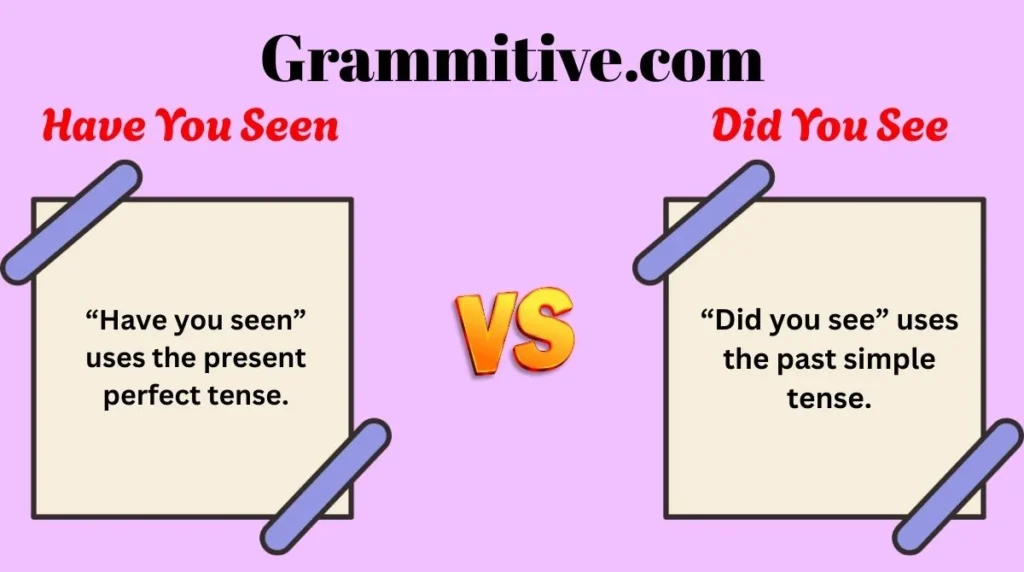
“Have you seen” uses the present perfect tense.
It asks about something that happened at an unknown time before now, or something that still matters now.
We don’t say exactly when it happened.
Grammar rule
Structure:
Have + subject + past participle (seen)
- Have you seen…?
- Has she seen…?
The verb see → seen (past participle)
When to use it
Use it when:
- time is not important
- the result is important now
- the action connects to the present
- asking about life experience
Examples
- Have you seen my keys? (I still need them now)
- Have you seen that new movie?
- Have you seen John today?
- Have you ever seen snow?
- Have you seen my glasses anywhere?
- Have you seen this message?
- Have you seen my dog? He’s missing.
- Have you seen this restaurant before?
Common learner confusion
Students often think:
“It happened in the past, so I must use past tense.”
But that’s not always correct.
Even though the action happened before now, the situation is still important now.
Example:
❌ Did you see my keys? (sounds finished)
✅ Have you seen my keys? (I still need them)
See the difference? The second one feels alive and current.
What Does “Did You See” Mean?
Simple definition
“Did you see” uses the past simple tense.
It asks about something that happened at a specific time in the past, and the action is finished.
Grammar rule
Structure:
Did + subject + base verb
Not “seen”
- Did you see…?
- Did she see…?
Never say: ❌ Did you seen
When to use it
Use it when:
- you mention a clear time (yesterday, last night, this morning, etc.)
- the action is finished
- you talk about a past event
Examples
- Did you see the game last night?
- Did you see my message yesterday?
- Did you see Tom at the party?
- Did you see the accident?
- Did you see what happened?
- Did you see her this morning?
- Did you see my email earlier?
- Did you see the teacher after class?
Common learner confusion
Many students use present perfect here:
❌ Have you seen the movie yesterday?
This is wrong because yesterday = specific past time.
Correct:
✅ Did you see the movie yesterday?
Time words decide the tense.
Difference Between Have You Seen and Did You See (Detailed)
Now let’s compare them clearly.
Quick comparison table
| Feature | Have you seen | Did you see |
|---|---|---|
| Tense | Present perfect | Past simple |
| Time | Not specific | Specific |
| Connection to now | Yes | No |
| Feeling | Still important | Finished |
| Time words | ever, yet, already | yesterday, last night |
Usage difference
Have you seen
- We care about now
- Time not mentioned
- Experience or result matters
Did you see
- We talk about a finished moment
- Time usually mentioned
- Just telling past story
Grammar logic
Present perfect = past + present connection
Past simple = only past
Sentence structure difference
Present perfect:
- Have + seen
Past simple:
- Did + see
Notice:
- present perfect → past participle
- past simple → base verb
Meaning comparison
Look at this pair:
Have you seen Anna?
→ I’m looking for her now.
Did you see Anna?
→ Maybe yesterday or earlier. Just asking about that time.
Small grammar change, different feeling.
Grammar Rules You Must Remember
Rule #1 – No specific time → use present perfect
✅ Have you seen my bag?
❌ Did you see my bag?
Rule #2 – Specific time → use past simple
✅ Did you see him yesterday?
❌ Have you seen him yesterday?
Rule #3 – Use past participle after “have”
✅ Have you seen
❌ Have you see
❌ Have you saw
Rule #4 – After “did”, use base verb
✅ Did you see
❌ Did you seen
❌ Did you saw
These small rules solve most problems.
Common Mistakes Students Make
Why mistakes happen
Many languages don’t have present perfect. So learners use only past tense.
Also, “seen” and “saw” confuse students.
Mistake 1
❌ Did you seen the movie?
✅ Did you see the movie?
Tip: after “did”, use base verb.
Mistake 2
❌ Have you saw my phone?
✅ Have you seen my phone?
Tip: present perfect needs past participle.
Mistake 3
❌ Have you seen her yesterday?
✅ Did you see her yesterday?
Tip: yesterday = past simple
Mistake 4
❌ Did you see my keys? (when still searching)
Better:
✅ Have you seen my keys?
Tip: think about NOW.
Easy Trick to Remember the Difference
Here’s a simple memory trick my students love.
Think of two questions:
Is the time finished?
→ Use did you see
Is the situation still important now?
→ Use have you seen
Another easy image:
Past simple = closed door 🚪
Present perfect = open door 🚪
If the past is closed and done → past simple
If it connects to now → present perfect
Your brain remembers pictures better than rules.
Daily Life Examples (Very Important)
These are how real people speak every day.
- Have you seen my charger? I need it now.
- Did you see the match last night?
- Have you seen this show before?
- Did you see what he posted yesterday?
- Have you seen Mom today?
- Did you see the doctor this morning?
- Have you seen my wallet anywhere?
- Did you see the accident on the road?
- Have you seen this email yet?
- Did you see her at the office earlier?
Notice how natural they sound.
Native speakers choose quickly without thinking. You will too with practice.
Practice Section
Choose the correct option.
Questions
- ___ you seen my book?
- ___ you see the movie last night?
- ___ you seen this place before?
- ___ you see John yesterday?
- ___ you seen my glasses anywhere?
Answers
- Have
- Did
- Have
- Did
- Have
FAQs
What is the difference between have you seen and did you see?
“Have you seen” connects the action to now and doesn’t mention time. “Did you see” talks about a finished moment in the past with a clear time.
Can we use have you seen in questions?
Yes. It is very common in questions, especially when asking about missing things, experiences, or recent events.
Is did you see formal or informal?
It works in both. It’s neutral and natural. You can use it in daily speech or formal writing.
Why can’t we say “have you seen yesterday”?
Because present perfect cannot use finished time words like yesterday, last week, or last year.
Which one is more common in conversation?
Both are common. It depends on meaning. People use present perfect for recent situations and past simple for stories or specific times.
Can Americans and British speakers use them differently?
Sometimes. British English uses present perfect a little more. Americans often use past simple more. But both are correct and understood.
Final Conclusion
This small grammar point feels confusing at first, but it’s actually very logical.
If the action connects to the present or the time is unknown, use have you seen.
If the action happened at a clear, finished time in the past, use did you see.
That’s the heart of it.
Don’t try to memorize long rules. Instead, ask yourself one simple question: Does this matter now or is it finished?
Practice with daily sentences. Listen to movies. Notice how people speak. Soon, you’ll choose naturally without stopping to think.
Little grammar changes make your English sound much more fluent. Keep practicing, and your confidence will grow every day.

I am Lucas Bennett, a digital content creator passionate about social media trends and online growth strategies.
I share practical insights and guides to help users better understand and navigate the digital world.