
Many English learners stop and think when they want to compare happiness.
Should you say “I feel happier today” or “I feel more happy today”?
Both sound possible. Both seem logical. But only one usually sounds natural to native speakers.
This small doubt can slow you down when speaking or writing. You may pause in the middle of a sentence and lose confidence.
It happens to beginners and even intermediate learners. English comparisons sometimes follow clear rules… and sometimes they don’t. That’s what makes them tricky.
The difference between happier and more happy is not just grammar. It’s also about natural English, fluency, and how real people talk every day.
Once you understand the simple rule behind this topic, things become much easier. You will know:
- which form sounds correct
- when each form is used
- how native speakers choose
- and how to avoid common mistakes
By the end, you won’t need to guess anymore. You’ll speak smoothly and naturally, like a confident English user.
Let’s clear this confusion step by step in very simple English.
What Does “Happier” Mean?
Simple definition
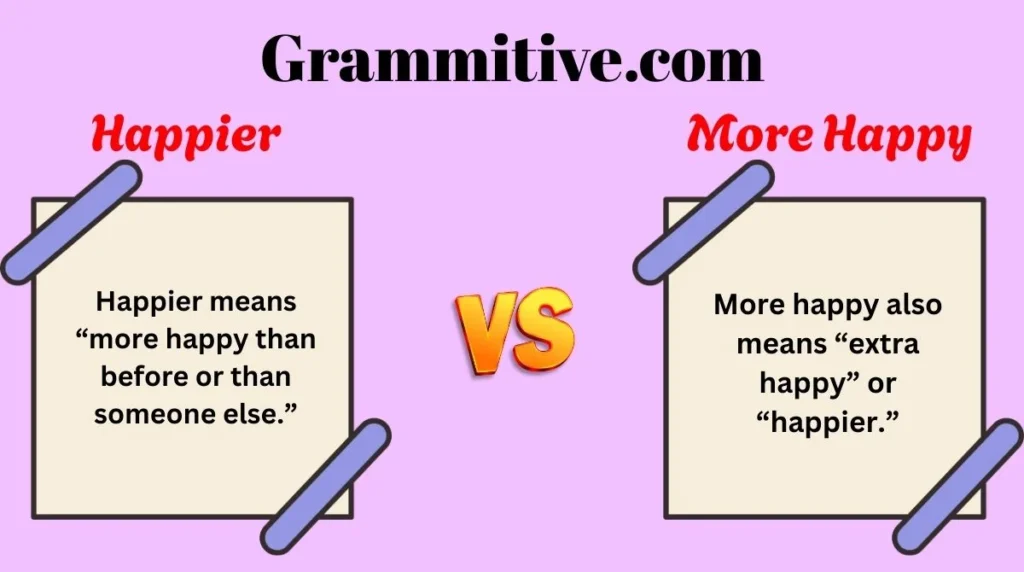
Happier means “more happy than before or than someone else.”
It is the comparative form of the adjective happy.
We use it when we compare two people, two things, or two times.
When to use it
Use happier when:
- comparing feelings
- comparing two situations
- talking about emotional improvement
- making everyday conversations
It is the most natural and common form in modern English.
Grammar rule
Happy is a short adjective (two syllables ending in -y).
For short adjectives, we usually add:
-er
But because happy ends in y, we:
- change y → i
- add -er
happy → happier
Examples
- I feel happier today.
- She looks happier after the holiday.
- He is happier than his brother.
- Kids are happier when they play outside.
- I’m much happier in my new job.
- We were happier in our old house.
- This song makes me happier.
- You seem happier these days.
Notice something? All these sentences sound natural and easy. Native speakers use this form almost every time.
Common learner confusion
Many learners think:
“Happy has two syllables, so maybe I should say more happy.”
That seems logical. But English doesn’t always follow perfect logic.
Words ending in -y often take -er:
- happy → happier
- funny → funnier
- easy → easier
- busy → busier
So happier is the normal choice.
What Does “More Happy” Mean?
Simple definition
More happy also means “extra happy” or “happier.”
Grammatically, it is not wrong.
But it is less common and sometimes sounds unnatural.
When to use it
We usually use more + adjective for:
- long adjectives (3+ syllables)
- formal or poetic writing
- special emphasis
Examples:
- more beautiful
- more comfortable
- more expensive
Since happy is short, “more happy” is not the first choice.
Grammar rule
Structure:
more + adjective
Example:
more + happy
This structure is grammatically correct, but not preferred in everyday English.
Examples
- She felt more happy after talking to her friend.
- I am more happy now than before.
- They seem more happy together.
- The kids were more happy at the park.
- He became more happy with time.
- We are more happy living in the countryside.
All of these are grammatically okay.
But they sound a bit strange or formal.
A native speaker would usually say happier instead.
Common learner confusion
Students often think:
“More = comparative, so more happy must be correct.”
Yes, it’s correct grammatically. But English is also about natural usage.
Natural English prefers shorter forms when possible.
That’s why happier wins.
Difference Between Happier and More Happy (Detailed)
Both forms compare happiness. But their usage is different.
Quick comparison table
| Feature | Happier | More Happy |
|---|---|---|
| Type | Comparative adjective | More + adjective |
| Natural in daily speech | ✅ Yes | ❌ Rare |
| Sounds fluent | ✅ Yes | ⚠️ Slightly awkward |
| Grammar level | Basic rule | Formal/less common |
| Best for exams | ✅ Yes | Usually avoid |
| Used by natives | Very often | Rarely |
Usage difference
Happier
- normal conversation
- everyday speech
- casual writing
More happy
- formal writing
- poetry
- special emphasis
- unusual situations
Grammar logic
English has two ways to compare adjectives:
Method 1: add -er
Used for short adjectives
tall → taller
fast → faster
happy → happier
Method 2: use more
Used for long adjectives
beautiful → more beautiful
interesting → more interesting
Since happy is short, it follows Method 1.
Sentence structure difference
Happier:
→ Subject + be + happier + than
She is happier than me.
More happy:
→ Subject + be + more happy + than
She is more happy than me.
Both work, but the first sounds smoother.
Meaning comparison
There is no big meaning difference.
Both mean “greater happiness.”
The difference is about:
- style
- fluency
- naturalness
Grammar Rules You Must Remember
Rule #1: Short adjectives → add -er
Small → smaller
Fast → faster
Happy → happier
Example:
I am happier now.
Rule #2: Long adjectives → use more
Beautiful → more beautiful
Comfortable → more comfortable
Example:
This chair is more comfortable.
Rule #3: Words ending in -y → change y to i
happy → happier
easy → easier
Example:
Math is easier today.
Rule #4: Don’t mix both forms
❌ more happier
❌ most happiest
Example:
Correct → happier
Wrong → more happier
Common Mistakes Students Make
Mistakes happen because learners try to follow logic instead of patterns.
Mistake 1
❌ She is more happier.
✅ She is happier.
Tip: Never use “more” with -er.
Mistake 2
❌ I feel very more happy.
✅ I feel much happier.
Tip: Use “much” or “a lot” with comparatives.
Mistake 3
❌ Today is happy than yesterday.
✅ Today is happier than yesterday.
Tip: Always change the adjective.
Mistake 4
Using “more happy” in casual speech
It’s not wrong, but sounds unnatural.
Better: use happier.
Easy Trick to Remember the Difference
Here’s a simple memory trick:
If the word is short and easy to say, add -er.
If the word is long and heavy, use more.
Try saying them aloud:
happier → fast and smooth
more happy → longer and slower
English often chooses the easier sound.
So your mouth already knows the answer.
Short word → shorter form.
Daily Life Examples (Very Important)
These are natural spoken English sentences:
- I’m happier now.
- She looks happier today.
- You seem happier after the trip.
- Kids are happier with ice cream.
- I’m happier working from home.
- He’s happier in his new school.
- We’re much happier together.
- My dog gets happier when I come home.
- She felt happier after the exam finished.
- Life feels happier with good friends.
Notice something again?
Nobody says “more happy” here.
Real conversations prefer “happier.”
Practice Section
Choose the correct option.
- I feel (happier / more happy) today.
- She is (happier / more happier) than before.
- Kids are (happier / more happy) outside.
- This movie made me (happier / more happier).
- I am (happier / most happy) now.
Answers
- happier
- happier
- happier
- happier
- happier
FAQs
What is the difference between happier and more happy?
Both compare happiness. “Happier” is the natural comparative form. “More happy” is grammatically correct but rarely used in daily speech.
Can we use more happy in questions?
Yes, but it may sound formal or strange. Native speakers usually say “happier.” Example: “Are you happier now?”
Is happier formal or informal?
It works in both. You can use it in conversation, writing, emails, and exams. It’s safe everywhere.
Why does happy become happier?
Because it ends in -y. English changes y to i and adds -er.
Is more happier correct?
No. Never use “more” with “-er.” Choose only one form.
Do native speakers say more happy?
Sometimes for emphasis or style, but rarely. In daily English, they almost always say happier.
Final Conclusion
Small grammar points like this can feel confusing at first. Two choices look correct, but only one sounds natural. That’s where many learners hesitate.
The good news is that this rule is simple.
For short adjectives like happy, always choose happier.
It’s shorter, smoother, and used by native speakers every day. “More happy” isn’t wrong, but it’s uncommon and may sound strange in normal conversation.
When speaking, don’t overthink. Trust the easy form. If the word is short, add -er. Your English will sound more natural right away.
Practice by making small sentences about your day.
“I feel happier today.”
“I’m happier at home.”
Simple sentences build strong habits.
Keep practicing, keep speaking, and soon these choices will feel automatic — just like they do for native speakers.

I am Lucas Bennett, a digital content creator passionate about social media trends and online growth strategies.
I share practical insights and guides to help users better understand and navigate the digital world.