
Many English learners struggle with words like “had died,” “has died,” and “was dead.” At first glance, these phrases seem similar.
They all talk about someone or something being gone or no longer alive. But in English, even small differences in grammar can change the meaning of a sentence.
Using the wrong one can confuse your listener or reader.
Understanding the difference is important. You might be telling a story about your family, reading a news article, or writing an essay.
Choosing the right phrase helps you sound natural and clear. For example, saying “He has died” is different from “He had died,” and “He was dead” gives another feeling.
English learners often mix them up because the meaning depends on time and grammar structure.
After reading this guide, you will clearly understand when to use each phrase.
You will learn simple rules, see plenty of examples, avoid common mistakes, and even get memory tricks to remember them.
By the end, you will feel more confident using these phrases in daily conversations, writing emails, or telling stories.
Let’s explore each phrase carefully, understand its meaning, and compare them so you never mix them up again.
What Does “Had Died” Mean?
Definition: “Had died” is the past perfect tense of “to die.” It tells us that someone or something died before another event in the past.
When to Use:
- When you want to show that an action was completed before another past action.
- Often used in storytelling or reporting past events.
Grammar Rule:
- Structure: Subject + had + past participle (died)
- Example: “She had died before we arrived.”
Examples:
- My grandfather had died before I was born.
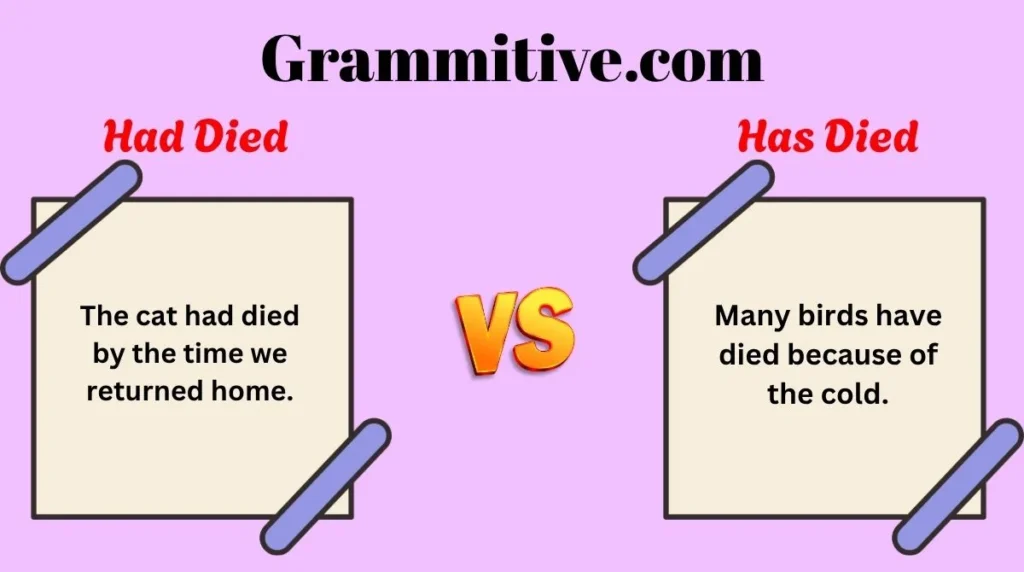
- The cat had died by the time we returned home.
- He had died when I reached the hospital.
- By last year, many soldiers had died in the war.
- The tree had died before the storm came.
- She realized her friend had died long ago.
- The patient had died before the doctor arrived.
- We didn’t know he had died until we read the newspaper.
Common Learner Confusion: Many students confuse “had died” with “has died.” Remember, “had died” is only used for past events relative to another past moment. It cannot be used for present situations.
What Does “Has Died” Mean?
Definition: “Has died” is the present perfect tense. It indicates that someone or something died at some point in the past, and the result affects the present.
When to Use:
- To talk about a recent death.
- To emphasize the result in the present.
- Often used in news, announcements, or personal conversations.
Grammar Rule:
- Structure: Subject + has/have + past participle (died)
- Example: “He has died recently.”
Examples:
- My uncle has died, so we are very sad.
- The famous actor has died this morning.
- She has died from illness.
- Many birds have died because of the cold.
- The plant has died because I forgot to water it.
- He has died, and everyone is mourning.
- Our dog has died; we miss him.
- The patient has died despite the doctors’ efforts.
Common Learner Confusion: Students often use “has died” with a past time marker like “yesterday” or “last year,” which is incorrect. Present perfect is for actions with present relevance, not specific past times.
What Does “Was Dead” Mean?
Definition: “Was dead” is the simple past tense using the adjective “dead.” It describes a state, not the action of dying.
When to Use:
- To describe the condition of being dead in the past.
- Often used in storytelling, novels, or historical events.
Grammar Rule:
- Structure: Subject + was/were + dead
- Example: “He was dead when we found him.”
Examples:
- The rabbit was dead when I found it.
- He was dead for hours before the ambulance arrived.
- The soldier was dead on the battlefield.
- By the time we reached, the fish was dead.
- She was dead after the accident.
- The candle was dead, so we lit a new one.
- The battery was dead, and the phone wouldn’t work.
- The tree was dead and needed to be removed.
Common Learner Confusion: Many learners confuse “was dead” with “had died.” “Was dead” describes a state in the past, while “had died” describes an action completed before another past action.
Difference Between Had Died, Has Died, and Was Dead
| Phrase | Tense | Meaning | Usage Example | Key Tip |
|---|---|---|---|---|
| Had Died | Past Perfect | Action completed before another past event | “He had died before I arrived.” | Use for past events relative to another past event |
| Has Died | Present Perfect | Action completed in past affecting present | “She has died recently.” | Use for recent deaths or news impacting present |
| Was Dead | Simple Past/State | Describes state of being dead in the past | “The cat was dead when I found it.” | Use to describe condition or state, not action |
Usage Difference:
- Had died focuses on sequence of past events.
- Has died focuses on result or news of a death in present.
- Was dead focuses on the state at a particular past moment.
Grammar Logic:
- “Had died” → past before past
- “Has died” → past affecting now
- “Was dead” → past state
Sentence Structure Difference:
- Had Died: Subject + had + past participle + past reference
- Has Died: Subject + has/have + past participle + optional present context
- Was Dead: Subject + was/were + dead + past description
Grammar Rules You Must Remember
Rule #1: Past Perfect Timeline
- Use “had died” to show an action finished before another past action.
- Example: “By the time we arrived, the bird had died.”
Rule #2: Present Perfect Relevance
- Use “has died” for actions in the past with present importance.
- Example: “The famous singer has died, and fans are mourning.”
Rule #3: State vs Action
- “Was dead” is about a state, not the action of dying.
- Example: “The phone was dead, so we couldn’t call anyone.”
Rule #4: Avoid Time Markers with Present Perfect
- Do not use exact past time like “yesterday” with “has died.”
- Correct: “He has died recently.”
- Wrong: “He has died yesterday.”
Common Mistakes Students Make
Mistake 1: Using “has died” for past time
- Wrong: “He has died last year.”
- Correct: “He died last year.”
Mistake 2: Using “was dead” as an action
- Wrong: “He was dead before the accident happened.” (sounds awkward)
- Correct: “He had died before the accident happened.”
Mistake 3: Mixing “had died” and “has died”
- Wrong: “He had died recently.” (past perfect + present relevance)
- Correct: “He has died recently.”
Tips to Correct:
- Ask yourself: “Am I talking about past before past, past affecting now, or past state?”
- Match tense to timeline.
- Practice with real-life examples.
Easy Trick to Remember the Difference
Think of a timeline:
- Past perfect (had died) → Action happened before another past event.
- Present perfect (has died) → Action happened in past but matters now.
- State (was dead) → Focus on condition in past, not the action.
Memory trick:
- HAD = history (past before past)
- HAS = happening (recent or relevant now)
- WAS = was-wait (state in the past)
Imagine telling a story:
- “By the time I got there, he had died.” (story past sequence)
- “He has died today.” (news, relevance now)
- “He was dead when I found him.” (state, story moment)
Daily Life Examples
- My grandmother had died before I could see her.
- He has died recently, and everyone is shocked.
- The car was dead after the accident.
- Our cat had died by the time we returned from vacation.
- She has died from illness, and the family is mourning.
- The phone was dead, so I couldn’t call my friend.
- Many soldiers had died before the ceasefire.
- The famous actor has died, reported on TV.
- The flowers was dead after a week without water.
- He had died peacefully before the doctor arrived.
Practice Section
Choose the correct option:
- By the time I got there, my dog _______. (had died / has died / was dead)
- The news said the singer _______ this morning. (had died / has died / was dead)
- When I checked the fridge, the milk _______. (had died / has died / was dead)
- Many birds _______ because of the cold last winter. (had died / has died / was dead)
- He _______ for hours before the ambulance arrived. (had died / has died / was dead)
Answers:
- had died
- has died
- was dead
- had died
- was dead
FAQs
1. What is the difference between “had died” and “has died”?
- “Had died” is past perfect, used for an action completed before another past event. “Has died” is present perfect, used for recent deaths with current relevance.
2. Can we use “has died” in questions?
- Yes, for example: “Has your uncle died?” This asks about a death with relevance now.
3. Is “was dead” formal or informal?
- It is neutral. You can use it in stories, news, or daily conversation to describe past states.
4. Can I say “He had died yesterday”?
- No. Use “He died yesterday” or “He has died recently” depending on context.
5. How to know if I should use “was dead” or “had died”?
- Use “was dead” for past state description. Use “had died” when showing sequence of past events.
6. Can “has died” be used for historical events?
- Typically no, unless the death has current relevance. For historical events, use simple past or past perfect.
Conclusion
Understanding “had died,” “has died,” and “was dead” is easier when you focus on time and state. Remember:
“had died” = past before past, “has died” = past affecting now, and “was dead” = past state. Start noticing these phrases in stories, news, and conversations.
Practice forming sentences with each one. Over time, you will instinctively know which phrase to use, and your English will sound much more natural and confident.
Keep practicing, and don’t worry if you make small mistakes—they are part of learning.

I am Lucas Bennett, a digital content creator passionate about social media trends and online growth strategies.
I share practical insights and guides to help users better understand and navigate the digital world.