
English spelling can be tricky. Some words sound exactly the same but are written differently. Others look almost correct but are actually mistakes. One pair that confuses many learners is greatful or grateful.
At first glance, both words seem possible. After all, “great” is a real word. So it feels natural to write greatful when you want to say you feel thankful or happy.
Many students think, “I feel great, so maybe greatful makes sense.” That logic sounds reasonable.
But English does not always follow logic.
This small spelling mistake appears everywhere — in school essays, emails, social media posts, and even job applications.
A tiny error like this can make your writing look less professional. That’s why it’s important to understand the correct form clearly.
When you finish reading, you will know:
- which spelling is correct
- why one form is wrong
- how to use the correct word in real life
- easy tricks to remember it forever
By the end, you won’t hesitate again. You’ll write it naturally and confidently, just like a native speaker.
What Does “Greatful” Mean?
Here’s the simple truth first:
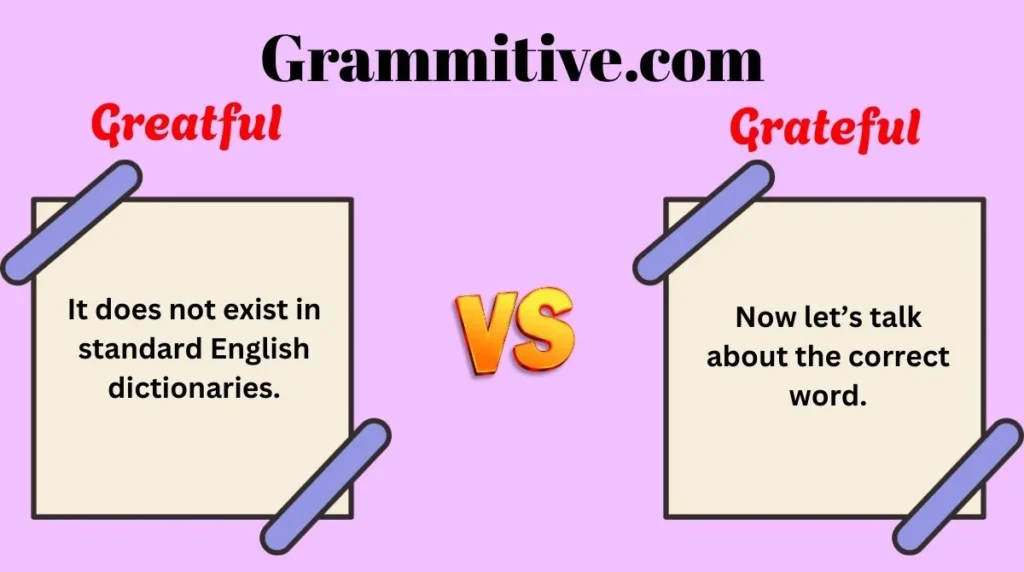
“Greatful” is NOT a correct English word.
It does not exist in standard English dictionaries.
It is only a spelling mistake of grateful.
Why do people write “greatful”?
Because of the word great.
Learners think:
- great = good
- feeling good = thankful
- so maybe great + ful = greatful
It sounds logical, but English history doesn’t work that way. The word grateful does not come from great. It comes from a different root word called gratitude.
So writing greatful is simply incorrect spelling.
When should you use it?
Never.
There is no situation where greatful is correct.
If you use it in:
- essays
- exams
- emails
- professional writing
it will be marked as wrong.
Grammar rule
Because the word is incorrect, it has no grammar use.
Example sentences (incorrect on purpose)
These sentences show common learner mistakes:
❌ I am greatful for your help.
❌ She felt greatful to her teacher.
❌ We are greatful for the gift.
❌ He was greatful that he passed.
❌ They sent a greatful message.
❌ I will always be greatful.
❌ She smiled greatfully.
❌ We feel very greatful today.
All of these are wrong.
Common learner confusion
Students often say:
- “But ‘great’ is positive, so why not?”
- “I see many people spell it this way online.”
Remember: just because many people use it doesn’t mean it’s correct.
Spelling mistakes spread quickly on the internet.
Always trust dictionaries and grammar rules, not random posts.
What Does “Grateful” Mean?
Now let’s talk about the correct word.
Simple definition
Grateful means:
👉 feeling thankful
👉 feeling thankful for kindness or help
👉 appreciating something good
In easy words: happy and thankful in your heart.
When to use it
Use grateful when:
- someone helps you
- you receive a gift
- you feel thankful
- something good happens
- you appreciate life
Word family
This helps you understand it better:
- gratitude (noun)
- grateful (adjective)
- gratefully (adverb)
- ungrateful (opposite)
See the connection?
They all start with grat-, not great-.
Grammar rule
Grateful = adjective
It describes feelings.
Structure:
- be + grateful
- feel + grateful
- grateful + for + noun
- grateful + to + person
Example sentences
✅ I am grateful for your support.
✅ She felt grateful to her parents.
✅ We are grateful for this opportunity.
✅ He was grateful that he got a second chance.
✅ They sent a grateful message.
✅ I’m truly grateful for everything.
✅ She smiled gratefully.
✅ The team felt grateful to their coach.
These all sound natural and correct.
Common learner confusion
Students sometimes mix:
- grateful
- great
- gratitude
They look similar, but meanings are different.
Think of this:
great = big/good
grateful = thankful
gratitude = thankfulness
Once you separate them in your mind, it becomes easier.
Difference Between Greatful and Grateful (Detailed)
Here’s the clear comparison.
Quick comparison table
| Feature | Greatful | Grateful |
|---|---|---|
| Is it real English? | ❌ No | ✅ Yes |
| Dictionary word? | ❌ No | ✅ Yes |
| Meaning | None | Thankful |
| Part of speech | None | Adjective |
| Correct for exams? | ❌ No | ✅ Yes |
| Professional writing | ❌ Never | ✅ Always |
Usage difference
There is actually no “usage difference,” because only one word exists.
- greatful → spelling error
- grateful → correct word
Grammar logic
The word comes from:
gratitude → grateful
NOT
great → greatful
So the spelling follows the root grat-.
English often keeps the same root spelling:
- create → creative
- nature → natural
- gratitude → grateful
Notice the pattern.
Sentence structure difference
Correct:
- I am grateful for you.
- She felt grateful to him.
Incorrect:
- I am greatful for you.
Meaning comparison
| Word | Meaning |
|---|---|
| grateful | thankful |
| great | big, excellent |
| greatful | no meaning |
This is why “greatful” doesn’t work logically.
Grammar Rules You Must Remember
Rule #1: Use “grateful,” never “greatful”
Correct: I am grateful.
Wrong: I am greatful.
Rule #2: Use “grateful for” things
Correct: I’m grateful for the gift.
Wrong: I’m grateful of the gift.
Rule #3: Use “grateful to” people
Correct: She is grateful to her teacher.
Wrong: She is grateful for her teacher. (sounds less natural)
Rule #4: Use it as an adjective, not a verb
Correct: I feel grateful.
Wrong: I grateful you.
Remember, you feel grateful.
Common Mistakes Students Make
Why mistakes happen
Most problems come from:
- pronunciation (sounds like “great”)
- fast typing
- autocorrect mistakes
- guessing spelling
- copying others online
Wrong vs Correct examples
❌ I’m very greatful today.
✅ I’m very grateful today.
❌ She is greatful to you.
✅ She is grateful to you.
❌ We feel greatful for this chance.
✅ We feel grateful for this chance.
Easy correction tips
Tip 1: Think of gratitude
Tip 2: Remember no “great” inside
Tip 3: Double-check spelling when writing emails
A small check saves embarrassment later.
Easy Trick to Remember the Difference
Here’s a simple memory trick students love.
The “Thank You” Trick
Think:
GRATeFUL → GRATitude → THANKFUL
Both start with grat.
So:
grat = thanks
If you see “great,” that means big or excellent, not thankful.
Another fun way:
“Be grateful, not great-ful.”
Thankfulness comes from the heart, not size.
Say it a few times and it sticks.
Daily Life Examples (Very Important)
These are natural spoken English sentences you might hear every day:
- I’m really grateful for your help today.
- Thanks, I’m so grateful.
- She felt grateful after the doctor helped her.
- We’re grateful to everyone who supported us.
- I’m grateful you called me.
- He looked grateful when we surprised him.
- I’ll always be grateful for my parents.
- They sent a grateful thank-you note.
- I feel grateful just to be alive.
- She said, “I’m truly grateful, thank you.”
These sound warm and human. Native speakers use them often.
Practice Section
Choose the correct word.
- I am ______ for your kindness.
- She felt ______ to her team.
- We are ______ for this chance.
- He wrote a ______ message.
- They were ______ for the support.
Answers
- grateful
- grateful
- grateful
- grateful
- grateful
(Notice: never greatful)
FAQs (SEO Focused)
1. What is the difference between greatful and grateful?
Greatful is a spelling mistake and not a real word. Grateful is correct and means thankful or appreciative. Always use grateful in writing.
2. Is greatful ever correct in English?
No. It is never correct. Dictionaries do not recognize it. Teachers and exams will mark it wrong.
3. Can we use grateful in questions?
Yes. Example: “Are you grateful for the help?” It works normally in questions, statements, and negatives.
4. Is grateful formal or informal?
It works in both. You can use it in casual speech and formal emails. It’s a very natural and polite word.
5. Why do people spell grateful as greatful?
Because it sounds similar to “great” and people guess the spelling. But the word comes from gratitude, not great.
6. What is the noun form of grateful?
The noun is gratitude. Example: “She showed her gratitude.” It means thankfulness.
Final Conclusion
Small spelling mistakes can change how people see your English. The confusion between greatful or grateful is very common, but the solution is simple once you understand the root.
Only one word is correct: grateful.
It means thankful, appreciative, and happy for kindness. The wrong form, greatful, has no place in proper English.
Think about gratitude whenever you write it. That connection helps your brain remember the correct spelling naturally.
Try using grateful in daily conversations. Say it out loud. Write it in sentences. The more you practice, the faster it becomes automatic.
Good English is not about big words. It’s about clear and correct ones. And now you’ve mastered another tricky spelling.
That’s something to feel grateful for.

I am Lucas Bennett, a digital content creator passionate about social media trends and online growth strategies.
I share practical insights and guides to help users better understand and navigate the digital world.