
English can be tricky in small, sneaky ways.
Sometimes the problem is not grammar rules or verb tenses. Sometimes it’s just one tiny letter.
Take this simple family word:
Should you write granddad or grandad?
Many English learners stop and think, “Which one is correct?”
Some dictionaries show both. Movies use both. Books use both. Even native speakers mix them up.
That can feel confusing.
You might worry:
- Is one wrong?
- Is one British and one American?
- Does one sound childish?
- Which one should I use in exams or writing?
These questions are very normal.
Family words like this are used every day in real life. You say them at home, in messages, in stories, and in conversations. So using the right form helps you sound more natural and confident.
By the end of this guide, you will clearly understand:
- the meaning of each word
- spelling differences
- where each is commonly used
- grammar rules
- mistakes to avoid
- easy memory tricks
- and plenty of real-life examples
After reading, you won’t hesitate again. You’ll simply know which one feels right.
What Does “Granddad” Mean?
Simple definition
Granddad means grandfather.
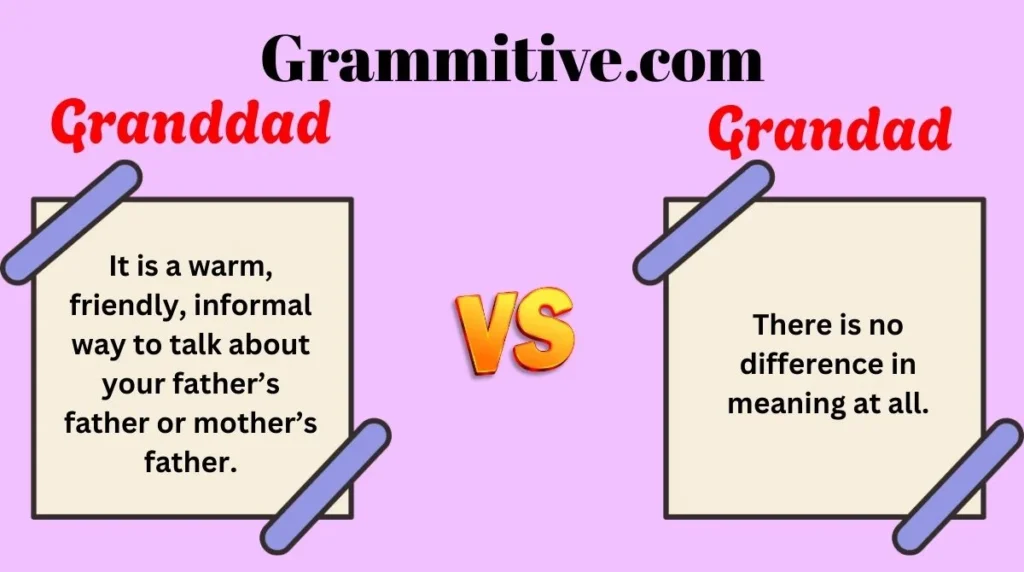
It is a warm, friendly, informal way to talk about your father’s father or mother’s father.
It sounds loving and personal.
Children use it a lot.
Adults use it too when speaking casually.
When to use it
Use granddad:
- in everyday speech
- in family conversations
- in stories
- when talking to children
- when you want a cozy, emotional tone
It is not very formal.
You usually don’t use it in official writing.
Grammar rule
It is a countable noun.
Forms:
- singular → granddad
- plural → granddads
- possessive → granddad’s / granddads’
Example sentences
- My granddad tells the best stories.
- We visit our granddad every Sunday.
- Granddad taught me how to fish.
- My granddad loves gardening.
- I called my granddad last night.
- Her granddad makes amazing cookies.
- The kids ran to their granddad.
- My granddad’s old watch is very special to me.
Common learner confusion
Many students think granddad is American only.
That’s not true.
Both Americans and British people use it.
It’s simply one spelling style.
Some learners also think it sounds childish. But adults use it too. It’s just affectionate, not childish.
What Does “Grandad” Mean?
Simple definition
Grandad also means grandfather.
Yes — exactly the same meaning.
There is no difference in meaning at all.
It is just a different spelling.
When to use it
Use grandad:
- in casual speech
- in friendly writing
- especially in British English
- in family stories or memories
This spelling is very common in the UK, Australia, and some other regions.
Grammar rule
It works the same way as granddad.
- singular → grandad
- plural → grandads
- possessive → grandad’s
Example sentences
- My grandad lives near the sea.
- We had dinner at my grandad’s house.
- Grandad used to work on a farm.
- I learned chess from my grandad.
- My grandad watches the news every night.
- Their grandad is 85 years old.
- Grandad fixed my bike yesterday.
- She baked a cake for her grandad.
Common learner confusion
Students often think:
- grandad is wrong spelling
- or it’s a typo
But it is 100% correct.
It’s simply shorter and very common in British English.
So don’t “correct” it automatically. It’s valid.
Difference Between Granddad and Grandad (Detailed)
Here’s the important truth:
They mean the same thing.
The difference is mainly spelling and regional style.
Quick comparison table
| Feature | Granddad | Grandad |
|---|---|---|
| Meaning | Grandfather | Grandfather |
| Formality | Informal | Informal |
| Common in | US + UK | UK + Commonwealth |
| Spelling style | Double “d” | Single “d” |
| Tone | Warm/family | Warm/family |
| Grammar | Same | Same |
Usage difference
In the United States:
- granddad is more common
In the United Kingdom:
- grandad is often more common
But people understand both everywhere.
Grammar logic
Both come from:
grand + dad
Over time:
- some people kept both d’s → granddad
- some shortened it → grandad
English often simplifies spellings.
So both forms stayed.
Sentence structure difference
There is no grammar difference.
You can replace one with the other:
- My granddad is funny.
- My grandad is funny.
Both are correct.
Meaning comparison
Emotion and meaning are identical.
Both feel:
- loving
- friendly
- personal
- family-focused
Not formal or academic.
Grammar Rules You Must Remember
Rule #1 – They are informal nouns
Use them in casual situations.
✔ I love my granddad.
✘ I would like to introduce my granddad in a business report.
For formal writing, use grandfather.
Rule #2 – Use capital letters only as a name
✔ I visited Grandad today. (used like a name)
✔ My grandad is here. (common noun)
Same rule as mom or dad.
Rule #3 – Plurals add “s”
✔ My granddads were both teachers.
✔ Her grandads served in the army.
Never add “es”.
Rule #4 – Possessive form uses apostrophe
✔ My granddad’s hat
✔ My grandad’s car
Shows ownership.
Common Mistakes Students Make
Mistake 1: Thinking one is wrong
✘ “Grandad is incorrect.”
✔ Both are correct.
Tip: Check region, not correctness.
Mistake 2: Using them in formal essays
✘ My granddad influenced my career path. (academic essay)
Better:
✔ My grandfather influenced my career path.
Tip: Use formal words in formal writing.
Mistake 3: Spelling mix
✘ grandadad
✘ grand-dad
✘ grand dad
Correct:
✔ granddad or grandad
Tip: One word only.
Mistake 4: Capitalizing randomly
✘ My Granddad is nice.
Correct:
✔ My granddad is nice.
✔ I love you, Granddad.
Easy Trick to Remember the Difference
Here’s a simple memory trick.
Think about location.
Double “d” → Double strong sound → America
Single “d” → Shorter → Britain
It’s not a strict rule, but it helps you remember patterns.
Or even easier:
Ask yourself:
“Do I normally write British or American English?”
Then choose that spelling and stay consistent.
Consistency matters more than choice.
Daily Life Examples (Very Important)
These are natural spoken sentences you may hear every day.
- My granddad picks me up from school.
- Grandad makes the best pancakes.
- I’m going fishing with my granddad tomorrow.
- Did you call your grandad yet?
- My granddad always falls asleep in the chair.
- Grandad told that joke again!
- We spent the holidays at our granddad’s farm.
- I really miss my grandad.
- My granddad taught me how to drive.
- Let’s visit grandad this weekend.
Notice how relaxed and friendly they sound.
These are everyday family sentences.
Practice Section
Choose the correct option.
1
My ______ lives in London.
A) granddad
B) grandad
2
I love my ______’s stories.
A) granddad
B) granddad’s
3
We visited both our ______ last summer.
A) grandads
B) grandad
4
______ taught me chess. (used like a name)
A) grandad
B) Grandad
5
For a formal report, use ______.
A) granddad
B) grandfather
Answers
1 → B
2 → B
3 → A
4 → B
5 → B
FAQs
What is the difference between granddad and grandad?
There is no difference in meaning. Both mean grandfather. The difference is mainly spelling and regional preference. Granddad is more common in American English, while grandad is popular in British English.
Which spelling is correct?
Both are correct. Dictionaries accept both. Choose one and use it consistently.
Can we use granddad or grandad in formal writing?
No. These words are informal. In formal situations, use grandfather instead.
Is grandad British English?
Yes, it is more common in British English. But people in other countries understand it too.
Can adults say granddad or only children?
Adults use it all the time. It sounds warm and affectionate, not childish.
What is the plural form?
Add “s”:
granddads or grandads.
Both are correct depending on your spelling choice.
Final Conclusion
Small spelling differences can create big confusion, especially when you’re learning English.
Granddad and grandad are a perfect example.
They look different but mean the same thing. Both are friendly, warm words for grandfather. The choice mostly depends on region or personal habit, not grammar rules.
If you write American English often, granddad will feel natural. If you follow British English, grandad may look better. Either way, people will understand you.
The most important thing is consistency and using the right tone. For casual family talk, these words are perfect. For formal writing, switch to grandfather.
Practice using them in sentences. Say them out loud. Write small stories about your family.
Soon, choosing the right spelling will feel easy and automatic.
English gets simpler when you notice these small patterns.

I am Lucas Bennett, a digital content creator passionate about social media trends and online growth strategies.
I share practical insights and guides to help users better understand and navigate the digital world.