
English looks simple at first. Short words. Easy verbs. Basic sentences. But then small phrases start causing big confusion.
One classic example is “good for me” and “good to me.”
Many learners mix them up every day.
You might hear:
- “My friend is good for me.”
- “My friend is good to me.”
Both sound correct. Both use the same words. Only one small preposition changes — for or to.
Yet the meaning changes completely.
This is why students feel unsure. They stop speaking. They think too much before talking. And sometimes they choose the wrong phrase.
The problem is not grammar difficulty. It’s meaning.
These two expressions talk about different ideas:
- One talks about benefit or health
- The other talks about kindness or behavior
Once you see this difference, everything becomes clear.
By the end of this guide, you will:
- understand both phrases easily
- know when to use each one
- stop translating from your first language
- speak naturally and confidently
- avoid common mistakes
Think of this like a friendly classroom lesson. Slow, simple, and practical. No complicated grammar terms. Just clear English you can use right away.
What Does “Good for Me” Mean?
Simple meaning
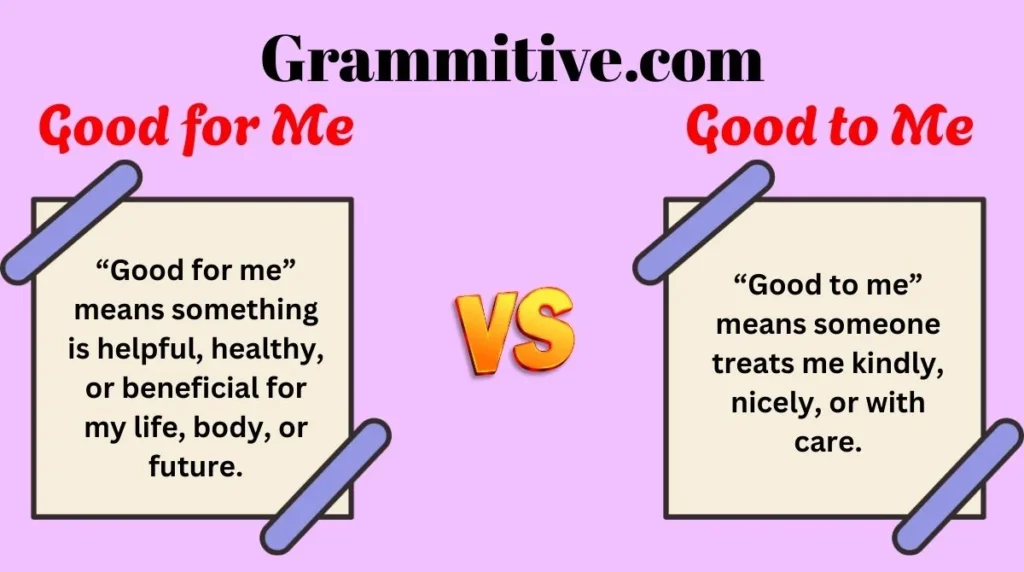
“Good for me” means something is helpful, healthy, or beneficial for my life, body, or future.
It focuses on results or effects.
If something improves your health, mind, money, or success, it is good for you.
When to use it
Use this phrase when talking about:
- health
- food
- habits
- choices
- exercise
- advice
- things that help your life
It is about benefit, not behavior.
Grammar rule
Structure:
Subject + be + good for + person/thing
Examples:
- This is good for me.
- Running is good for your heart.
- Water is good for plants.
Notice: we use for, not to.
Example sentences
- Vegetables are good for me.
- Morning walks are good for your health.
- Drinking water is good for your skin.
- This job is good for my career.
- Reading daily is good for the brain.
- Yoga is good for stress.
- Saving money is good for the future.
- This break is good for me. I feel relaxed.
Common learner confusion
Students sometimes say:
❌ My teacher is good for me.
(Do you mean helpful or kind?)
This sentence is unclear.
If you mean the teacher helps you grow, it can work.
But if you mean the teacher treats you kindly, then you must use good to me.
So remember:
Good for = benefit or effect
What Does “Good to Me” Mean?
Simple meaning
“Good to me” means someone treats me kindly, nicely, or with care.
It talks about behavior, not benefit.
It describes how a person acts toward you.
When to use it
Use this phrase when talking about:
- kindness
- respect
- love
- polite behavior
- friendly actions
This phrase is often about people, not things.
Grammar rule
Structure:
Subject + be + good to + person
Examples:
- She is good to me.
- He was good to his parents.
We use to because it shows direction of behavior toward someone.
Example sentences
- My grandmother is always good to me.
- The nurse was very good to the patient.
- He has been good to his dog.
- My boss is good to all employees.
- She was good to me when I was sick.
- Please be good to your little sister.
- They were good to us during our visit.
- Thank you for being good to me.
Common learner confusion
Students often say:
❌ Milk is good to me.
This sounds strange because milk cannot show kindness.
Milk helps your body, so it is:
✅ Milk is good for me.
So remember:
Good to = behavior or treatment
Difference Between Good for Me and Good to Me (Detailed)
This is where everything becomes crystal clear.
Quick comparison table
| Feature | Good for me | Good to me |
|---|---|---|
| Meaning | Helpful/beneficial | Kind/nice behavior |
| Focus | Result/effect | Action/behavior |
| Usually used for | Things, habits, food | People |
| Question answered | Does it help me? | How do they treat me? |
| Preposition logic | Benefit for someone | Action to someone |
Usage difference
If something improves your life, use for.
If someone treats you nicely, use to.
Compare:
- Exercise is good for me. (health benefit)
- My trainer is good to me. (kind behavior)
Grammar logic
Think about direction.
For → benefit goes toward you
To → action goes toward you
So:
- The medicine works for you → good for you
- The nurse acts kindly to you → good to you
Sentence structure difference
Good for:
- This food is good for children.
- Studying is good for success.
Good to:
- She is good to children.
- He was good to me.
Notice that good to usually needs a person or living thing.
Meaning comparison
Look at these two sentences:
- My job is good for me.
→ It helps my career or money. - My boss is good to me.
→ My boss treats me kindly.
Same idea of “good,” but completely different meanings.
Grammar Rules You Must Remember
Rule #1 – Use “for” with benefits
If something helps your health, life, or success → use for.
Example:
Swimming is good for your lungs.
Rule #2 – Use “to” with behavior
If someone treats another person nicely → use to.
Example:
She is always good to her neighbors.
Rule #3 – Things usually use “for”
Objects or habits rarely use to.
Example:
Sleep is good for you.
(not “good to you”)
Rule #4 – People can use both (but meaning changes)
This is important.
A person can be good for you OR good to you, but the meaning changes.
Example:
- He is good for you. → He improves your life
- He is good to you. → He treats you kindly
Common Mistakes Students Make
Why mistakes happen
The problem comes from:
- direct translation
- similar words
- same adjective “good”
- small prepositions
Tiny words cause big errors.
Mistake 1
❌ Chocolate is good to me.
✅ Chocolate is good for me.
Chocolate cannot be kind. It only affects your health.
Mistake 2
❌ My parents are good for me.
(usually wrong meaning)
If you mean they treat you kindly:
✅ My parents are good to me.
Mistake 3
❌ He is good for everyone. (when you mean kind)
Better:
✅ He is good to everyone.
Easy correction tips
Ask yourself:
- Is this about help or benefit? → for
- Is this about kindness or behavior? → to
If unsure, replace “good” with:
- helpful → for
- kind → to
It works almost every time.
Easy Trick to Remember the Difference
Here’s a simple classroom trick students love.
Think:
F = Fitness → good for health
T = Treatment → good to people
So:
- Fitness → for
- Treatment → to
Another way:
Imagine arrows.
- Benefit flows for you
- Behavior goes to you
Visual thinking makes it easy to remember during conversation.
Daily Life Examples (Very Important)
These are sentences you will actually hear in real life.
- Drinking water is good for you.
- My dog is always good to me.
- This app is good for learning English.
- The teacher was good to the new student.
- Taking breaks is good for your mind.
- My sister is good to everyone.
- This chair is not good for my back.
- He has always been good to his family.
- Fresh air is good for children.
- The nurse was very good to my grandfather.
Try reading these out loud. They sound natural and everyday.
Practice Section
Choose for or to.
- Milk is good ___ bones.
- She is always good ___ her friends.
- Exercise is good ___ stress.
- My neighbor is good ___ me.
- This course is good ___ beginners.
Answers
- for
- to
- for
- to
- for
FAQs
What is the difference between good for me and good to me?
“Good for me” means helpful or beneficial. “Good to me” means someone treats you kindly. One is about results, the other about behavior.
Can we use both with people?
Yes. But the meaning changes.
“He is good for me” means he improves your life.
“He is good to me” means he treats you kindly.
Can we use “good to” with things?
Usually no. Things cannot show kindness. Use “good for” with food, habits, or objects.
Is one more formal than the other?
Both are common and natural in daily English. They are used in casual and formal speech.
Why do learners confuse these phrases?
Because both use “good” and only the preposition changes. Many languages don’t make this difference, so students translate directly.
Can I replace them with other words?
Yes.
Good for → helpful, healthy, beneficial
Good to → kind, nice, caring
These synonyms help check your sentence.
Final Conclusion
Small grammar points often create the biggest stress. A tiny word like for or to can change your whole message.
But once you understand the logic, everything feels simple.
Remember the heart of it:
- good for = benefit
- good to = kindness
Think about health versus behavior. Help versus treatment. Fitness versus treatment. The meaning becomes clear right away.
Try using these phrases in your daily life. Speak them out loud. Make your own examples. Notice how native speakers use them in movies and conversations.
With practice, you won’t need to think anymore. You’ll just say the correct one naturally.
That’s when grammar becomes real English — not rules, but habit.
Keep learning step by step. Small improvements every day lead to big confidence.

I am Lucas Bennett, a digital content creator passionate about social media trends and online growth strategies.
I share practical insights and guides to help users better understand and navigate the digital world.