

Many English learners feel confused when they hear sentences like:
- “We’re going to the beach.”
- “We go to school every day.”
- “Let’s go to bed.”
Then suddenly someone asks, “Can we say go to beach?”
Now everything feels messy.
Sometimes English uses the. Sometimes it doesn’t. There seems to be no clear rule. You might wonder:
Why do we say go to the beach but go to school?
Why not go to beach?
This small word “the” causes big headaches for learners. Even advanced students make mistakes with articles (a, an, the).
And in daily conversation, native speakers use these phrases all the time. So if you use the wrong form, it sounds strange or unnatural.
The good news is that this topic is not as scary as it looks. There is a clear reason behind it. Once you understand the grammar and the meaning difference, it becomes simple and logical.
By the end, you will clearly know:
- Why go to the beach is correct
- Why go to beach sounds wrong
- When we drop “the” in similar phrases
- Easy tricks to remember the rule
- How native speakers really talk
Everything will feel natural, not confusing.
What Does “Go to the Beach” Mean?
Simple meaning
“Go to the beach” means:
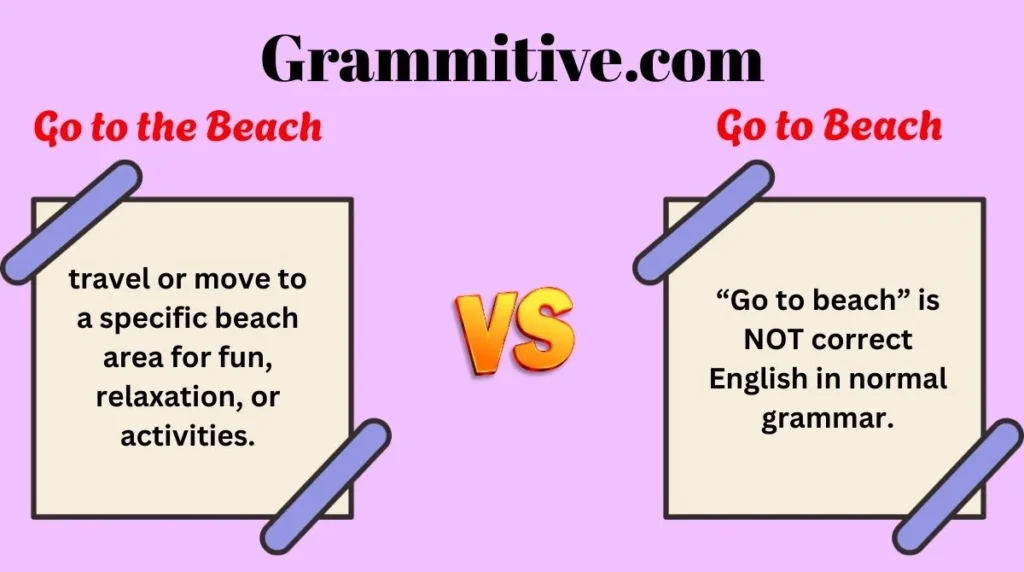
👉 travel or move to a specific beach area for fun, relaxation, or activities.
It talks about a real place — sand, water, sun, waves.
When to use it
Use this phrase when:
- talking about visiting a beach
- going for swimming, walking, or relaxing
- speaking about a physical location
Grammar rule
“Beach” is a countable common noun.
Countable nouns usually need:
- a/an
- the
- my/your
- or another determiner
So we normally cannot say “go to beach” alone.
We must say:
- the beach
- a beach
- this beach
- that beach
Examples
- We are going to the beach this weekend.
- She goes to the beach every summer.
- Let’s go to the beach after lunch.
- They drove to the beach at sunset.
- I love walking on the beach in the morning.
- The kids want to go to the beach today.
- We went to the beach for a picnic.
- He runs to the beach every evening.
Common learner confusion
Students often think:
“Beach is a place like school or home, so maybe no article?”
But that’s not how English works.
“Beach” is not a special institution like school or hospital. It’s simply a normal place, so it needs an article.
That’s why go to the beach sounds natural, and go to beach sounds incomplete.
What Does “Go to Beach” Mean?
Simple meaning
Here’s the important truth:
👉 “Go to beach” is NOT correct English in normal grammar.
It doesn’t have a proper meaning.
It sounds broken or unfinished.
Native speakers never say this in everyday conversation.
Why it sounds wrong
Because:
- “Beach” is countable
- Countable nouns need an article
- No article = grammar mistake
So the phrase feels like something is missing.
It’s like saying:
- ❌ I bought car
- ❌ She went to park
- ❌ We visited museum
They all sound incomplete.
Correct versions
Instead, you must say:
- go to the beach
- go to a beach
- go to that beach
- go to my favorite beach
Examples (corrected)
Instead of:
❌ We go to beach every Sunday.
Say:
✅ We go to the beach every Sunday.
Instead of:
❌ They went to beach yesterday.
Say:
✅ They went to the beach yesterday.
Common learner confusion
Learners notice phrases like:
- go to school
- go to bed
- go to work
So they think:
“Maybe beach works the same way?”
But those words are special cases. Beach is not one of them.
So the rule is different.
Difference Between Go to the Beach and Go to Beach (Detailed)
Here is a clear comparison:
| Feature | Go to the beach | Go to beach |
|---|---|---|
| Grammar | Correct | Incorrect |
| Article used | Yes (the) | No |
| Natural English | Yes | No |
| Sounds complete | Yes | No |
| Used by natives | Always | Never |
| Meaning | Visit a beach | No clear meaning |
Usage difference
Go to the beach → normal, correct, everyday phrase
Go to beach → grammar mistake
Grammar logic
English rule:
👉 Countable singular nouns need determiners.
Beach = countable
So it needs the / a / my / this
Sentence structure
Correct:
Subject + go + to + the + noun
Example:
We go to the beach.
Wrong:
Subject + go + to + noun (no article)
Example:
❌ We go to beach.
Meaning comparison
There is no special meaning difference. One is simply correct; the other is incorrect.
Grammar Rules You Must Remember
These rules will help you not only with “beach,” but many other nouns too.
Rule #1 — Countable nouns need an article
Example:
- I saw the beach.
- She cleaned the room.
Never say:
❌ I saw beach.
Rule #2 — Use “the” for specific places
When you talk about a real, known place, use the.
Example:
- the beach
- the park
- the mall
Sentence:
We are going to the park.
Rule #3 — Some places drop the article (special cases)
Certain words act differently:
- go to school
- go to bed
- go to work
- go home
These are institutional uses, not physical places.
Example:
I go to school. (student purpose, not building)
But:
I went to the school to meet the teacher. (specific building)
Rule #4 — If unsure, use “the”
This trick works most of the time.
If you feel confused, adding the is usually safer.
Example:
go to the beach
go to the store
go to the market

Common Mistakes Students Make
Why mistakes happen
- They translate directly from their language
- They copy patterns like “go to school”
- They forget article rules
Wrong vs Correct
❌ Let’s go to beach.
✅ Let’s go to the beach.
❌ We walked to beach.
✅ We walked to the beach.
❌ They are going beach tomorrow.
✅ They are going to the beach tomorrow.
Easy correction tips
- Always check: Is the noun countable?
- If yes, add “the”
- Say the sentence aloud — does it sound complete?
Practice helps a lot.
Easy Trick to Remember the Difference
Here’s a simple memory trick.
Think:
👉 Can you count it? Then use “the.”
Can you count beaches?
Yes.
One beach, two beaches.
So → use the beach
But:
- school (activity)
- bed (purpose)
These are more like actions, not objects.
So no article.
Real-life logic
If you can touch or see the place like a normal location, you usually need “the”.
Beach = sand + water → real place → use “the”.
Very simple.
Daily Life Examples (Spoken English)
These are natural sentences you will hear every day.
- Do you want to go to the beach today?
- We’re going to the beach after work.
- They went to the beach early to avoid the crowd.
- Let’s go to the beach and watch the sunset.
- I love going to the beach with my family.
- Are you going to the beach this weekend?
- We packed food before going to the beach.
- She runs to the beach every morning.
- They spent the whole day at the beach.
- Kids are excited to go to the beach tomorrow.
Notice something?
Every sentence uses the beach.
Never just “beach”.
Practice Section
Choose the correct option.
Questions
- We are going to (beach / the beach).
- Let’s go to (beach / the beach) after dinner.
- They walked to (beach / the beach).
- I love relaxing at (beach / the beach).
- Are you going to (beach / the beach) tomorrow?
Answers
- the beach
- the beach
- the beach
- the beach
- the beach
All answers use the beach.
FAQs
1. What is the difference between go to the beach and go to beach?
“Go to the beach” is correct grammar. “Go to beach” is incomplete and wrong because beach needs an article.
2. Can we ever say go to beach without “the”?
No. In standard English, you always need an article: the beach, a beach, my beach, etc.
3. Why do we say go to school but go to the beach?
School can mean an activity (studying), so the article disappears. Beach is only a place, so it needs “the.”
4. Is go to the beach formal or informal?
It works in both. You can use it in everyday speech or writing.
5. Can I say go to a beach?
Yes. Use “a beach” when it is not specific. Example: We found a beach near the hotel.
6. Do all places need “the”?
Most countable places do: the park, the store, the cinema. Only special institutional nouns sometimes drop it.
Final Conclusion
Small grammar words like “the” look tiny, but they make a big difference in English. Many learners struggle with articles because there isn’t always a simple rule. Still, this case is actually easy once you see the logic.
Beach is a normal, countable place. So it needs an article. That’s why go to the beach sounds natural and complete, while go to beach sounds broken and incorrect.
Whenever you talk about visiting a physical place like a park, beach, or mall, remember to use the. If you feel unsure, adding “the” is usually the safe choice.
Practice saying full sentences out loud. Listen to native speakers. Over time, it will feel automatic.
Soon you won’t even think about the rule. Your brain will just know what sounds right.
And that’s when real English starts to feel easy.

I am Lucas Bennett, a digital content creator passionate about social media trends and online growth strategies.
I share practical insights and guides to help users better understand and navigate the digital world.