

English learners often get confused when choosing between “go home” and “go to home.” Both phrases seem to talk about returning to a house, but they are not the same.
Many students make mistakes because the rules behind these phrases are subtle but very important.
Misusing them can make your English sound unnatural, even if the meaning is clear.
In everyday conversation, native speakers say “go home” almost all the time. Using “go to home” sounds odd or incorrect.
Understanding this difference helps you speak naturally, write correctly, and avoid embarrassing mistakes.
Once you know the rules, you will use these phrases like a native speaker without thinking.
After reading this guide, you will clearly understand:
- The correct meaning and use of “go home.”
- Why “go to home” is usually wrong.
- Grammar rules behind these phrases.
- Common mistakes and how to fix them.
- Easy tricks to remember the difference.
- Real-life examples and practice sentences.
By the end, you will feel confident using these expressions in daily life, at work, or in school. You will also know why some common errors happen and how to avoid them.
What Does “Go Home” Mean?
Simple Definition
“Go home” means moving from your current place to your own home or the place where you live. It is a complete idea by itself and does not need “to.” Native speakers always say “go home,” not “go to home.”
When to Use It
Use “go home” when you are returning to your house, apartment, or residence. You can also use it for other people if it is clear whose home you mean (e.g., “I will go home to my parents’ house”).
Grammar Rule
“Home” is a special noun called an adverbial noun in English. This means it can act like an adverb of place. When we use it with verbs like “go,” “come,” or “run,” we do not need a preposition like “to.”
Example Sentences
- I want to go home after school.
- She goes home every evening at 6 PM.
- They went home because it was raining.
- We are going home now.
- He didn’t feel well, so he went home early.
- Can I go home for lunch?
- After the party, everyone went home.
- I just want to go home and sleep.
Common Learner Confusion
Many learners think every place requires “to,” like in “go to school” or “go to the park.” But “home” is an exception. Saying “go to home” is grammatically incorrect, even though it may sound understandable.
What Does “Go to Home” Mean?
Simple Definition
Technically, “go to home” is trying to add the preposition “to” before “home.” In standard English, this is wrong. English does not use “to” with the word “home” when talking about movement toward it.
When Learners Might Use It
Students often use “go to home” because:
- They learned “go to” for other places (e.g., “go to school,” “go to the market”).
- They are translating directly from their native language.
- They are not aware that “home” is special.
Grammar Rule
“Home” is treated as already directional, so you don’t need “to.” Adding “to” is unnecessary and incorrect. Only use “to” if you describe a specific house, like “go to my home” or “go to John’s home.”
Example Sentences
- ❌ I will go to home after work. (Incorrect)
- ✅ I will go home after work. (Correct)
- ❌ She is going to home now. (Incorrect)
- ✅ She is going home now. (Correct)
- ❌ They went to home yesterday. (Incorrect)
- ✅ They went home yesterday. (Correct)
Common Learner Confusion
Many beginners overgeneralize the “go to” rule and try to attach it to every place. Remember: “home” is different because it is inherently directional.
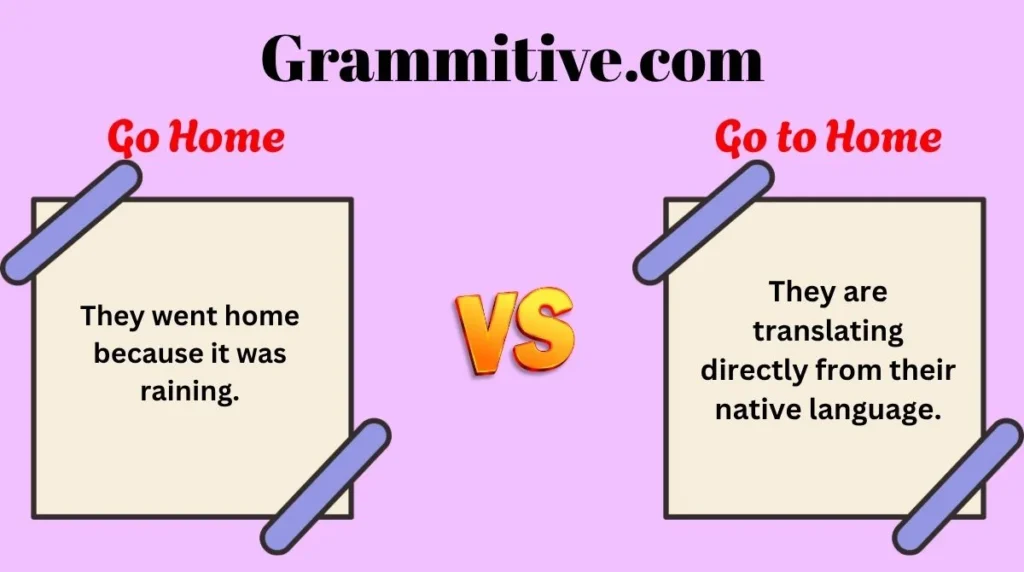
Difference Between Go Home and Go to Home (Detailed)
| Feature | Go Home | Go to Home |
|---|---|---|
| Correctness | ✅ Correct | ❌ Incorrect |
| Preposition | No “to” needed | Uses “to” incorrectly |
| Grammar Type | “Home” as adverbial noun | Misuse of preposition |
| Example | I go home at 5. | ❌ I go to home at 5. |
| Usage | Everyday English, native speakers | Only seen in learner mistakes |
| Meaning | Return to own house | Attempted, but wrong form |
Usage Difference
- Go home is used in all correct English situations for returning to your home.
- Go to home is almost never used; it sounds unnatural.
- Use “go to” only with specific homes: “go to my home,” “go to Sarah’s home.”
Sentence Structure Difference
- Go home → Verb + Home (no article, no preposition)
- Go to home → Verb + Preposition + Home (wrong for standard English)
Meaning Comparison
- Go home = Return to where you live
- Go to home = Incorrect attempt to express the same idea
Grammar Rules You Must Remember
Rule #1: No “to” with home
- ✅ Correct: I am going home now.
- ❌ Wrong: I am going to home now.
Rule #2: Use “to” only with specific homes
- ✅ Correct: I will go to my friend’s home.
- ✅ Correct: She went to her parents’ home.
Rule #3: “Home” can act like an adverb
- ✅ Correct: Come home quickly.
- Explanation: “Home” tells the direction of movement.
Rule #4: Other places require “to”
- ✅ Correct: go to school, go to the market, go to the park
- Explanation: Only “home” is special; all other places need “to.”
Common Mistakes Students Make
Mistake #1: Using “to” with home
- Wrong: I go to home every evening.
- Correct: I go home every evening.
- Tip: Remember “home” is directional, no preposition.
Mistake #2: Confusing home with house
- Wrong: I go home to sleep in a hotel. (if hotel is not your home)
- Correct: I go to the hotel to sleep.
- Tip: Use “home” only for your residence.
Mistake #3: Mixing articles
- Wrong: I am going to the home now. (if talking about your own home)
- Correct: I am going home now.
- Tip: Do not add “the” unless specifying someone else’s home.
Mistake #4: Direct translation errors
- Many languages always use prepositions before “home.” Learn English exceptions.
Easy Trick to Remember the Difference
Think of “home” as a magic directional word. When you move toward home, the word itself knows the direction. No extra “to” is needed. For other places, like school or park, you need “to” because they are not inherently directional.
Memory trick:
- Go home = Go to where your heart is.
- Go to home = ❌ forget it. Only use it with “my home” or “Sarah’s home.”
Real-life logic: You can say, “I go home” anywhere. But “I go to the school” sounds correct, not “I go school.”

Daily Life Examples
- I can’t wait to go home after this long day.
- She goes home by bus every morning.
- We stayed at the office late, then went home.
- He told me, “Go home and rest.”
- Are you going home for the holidays?
- After shopping, they went home.
- I was tired, so I went home early.
- Mom said, “Come home quickly!”
- After the movie, we all went home.
- Don’t forget to go home and eat something.
These sentences show how “go home” is used naturally in everyday spoken English.
Practice Section
Choose the correct option:
- I will ______ after work.
- a) go home
- b) go to home
- She is tired. She should ______ early.
- a) go home
- b) go to home
- After the party, we ______.
- a) went home
- b) went to home
- He always ______ by 5 PM.
- a) goes home
- b) goes to home
- Tomorrow, I will ______ to visit my friend.
- a) go home
- b) go to home
Answers: 1-a, 2-a, 3-a, 4-a, 5-b (only correct because it specifies a friend’s home)
FAQs
1. What is the difference between “go home” and “go to home”? “Go home” is correct and used by native speakers. “Go to home” is wrong unless you specify whose home, like “go to my home.”
2. Can we use “go home” in questions? Yes. Example: “Are you going home now?” This is natural and correct.
3. Is “go home” formal or informal? It is neutral. You can use it in casual conversation, writing, emails, and even reports.
4. Can I say “go to my home”? Yes, if you want to specify whose home. Example: “I am going to my home in Lahore.”
5. Why do learners say “go to home”? Because they overgeneralize the rule for other places. English treats “home” as a directional noun.
6. Are there other exceptions like “home”? Yes, words like “abroad” also do not require “to.” Example: “I am going abroad.” But “to school” is required.
Final Conclusion
Understanding the difference between “go home” and “go to home” is essential for clear, natural English.
Remember that “home” is a special noun that does not need “to.” Use “go home” for your own residence, and only use “go to” when specifying someone else’s home.
Avoid adding “to” unnecessarily—it is one of the most common mistakes in English.
By practicing these rules with real-life sentences, conversations, and exercises, you will start using “go home” automatically.
Pay attention to native speakers and repeat the correct forms often. Over time, your English will sound smooth and confident.
Keep practicing, and soon “go home” will feel as natural as saying “sleep” or “eat.” The little difference matters, but mastering it makes your English much stronger.

I am Lucas Bennett, a digital content creator passionate about social media trends and online growth strategies.
I share practical insights and guides to help users better understand and navigate the digital world.