
English has many small words that look simple but quietly confuse learners.
“Giving” and “given” are perfect examples.
Both come from the verb give, both look similar, and both appear in everyday sentences. Still, students often stop and think:
“Should I say giving or given here?”
“Why does this sentence sound wrong?”
“Is this active or passive?”
These questions are very common, even for intermediate learners.
The problem is that these two forms belong to different grammar families. One shows action happening, while the other often shows something already completed or something received.
If you mix them up, the sentence can sound strange or even change meaning completely.
And because “give” is used all the time in daily English — giving advice, giving gifts, giving help, being given homework — understanding these two forms is very important for speaking naturally.
After reading this guide, you will clearly know:
- when to use giving
- when to use given
- how their grammar works
- how to avoid common mistakes
- how to use them confidently in real conversations
Everything is explained in simple, friendly English, just like a teacher talking to you in class.
What Does “Giving” Mean?
Simple definition
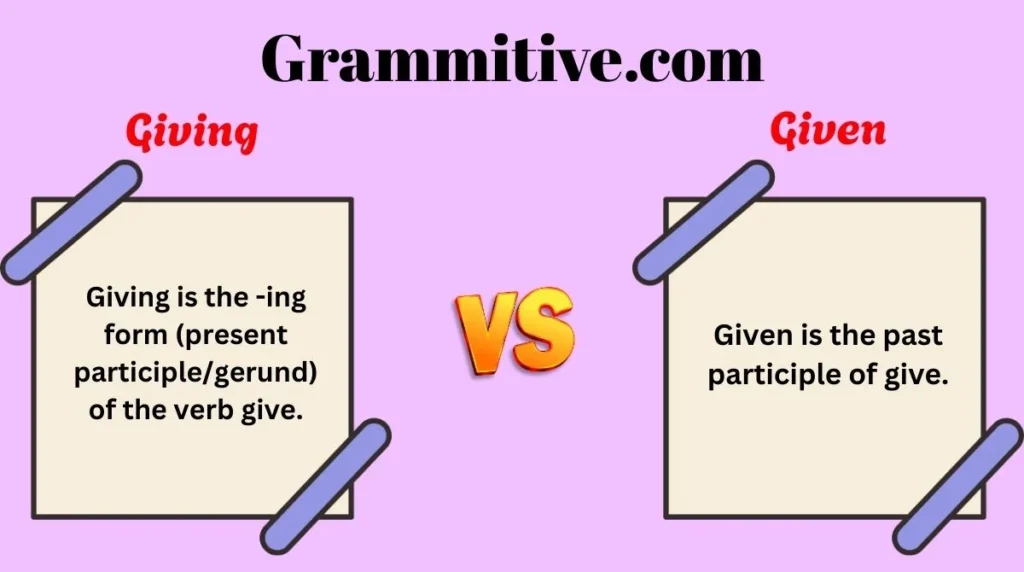
Giving is the -ing form (present participle/gerund) of the verb give.
It usually shows:
- an action happening now
- an action in progress
- or an action used like a noun
Think of it like this:
👉 giving = the act of give
When do we use “giving”?
We use giving:
- In continuous tenses
- As a gerund (verb acting like a noun)
- After prepositions
- In reduced clauses
Grammar rule
Base verb + -ing = giving
Give → giving
It can function as:
- Verb: She is giving a speech.
- Noun: Giving is better than receiving.
- Adjective-like: a giving person
Examples
- She is giving me a ride home.
- They are giving free samples today.
- I enjoy giving gifts to my friends.
- He kept giving excuses.
- We are giving the baby a bath.
- She stopped giving him attention.
- Giving advice is easy, but following it is hard.
- The teacher is giving a test tomorrow.
Common learner confusion
Many students say:
❌ I am given him a book.
This is wrong because given is not used in continuous tense.
It must be:
✅ I am giving him a book.
Remember:
If the action is happening right now, use giving, not given.
What Does “Given” Mean?
Simple definition
Given is the past participle of give.
It usually shows:
- something already completed
- something received
- or passive voice
👉 given = already gave / received
When do we use “given”?
We use given:
- In perfect tenses
- In passive voice
- As an adjective
- In conditional or formal phrases
Grammar rule
Give → gave → given
Past participle form.
It often needs:
- have/has/had
- be (is/was/were/been)
Examples
- She has given me great advice.
- I was given a gift yesterday.
- They have given us another chance.
- He had given up before we arrived.
- The teacher has given homework.
- We were given free tickets.
- Given enough time, he will succeed.
- She felt given more responsibility.
Common learner confusion
Students sometimes say:
❌ She has giving me money.
Wrong.
After has/have/had, always use given, not giving.
Correct:
✅ She has given me money.
Difference Between Giving and Given (Detailed)
This is where most learners struggle. Both words come from “give,” but their jobs are different.
Quick comparison table
| Feature | Giving | Given |
|---|---|---|
| Form | -ing form | past participle |
| Time | happening now/ongoing | completed |
| Used in | continuous tenses | perfect/passive |
| Role | action | result/state |
| Example | She is giving help | Help was given |
Usage difference
Giving → shows the action happening
Given → shows something finished or received
Compare:
- She is giving a speech. (action happening now)
- She has given a speech. (speech already finished)
Grammar logic
Think about time.
If the action is moving, use giving.
If the action is done, use given.
Sentence structure difference
Giving often follows:
- am/is/are
- was/were
- enjoy/like/love + -ing
Given often follows:
- have/has/had
- be + past participle (passive)
Meaning comparison
Active action
- He is giving money.
Completed or passive
- Money was given to him.
See the change?
The focus moves from the doer to the result.
Grammar Rules You Must Remember
Rule #1 – Continuous tense → use giving
Correct:
She is giving a presentation.
Never:
❌ She is given a presentation.
Rule #2 – Perfect tense → use given
Correct:
They have given me the answer.
Never:
❌ They have giving me the answer.
Rule #3 – Passive voice → use given
Correct:
I was given a chance.
Passive voice always uses past participle.
Rule #4 – After prepositions → use giving
Correct:
Thank you for giving me time.
After for, of, about, without → use -ing.
Common Mistakes Students Make
Why mistakes happen
Both words come from “give,” so learners think they are interchangeable.
But English verbs don’t work like that. Each form has a special job.
Wrong vs correct examples
❌ I am given him help.
✅ I am giving him help.
❌ She has giving me advice.
✅ She has given me advice.
❌ We were giving tickets yesterday.
✅ We were given tickets yesterday.
❌ Thank you for give me time.
✅ Thank you for giving me time.
Easy correction tips
Ask yourself:
- Happening now? → giving
- Already finished? → given
- Passive sentence? → given
- After preposition? → giving
Easy Trick to Remember the Difference
Here’s a simple classroom trick.
Think:
GIV-ING → MOV-ING
Both end in -ing.
Both show action happening.
So:
- walking
- running
- giving
All are happening actions.
And:
Given → done
Both end with -en sound.
So think:
“Given = already done.”
It’s not perfect grammar logic, but it helps memory.
Daily Life Examples (Very Important)
These are the kinds of sentences you hear every day.
- I’m giving you my phone number.
- She is giving the baby food.
- Thanks for giving me a ride.
- He kept giving funny answers.
- I was given a warning at work.
- We were given free coffee.
- They have given us another opportunity.
- She has given up sugar.
- Stop giving excuses.
- We were given clear instructions.
These sound very natural in real conversations.
Practice Section
Choose the correct word: giving or given
- She has _____ me good advice.
- They are _____ free gifts today.
- I was _____ a second chance.
- Thank you for _____ your time.
- He kept _____ silly answers.
Answers
- given
- giving
- given
- giving
- giving
FAQs
What is the difference between giving and given?
Giving shows an action happening now or in progress.
Given shows something finished or received.
One is active, the other often passive or completed.
Can we use given in questions?
Yes.
Example: Have you given him the keys?
It works in perfect tenses and passive forms.
Is giving formal or informal?
It works in both.
It’s just a normal verb form.
Used in daily speech and formal writing too.
Why can’t we say “has giving”?
Because after has/have/had, English needs a past participle.
The past participle of give is given, not giving.
Can given be an adjective?
Yes.
Example: On any given day, anything can happen.
Here it describes “day.”
Which is more common in daily speech?
Both are very common.
But giving appears more in continuous actions, while given appears in results or passive sentences.
Final Conclusion
Small grammar differences often cause big confusion. “Giving” and “given” look almost the same, but they play very different roles.
One shows action happening right now. The other shows something finished, completed, or received.
When you focus on time and sentence structure, the choice becomes easy. If the action is moving, use giving.
If the action is done or passive, use given. That simple idea solves most problems.
Try noticing these forms when you watch movies or read English. You will start spotting them everywhere.
Practice speaking them out loud too. Real sentences help your brain remember faster than rules alone.
With regular practice, choosing between these two forms will feel natural — just like native speakers do.

I am Lucas Bennett, a digital content creator passionate about social media trends and online growth strategies.
I share practical insights and guides to help users better understand and navigate the digital world.