
Many English learners feel confused when they see given and gave. Both words come from the verb give, and both talk about something in the past.
Because they look similar and sound related, it is easy to mix them up.
You might hear sentences like:
- She gave me a gift.
- She has given me a gift.
Both talk about the past, but they are not used the same way. The grammar changes. The sentence structure changes. Even the feeling of time changes.
This small difference can cause big mistakes. Some students say things like “I have gave him money” or “She given me a book yesterday.” These sound wrong to native speakers.
Understanding these two forms helps you speak more naturally. It also helps in writing emails, exams, and conversations.
You will feel more confident when telling stories, explaining past events, or talking about experiences.
By the end, you will clearly know:
- what gave means
- what given means
- when to use each one
- easy rules to remember
- common mistakes to avoid
- lots of real-life examples
Everything is explained in simple English, step by step, just like in a classroom.
What Does “Gave” Mean?
Simple definition
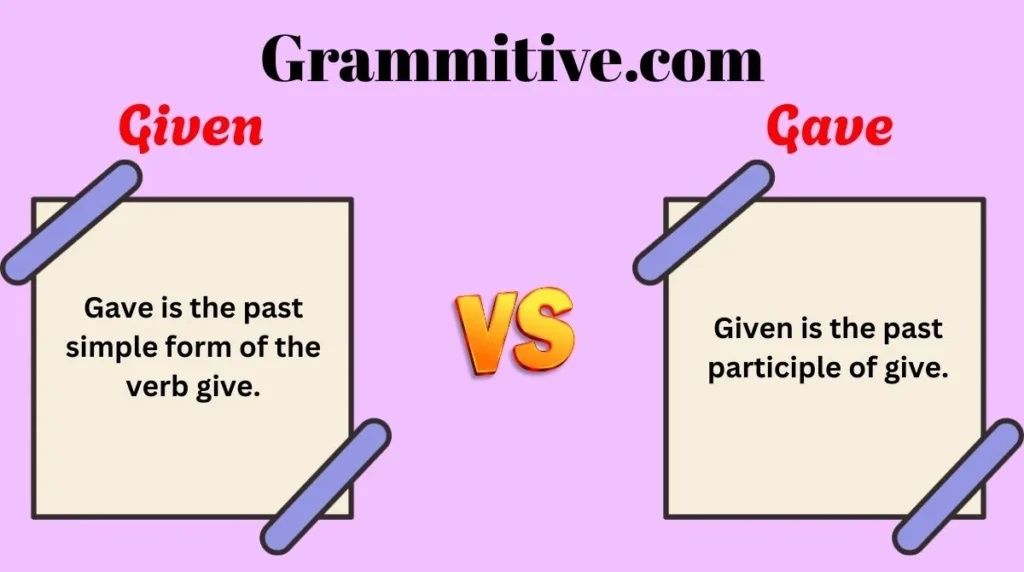
Gave is the past simple form of the verb give.
It talks about an action that happened in the past and is finished.
When to use it
Use gave when:
- the action is complete
- you know the time (yesterday, last week, last year, etc.)
- you are telling a story
- you are describing something that already happened
Grammar rule
Subject + gave + object
or
Subject + gave + person + thing
Examples:
- I gave him the book.
- She gave me a pen.
Example sentences
- I gave my sister some chocolate.
- He gave me his phone number.
- They gave us free tickets.
- She gave her teacher a card.
- My dad gave me advice yesterday.
- We gave food to the dog.
- The teacher gave homework last night.
- Tom gave his seat to an old man.
Common learner confusion
Many learners think gave = any past action. But that is not always true.
For example:
❌ I have gave him money.
✅ I have given him money.
Why? Because gave cannot be used with “have/has/had.”
Remember: gave works alone, not with helping verbs like have.
What Does “Given” Mean?
Simple definition
Given is the past participle of give.
It is used with helping verbs such as:
- have
- has
- had
- be (is/was/were/been)
- get (sometimes in passive)
When to use it
Use given when:
- making perfect tenses (have given, has given, had given)
- using passive voice (was given, is given)
- describing experience or result
- talking about something connected to now
Grammar rule
have/has/had + given
or
be + given (passive voice)
Example sentences
- I have given him my answer.
- She has given me great advice.
- They had given us the keys earlier.
- The teacher has given too much homework.
- He has given up smoking.
- We were given free drinks.
- She was given a prize.
- The police have given a warning.
Common learner confusion
Students often forget the helping verb.
❌ I given him the book.
✅ I have given him the book.
Given never stands alone. It always needs a helper.
Think of it like this: given needs a partner.
Difference Between Gave and Given (Detailed)
These two forms belong to the same verb family, but their jobs are different.
Quick comparison table
| Feature | Gave | Given |
|---|---|---|
| Verb form | Past simple | Past participle |
| Helper verb needed? | No | Yes |
| Time | Finished past | Past linked to present or passive |
| Structure | Subject + gave | have/has/had + given |
| Example | I gave him money | I have given him money |
Usage difference
Gave → simple past story
Given → perfect tense or passive voice
Compare:
- I gave her a gift yesterday. (specific time, finished)
- I have given her many gifts. (life experience, not specific time)
Grammar logic
English verbs often have three forms:
- base: give
- past: gave
- past participle: given
This pattern is common:
- take → took → taken
- write → wrote → written
- break → broke → broken
So gave and given follow the same system.
Sentence structure difference
With gave:
Subject + gave + object
With given:
Subject + have/has/had + given + object
Or:
Object + be + given (passive)
Meaning comparison
Both talk about the past, but the feeling changes.
Gave feels like:
- story
- finished action
- clear past time
Given feels like:
- result
- experience
- connection to now
Grammar Rules You Must Remember
Rule #1: Use “gave” for simple past
If the action is finished, use gave.
Example:
- She gave me her keys last night.
Rule #2: Use “given” with have/has/had
Perfect tenses always need given.
Example:
- She has given me her keys.
Rule #3: Use “given” in passive voice
When the subject receives the action:
Example:
- I was given a chance.
Rule #4: Never use “gave” after have/has/had
This is always wrong.
❌ I have gave him money.
✅ I have given him money.
Common Mistakes Students Make
Why mistakes happen
- both words look similar
- both talk about the past
- irregular verbs are hard
- many languages do not have participles
Wrong vs correct examples
❌ I have gave you the book.
✅ I have given you the book.
❌ She given me help.
✅ She has given me help.
❌ He was gave a prize.
✅ He was given a prize.
❌ They have gave us food.
✅ They have given us food.
Easy correction tips
- See have/has/had? → use given
- No helper verb? → use gave
- Passive voice? → use given
Easy Trick to Remember the Difference
Here’s a small memory trick many students love.
Think:
Gave = alone
Given = needs help
Picture this:
- “Gave” walks alone.
- “Given” holds hands with “have/has/had.”
So if you see a helper verb, your brain should say:
👉 “Okay, I need GIVEN.”
It becomes automatic after practice.
Daily Life Examples (Very Important)
These sound like real conversations.
- I gave him your message.
- She gave me a ride home.
- My boss gave me extra work today.
- They gave us free coffee.
- I have given you my answer already.
- She has given me great support.
- We were given two tickets at the door.
- He has given up junk food.
- The doctor gave me medicine.
- I had given them the address before they called.
These are exactly how native speakers talk every day.
Practice Section
Choose gave or given.
- She has ___ me good advice.
- I ___ him my pen yesterday.
- They were ___ free samples.
- We have ___ the teacher our homework.
- He ___ me a call last night.
Answers
- given
- gave
- given
- given
- gave
FAQs
What is the difference between gave and given?
Gave is past simple and works alone. Given is the past participle and needs a helper verb like have or has. The structure decides which one you use.
Can we use given without have or has?
No. Given cannot stand alone. It must come with have, has, had, or be (for passive voice).
Is gave more common in speaking?
Yes. In daily conversations and stories, people often use gave because we talk about finished past actions.
When should I use have given?
Use have given for experiences or actions connected to the present. Example: I have given him many chances.
Is given used in passive voice?
Yes. Passive sentences use given. Example: She was given a certificate.
Why is “have gave” wrong?
Because English grammar needs the past participle after “have.” The correct form is have given, not have gave.
Final Conclusion
Understanding these two forms becomes much easier once you see their jobs clearly. Gave tells a simple past story.
It talks about something finished. It stands alone and does not need help. Given, on the other hand, always works with a helping verb or in passive sentences. It connects the past with the present or shows a result.
Many learners struggle at first, but the pattern is very regular. If you remember the small trick — gave alone, given with help — you will avoid most mistakes.
After some practice, your brain will choose the right form automatically.
Try using both words in daily sentences. Speak them out loud. Write small stories. The more you use them, the more natural they will feel.
English grammar gets easier step by step. Small wins like this build strong confidence.

I am Lucas Bennett, a digital content creator passionate about social media trends and online growth strategies.
I share practical insights and guides to help users better understand and navigate the digital world.