

Small English phrases can cause big confusion.
“From my end” and “from my side” look simple, but many learners stop and think, Which one should I use? Are they the same? Is one wrong?
You might hear these phrases in emails, meetings, phone calls, or casual talks. For example:
- “Everything is done from my side.”
- “There’s no problem from my end.”
Both sound natural. Both are common. But they are not always used in the same way.
This is where many students get stuck. Some people think one phrase is formal and the other is informal. Others feel both mean “my opinion.” Some avoid using them because they are afraid of sounding strange.
That worry is normal. Even advanced learners feel unsure about these expressions.
Understanding these phrases is important because they appear a lot in:
- office emails
- customer service messages
- teamwork conversations
- daily spoken English
Once you clearly understand them, you’ll speak more confidently and sound more natural, like a native speaker.
By the end, you will know:
- the meaning of each phrase
- when to use each one
- grammar rules
- common mistakes
- easy memory tricks
- many real-life examples
Everything is explained in simple, friendly English.
What Does “From My End” Mean?
Simple definition
“From my end” means: from my side of the work, from my responsibility, or from my position.
It focuses on tasks, actions, or progress, not feelings or opinions.
Think about it like this:
👉 My end = my part of the job
When to use it
Use “from my end” when talking about:
- work progress
- completed tasks
- responsibility
- technical or project updates
- business or professional situations
It is very common in emails and offices.
Grammar rule
Structure:
From my end + clause
Examples:
- From my end, everything is finished.
- From my end, there are no issues.
It usually comes at:
- the beginning, or
- the end of a sentence
Examples (6–8 sentences)
- From my end, the report is ready.
- There are no problems from my end.
- Everything looks good from my end.
- From my end, the payment has been sent.
- The system is working fine from my end.
- From my end, we can start the meeting now.
- I have completed all tasks from my end.
- From my end, the file was uploaded yesterday.
Common learner confusion
Many students think:
❌ “From my end” = my opinion
That is not correct.
It usually talks about work or action, not feelings.
If you want to give your opinion, “from my side” or “in my opinion” may sound better.
What Does “From My Side” Mean?
Simple definition
“From my side” means: from my position, perspective, or involvement.
It can talk about:
- actions
- help
- support
- opinion
- feelings
It is more flexible and more personal.
When to use it
Use “from my side” when you talk about:
- offering help
- sharing feelings
- promising support
- talking about your involvement
- casual conversations
It sounds slightly warmer and more human than “from my end.”
Grammar rule
Structure:
From my side + clause
Examples:
- From my side, I will help you.
- Everything is okay from my side.
Examples (6–8 sentences)
- From my side, I will fully support this plan.
- Everything is fine from my side.
- From my side, you can trust me.
- There are no objections from my side.
- From my side, I’m happy to join.
- From my side, the decision is clear.
- You will get full cooperation from my side.
- From my side, I apologize for the delay.
Common learner confusion
Students sometimes think:
❌ “From my side” sounds wrong or non-native.
Not true.
Native speakers use it often, especially in:
- friendly emails
- customer service
- teamwork
It just sounds more personal than “from my end.”
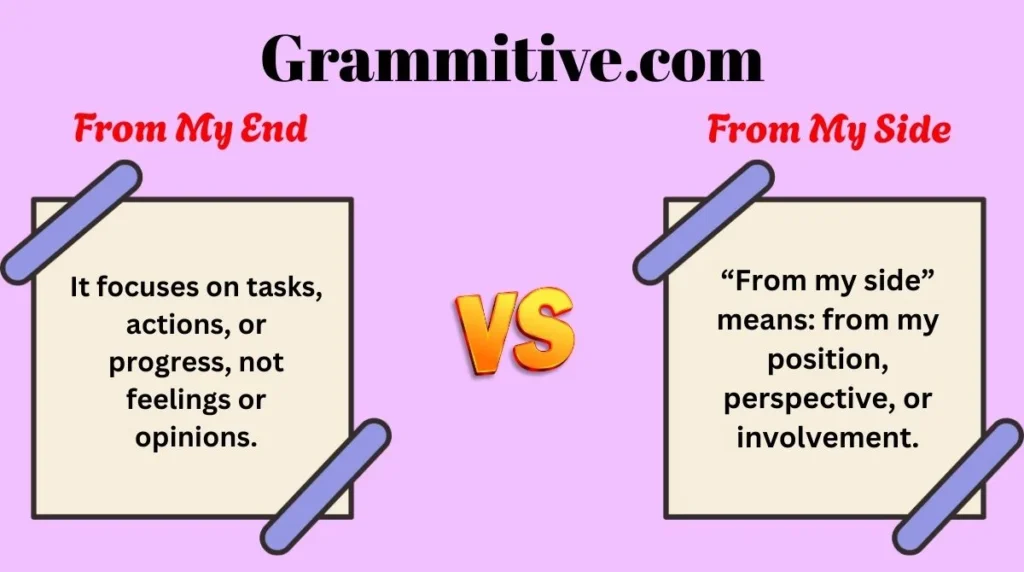
Difference Between From My End and From My Side (Detailed)
Both phrases look similar. Both talk about “my part.”
But the feeling and use are slightly different.
Quick comparison table
| Feature | From my end | From my side |
|---|---|---|
| Focus | tasks/work | person/position |
| Tone | professional | personal/friendly |
| Use in offices | very common | common |
| Talks about feelings | rarely | yes |
| Talks about responsibility | yes | yes |
| Sounds warm | less | more |
Usage difference
From my end
→ progress, updates, completion
Example:
“From my end, the software is installed.”
From my side
→ support, opinion, involvement
Example:
“From my side, you have my full support.”
Grammar logic
- “End” suggests the end or part of a system or project.
- “Side” suggests a person or team position.
So:
- End → mechanical or task-focused
- Side → human or relationship-focused
Sentence structure difference
Both use the same structure, but meaning changes:
- From my end, everything is done. (task finished)
- From my side, everything is okay. (my position/opinion)
Meaning comparison
Imagine a group project:
If you say:
👉 “From my end, I finished the slides.”
= work update
If you say:
👉 “From my side, I support your idea.”
= opinion/support
Small change. Big meaning difference.
Grammar Rules You Must Remember
Rule #1: Use for responsibility or tasks
Use from my end for work or progress.
✔ From my end, the file is uploaded.
Rule #2: Use for support or feelings
Use from my side for emotional or personal involvement.
✔ From my side, I completely agree.
Rule #3: Place at start or end
Both phrases can be used at the beginning or end.
✔ From my side, I’m ready.
✔ I’m ready from my side.
Rule #4: Don’t use with “to”
Never say:
❌ from my end to
❌ from my side to
They are not used like directions.
Common Mistakes Students Make
Why mistakes happen
Because both phrases look the same, learners use them randomly.
But sometimes the sentence sounds unnatural.
Mistake 1
❌ From my end, I love this movie.
✔ From my side, I love this movie.
Love is a feeling → use side.
Mistake 2
❌ From my side, the server has restarted.
✔ From my end, the server has restarted.
Technical task → use end.
Mistake 3
❌ Everything is completed from my side of the project side.
Too many “side.” Sounds messy.
✔ Everything is completed from my end.
Easy correction tips
Ask yourself:
👉 Is this about work progress? → end
👉 Is this about support or opinion? → side
Simple.
Easy Trick to Remember the Difference
Here’s a memory trick many students like.
Think like this:
End = work ends
Side = standing beside someone
So:
- tasks finish at the “end”
- people stand on a “side”
If you picture this, you’ll rarely make mistakes.

Daily Life Examples (Very Important)
These are natural sentences you may hear every day.
- From my end, the email was sent yesterday.
- From my side, you have full support.
- Everything looks fine from my end.
- From my side, I’m happy with the decision.
- There are no issues from my end.
- From my side, we can meet tomorrow.
- Payment is done from my end.
- From my side, thank you for your help.
- From my end, the system is ready to use.
- From my side, let me know if you need anything.
Notice how natural they sound in daily talk.
Practice Section
Choose the correct option.
1
_____ the report is finished.
a) from my end
b) from my side
2
_____ I fully support your idea.
a) from my end
b) from my side
3
There is no problem _____ .
a) from my end
b) from my side
4
_____ I feel this plan is risky.
a) from my end
b) from my side
5
The software works fine _____ .
a) from my end
b) from my side
Answers
1 → a
2 → b
3 → a
4 → b
5 → a
FAQs
1. What is the difference between from my end and from my side?
“From my end” talks about tasks, progress, or responsibility.
“From my side” talks about support, opinions, or personal involvement.
Both are correct but used in different situations.
2. Can we use from my side in emails?
Yes. It is very common in friendly or semi-formal emails.
It sounds warm and cooperative.
Great for teamwork or customer service messages.
3. Is from my end formal or informal?
It sounds more professional and neutral.
Very common in office communication and technical updates.
Perfect for business emails.
4. Can both phrases mean the same thing?
Sometimes yes.
For simple updates like “Everything is fine,” both work.
But for feelings or support, “from my side” sounds better.
5. Which is more natural for native speakers?
Both are natural.
Native speakers use “from my end” in work settings and “from my side” in personal or supportive contexts.
6. Can I replace them with something simpler?
Yes. You can say:
- on my part
- for me
- I finished
- I support
But these phrases sound more natural in professional English.
Final Conclusion
English has many small phrases that look simple but carry different meanings. “From my end” and “from my side” are perfect examples.
They are short, but choosing the right one makes your English clearer and more natural.
Remember the basic idea. Use “from my end” when you talk about work, tasks, or progress.
Use “from my side” when you talk about support, feelings, or personal involvement. That small difference changes the tone of your sentence.
Don’t worry if you mix them sometimes. Even fluent speakers do. With practice, your brain will start choosing the right phrase automatically.
Try using both expressions in your next email or conversation. Real-life use is the fastest way to learn.
Little improvements like this make your English sound smooth and confident. Keep practicing, and you’ll notice the difference very soon.

I am Lucas Bennett, a digital content creator passionate about social media trends and online growth strategies.
I share practical insights and guides to help users better understand and navigate the digital world.