
English learners often stop and think when they want to talk about memory.
Should you say “I forgot my keys” or “I have forgotten my keys”?
Is “forgotten” always correct in perfect tense?
Can “forgot” ever be used with have or had?
These small questions cause big confusion.
Many students mix these two words because they both come from the same verb forget. They look similar. They sound similar. But their grammar jobs are different.
And in daily English, using the wrong form can make your sentence sound strange or incorrect.
You hear these forms everywhere:
- “Sorry, I forgot.”
- “I’ve forgotten your name.”
- “She had forgotten the meeting.”
So knowing the difference is not just grammar for exams. It helps you speak naturally at work, school, and home.
By the end of this guide, you’ll clearly understand:
- when to use forgot
- when to use forgotten
- how tenses change meaning
- common mistakes learners make
- simple tricks to remember forever
Everything is explained in easy, friendly English with lots of examples.
What Does “Forgot” Mean?
Simple definition
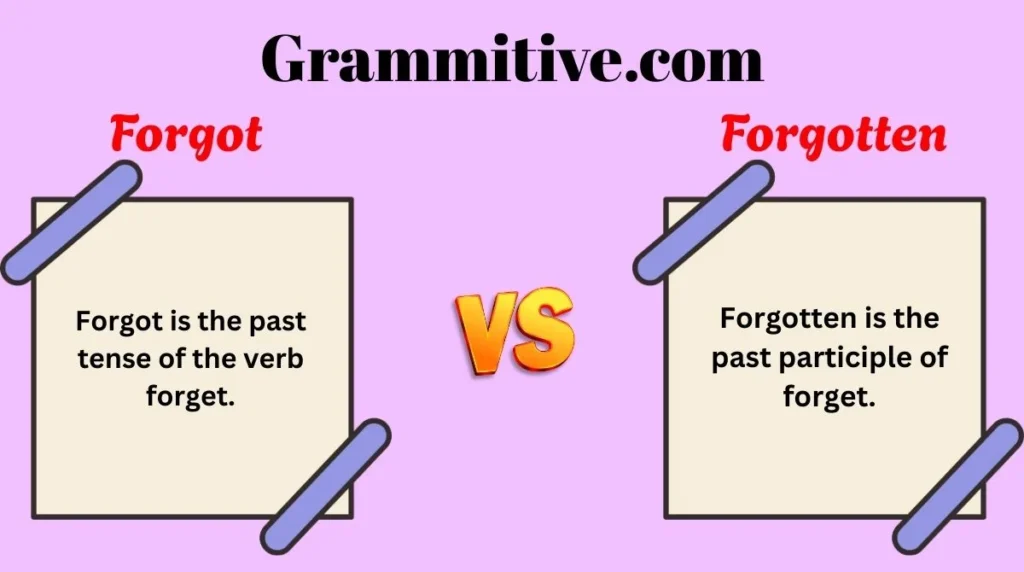
Forgot is the past tense of the verb forget.
It talks about something that happened in the past.
It means:
👉 you did not remember something at that time.
When to use it
Use forgot when:
- talking about yesterday, last week, or any finished time
- describing a completed past action
- using simple past tense
Time words often appear:
- yesterday
- last night
- this morning
- two hours ago
- in 2020
Grammar rule
Subject + forgot + object
or
Subject + forgot + to + verb
Examples
- I forgot my wallet at home.
- She forgot her password.
- We forgot the teacher’s name.
- He forgot to call me.
- They forgot the meeting yesterday.
- I forgot your birthday last year.
- My sister forgot her homework.
- Sorry, I forgot the time.
Common learner confusion
Many learners say:
❌ I have forgot my keys.
This is wrong.
Because forgot cannot be used with have/has/had.
It only works in simple past.
What Does “Forgotten” Mean?
Simple definition
Forgotten is the past participle of forget.
It cannot stand alone.
It must be used with helping verbs like:
- have
- has
- had
- be (sometimes)
When to use it
Use forgotten in:
- present perfect (have/has forgotten)
- past perfect (had forgotten)
- passive voice
- sometimes as an adjective
It connects the past to the present.
Grammar rule
Subject + have/has/had + forgotten + object
Examples
- I have forgotten your name.
- She has forgotten her bag.
- We had forgotten the address.
- They have forgotten the rules.
- He has forgotten to reply.
- I’ve forgotten my phone at home.
- She had forgotten my birthday.
- The password has been forgotten.
Common learner confusion
Students often say:
❌ I forgotten my keys.
This sentence has no helping verb. It is incomplete.
Correct:
✅ I have forgotten my keys.
✅ I had forgotten my keys.
Difference Between Forgot and Forgotten (Detailed)
This is where most students get stuck. So let’s slow down and compare clearly.
Quick comparison table
| Feature | Forgot | Forgotten |
|---|---|---|
| Type | Past tense | Past participle |
| Used alone? | Yes | No |
| Needs helping verb? | No | Yes |
| Tense | Simple past | Perfect tenses |
| Time meaning | Finished past | Past connected to now |
| Example | I forgot | I have forgotten |
Usage difference
Forgot
→ action finished in the past
→ time is clear or understood
Forgotten
→ action happened before now
→ result still matters
Grammar logic
Think like this:
- forgot = yesterday story
- forgotten = past + present connection
Sentence structure difference
Simple past:
👉 I forgot my keys.
Present perfect:
👉 I have forgotten my keys.
Past perfect:
👉 I had forgotten my keys.
Meaning comparison
Look at the feeling:
I forgot my keys.
→ It happened earlier. Maybe not important now.
I have forgotten my keys.
→ I still don’t have them now. It affects the present.
That small difference changes the meaning a lot.
Grammar Rules You Must Remember
Rule #1 – Use “forgot” for finished past time
If you mention yesterday or last week, use forgot.
Example:
I forgot my phone yesterday.
Rule #2 – Use “forgotten” with have/has/had
Always add a helping verb.
Example:
She has forgotten her lunch.
Rule #3 – Never use “forgot” after have/has/had
Wrong:
❌ I have forgot
Correct:
✅ I have forgotten
Rule #4 – “Forgotten” can be an adjective
Sometimes it describes a noun.
Example:
This is a forgotten village.
A forgotten memory.
Here it means “not remembered.”
Common Mistakes Students Make
Mistakes happen because both words come from the same verb. The brain mixes them.
Mistake 1
❌ I have forgot my bag.
✅ I have forgotten my bag.
Tip: after have, always use past participle.
Mistake 2
❌ I forgotten my homework.
✅ I forgot my homework.
✅ I have forgotten my homework.
Tip: “forgotten” never stands alone.
Mistake 3
❌ Yesterday I have forgotten my keys.
✅ Yesterday I forgot my keys.
Tip: specific past time → simple past.
Mistake 4
❌ She forgot to have done it.
✅ She forgot to do it.
Don’t mix tense forms.
Easy correction method
Ask yourself:
- Is there have/has/had? → use forgotten
- Is it yesterday/last night? → use forgot
Simple check. Works every time.
Easy Trick to Remember the Difference
Here’s a small memory trick my students love.
The “H rule”
If you see H, choose forgotten.
H words:
- have
- has
- had
All start with H.
So:
H → forgotten
No H → forgot
Examples:
I have forgotten
She has forgotten
They had forgotten
But:
I forgot
She forgot
Quick and easy. Your brain remembers faster.
Daily Life Examples (Very Important)
These sound like real conversations you hear every day.
- Sorry, I forgot your name.
- Oh no, I’ve forgotten my keys inside!
- Did you forget to lock the door?
- I forgot my lunch at home today.
- He has forgotten our plan again.
- We had forgotten the time and missed the bus.
- Mom forgot to buy milk.
- I think I’ve forgotten my password.
- She forgot where she parked the car.
- I’ve completely forgotten that movie.
These are natural, spoken English sentences. Try saying them aloud.
Practice Section
Choose the correct option: forgot / forgotten
Questions
- I have ______ my wallet.
- She ______ her homework yesterday.
- They had ______ the address.
- Sorry, I ______ to call you.
- We have ______ the rules.
Answers
- forgotten
- forgot
- forgotten
- forgot
- forgotten
If you got all correct, great job. If not, read again and try once more.
FAQs
What is the difference between forgot and forgotten?
Forgot is simple past. It talks about a finished past action. Forgotten is the past participle and needs have, has, or had. It connects past actions to the present.
Can we use forgotten alone?
No. Forgotten cannot stand alone as the main verb. You must use a helping verb like have or had.
Is forgot formal or informal?
Forgot is normal everyday English. It is used in both speaking and writing. It is not informal or formal. It is just standard grammar.
Can I say “I have forgot”?
No. That is grammatically wrong. After have/has/had, always use forgotten.
When should I use present perfect with forgotten?
Use it when the past action still matters now. Example: I have forgotten my keys (so I can’t open the door now).
Is forgotten ever an adjective?
Yes. It can describe nouns. Example: a forgotten story, a forgotten town, forgotten memories.
Final Conclusion
Small grammar differences can feel confusing at first, especially when two words look almost the same. But once you see their jobs clearly, everything becomes simple.
Forgot is your past story word. Something happened and finished.
Forgotten works with helping verbs and connects the past to now.
Just remember the “H rule.” If you see have, has, or had, use forgotten. No helping verb? Use forgot.
Practice by making your own sentences. Say them out loud. Notice how native speakers use them in movies or conversations. Soon, you won’t even think about it. The correct form will come naturally.
Grammar becomes easy when you understand the logic behind it.
Keep practicing, and you’ll never mix these two again.

I am Lucas Bennett, a digital content creator passionate about social media trends and online growth strategies.
I share practical insights and guides to help users better understand and navigate the digital world.