
Many English learners feel confused when they hear someone say, “The movie was fair,” or “The food was good.”
Both words sound positive. Both can describe something nice. So why do native speakers sometimes choose fair and sometimes choose good?
Here is the problem.
These two words do not mean the same thing. Not even close.
One shows average quality, and the other shows positive quality. But in daily speech, people often use them loosely. That makes things even more confusing for students.
Imagine your teacher says your test result is fair.
How do you feel? Happy? Sad? Unsure?
Now imagine the teacher says good.
That feels clearly better, right?
Small word changes can change feelings and meaning.
Understanding these two words helps you:
- describe quality correctly
- sound natural in conversation
- avoid embarrassing mistakes
- speak like a native speaker
By the end, you will clearly know:
- what fair really means
- what good really means
- when to use each one
- grammar rules
- common mistakes
- real-life examples
Everything is explained in simple, everyday English, just like a classroom lesson.
What Does “Fair” Mean?
Simple definition
Fair usually means:
👉 okay, average, not very good, not very bad
It sits in the middle.
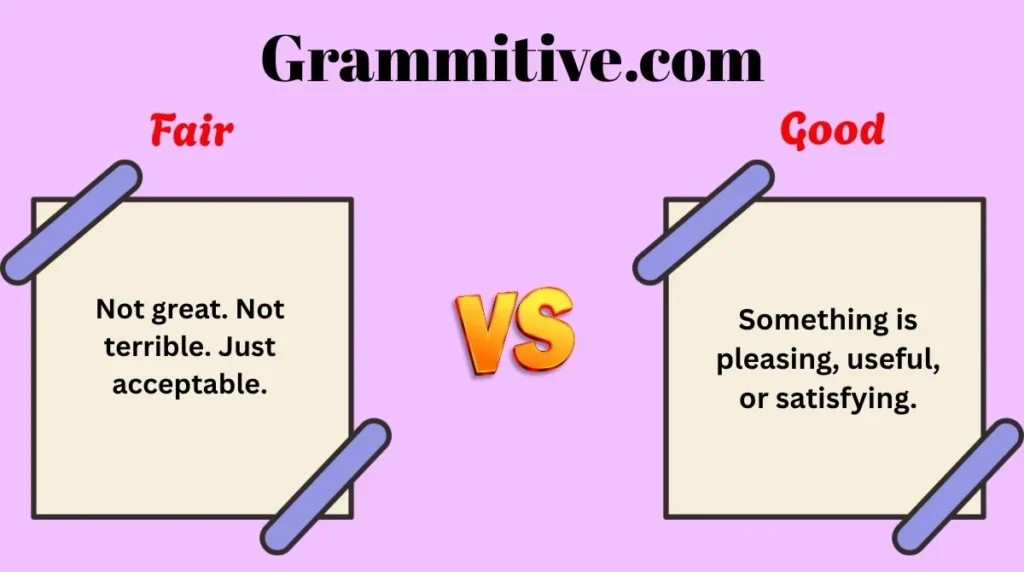
Not great. Not terrible. Just acceptable.
Think of it like 5 or 6 out of 10.
When to use it
Use fair when something:
- is average
- is acceptable but not impressive
- could be better
- is “so-so”
It often sounds polite but slightly negative.
Grammar rule
Fair is mostly used as:
- an adjective → fair result, fair weather, fair performance
Structure:
- be + fair
- fair + noun
Examples:
- The weather is fair.
- She did a fair job.
- The movie was fair.
Example sentences (6–8)
- The exam was fair, not too easy or too hard.
- His English is fair, but he needs practice.
- The food tasted fair, nothing special.
- We had fair weather today.
- Her performance was fair, not excellent.
- The hotel service was fair.
- I got a fair score on the test.
- The match was fair but a little boring.
Common learner confusion
Many students think fair = good.
But native speakers often hear it as:
👉 “not very good”
If you say:
- “Your cooking is fair.”
It may sound like:
- “It’s just okay.”
Sometimes people may even feel a little disappointed.
So be careful. Fair is not strong praise.
What Does “Good” Mean?
Simple definition
Good means:
👉 nice, positive, better than average
It shows clear approval.
Something is pleasing, useful, or satisfying.
Think of it like 7 or 8 out of 10.
When to use it
Use good when something:
- makes you happy
- works well
- has quality
- is better than normal
It is more positive and friendly than fair.
Grammar rule
Good is also an adjective.
Structure:
- be + good
- good + noun
Examples:
- She is good.
- This is a good book.
- The food tastes good.
Example sentences (6–8)
- The movie was good. I enjoyed it.
- She is a good student.
- This restaurant serves good food.
- I got a good grade in math.
- He did a good job today.
- That sounds like a good idea.
- We had a good time at the party.
- The weather is good for a picnic.
Common learner confusion
Some learners use good for everything.
But sometimes good is too strong.
Example:
- If the service was just okay, saying good sounds too positive.
So choose based on real quality, not just habit.
Difference Between Fair and Good (Detailed)
This is where most students get stuck.
Both can sound positive, but their strength is different.
Quick comparison table
| Feature | Fair | Good |
|---|---|---|
| Quality level | Average | Above average |
| Feeling | Neutral / slight negative | Positive |
| Score feeling | 5–6/10 | 7–9/10 |
| Praise level | Weak | Strong |
| Common meaning | Okay | Nice / satisfying |
| Emotional impact | Mild | Happy |
Usage difference
Fair
- acceptable
- could be better
- not impressive
Good
- satisfying
- pleasing
- clearly positive
Grammar logic
Both are adjectives.
Both come after be verbs.
But their meaning strength is different.
Example:
- His work is fair. → average
- His work is good. → nice quality
Same grammar. Different feeling.
Sentence structure difference
Structure stays the same:
- fair + noun
- good + noun
Examples:
- fair result
- good result
But the message changes.
Meaning comparison
Listen to the feeling:
- The movie was fair. → meh 😐
- The movie was good. → I liked it 😊
That small change tells a big story.
Grammar Rules You Must Remember
Rule #1: Both are adjectives
They describe nouns.
Correct:
- good food
- fair score
Wrong:
- goodly food
- fairly score
Rule #2: Use with “be” verbs
Structure:
- be + fair/good
Examples:
- The test is fair.
- The test is good.
Rule #3: Don’t use “very fair” too often
Native speakers rarely say:
❌ very fair
Instead say:
✅ pretty fair
✅ quite fair
Example:
- The weather is quite fair today.
Rule #4: Don’t confuse “good” and “well”
❌ I feel goodly
❌ I speak good
Correct:
- I feel good.
- I speak well.
Good = adjective
Well = adverb
Common Mistakes Students Make
Why mistakes happen
Because:
- both words look simple
- dictionaries show similar meanings
- translation in other languages is the same
But English speakers feel different emotions with each word.
Mistake 1
❌ Your cooking is fair! (to praise)
Sounds weak.
✅ Your cooking is good!
Mistake 2
❌ I got a good score (when score is 50%)
That is not good.
✅ I got a fair score.
Mistake 3
❌ very fair weather
Sounds unnatural.
✅ pretty fair weather
Easy correction tips
Ask yourself:
👉 Is it just okay? → fair
👉 Is it nice/satisfying? → good
Simple.
Easy Trick to Remember the Difference
Here’s a fun memory trick.
Think about school grades.
Imagine:
- Fair = C grade
- Good = B or A grade
Would you celebrate a C?
Probably not.
Would you celebrate an A?
Yes!
So:
Fair → average
Good → happy feeling
Also remember:
G in good = Great feeling
That helps many students.
Daily Life Examples (Very Important)
These are how people really speak.
Conversation style sentences
- “How was the movie?” – “It was fair. Nothing special.”
- “How’s the food?” – “Pretty good actually!”
- “My English is fair, but I’m learning.”
- “You did a good job today.”
- “The service was fair, so I won’t come again.”
- “We had a good time at the beach.”
- “The weather looks fair, let’s go out.”
- “His marks are good this year.”
- “The match was fair, a bit boring.”
- “That’s a good idea!”
Notice how good sounds happy and fair sounds neutral.
Practice Section
Choose the correct word: fair or good.
- The teacher said my project was ______. (nice quality)
- The weather is ______ today, not sunny but not rainy.
- She did a ______ job on the presentation.
- My score is just average, so it’s ______.
- We had a ______ dinner at the new restaurant.
Answers
- good
- fair
- good
- fair
- good
FAQs
1. What is the difference between fair and good?
Fair means average or okay. Good means better than average and pleasing. Good shows stronger praise.
2. Can we use fair in questions?
Yes.
Example: “Was the test fair?”
It usually means reasonable or balanced.
3. Is good formal or informal?
Good works in both formal and informal English. It is very common everywhere.
4. Does fair always mean average?
Not always. Sometimes it means equal or just (fair decision). But for quality, it usually means average.
5. Which word sounds more positive?
Good sounds clearly positive. Fair sounds neutral or slightly negative.
6. Can I use both words for food?
Yes, but meaning changes.
Fair food = just okay
Good food = tasty and enjoyable
Final Conclusion
Small English words often create big confusion, and these two are perfect examples. Both look easy. Both are short. But their feelings are very different.
Fair sits in the middle. It means acceptable, average, nothing special. It is polite but weak.
Good feels warm and positive. It shows clear satisfaction and approval. It sounds friendly and encouraging.
When describing things, always ask yourself one simple question: “Am I happy with it, or is it just okay?”
If you are happy, choose good.
If it’s only average, choose fair.
Practice using them in daily speech. Notice how native speakers talk. After some time, the difference will feel natural, not confusing.
Language learning becomes easier when small details become clear.
Keep practicing, keep speaking, and don’t worry about mistakes. That’s how real progress happens.

I am Lucas Bennett, a digital content creator passionate about social media trends and online growth strategies.
I share practical insights and guides to help users better understand and navigate the digital world.