

Many English learners feel confused when they hear words like experienced and seasoned. Both seem to talk about skill. Both describe someone who knows a lot.
And both often appear in job ads, resumes, and everyday conversations.
So naturally, students start asking:
“Are they the same?”
“Can I use them in any sentence?”
“Which one sounds more natural?”
The trouble is that dictionaries often give almost the same meaning. But in real life, these words are not always equal.
Native speakers choose one or the other for small reasons—tone, feeling, and situation. And those small reasons can change how professional or natural you sound.
For example, you might say an experienced teacher, but you usually hear a seasoned traveler. Why? There is a subtle difference in feeling.
Understanding these differences helps you:
- sound more fluent
- speak naturally
- write better resumes and emails
- avoid small but awkward mistakes
By the end, you will clearly know:
- what each word truly means
- when to use each one
- grammar rules
- common mistakes
- easy memory tricks
- and lots of daily-life examples
Everything is explained in simple, friendly English, just like a classroom lesson.
What Does “Experienced” Mean?
Simple definition
Experienced means:
👉 someone who has done something many times and has learned from it.
It focuses on practice and time.
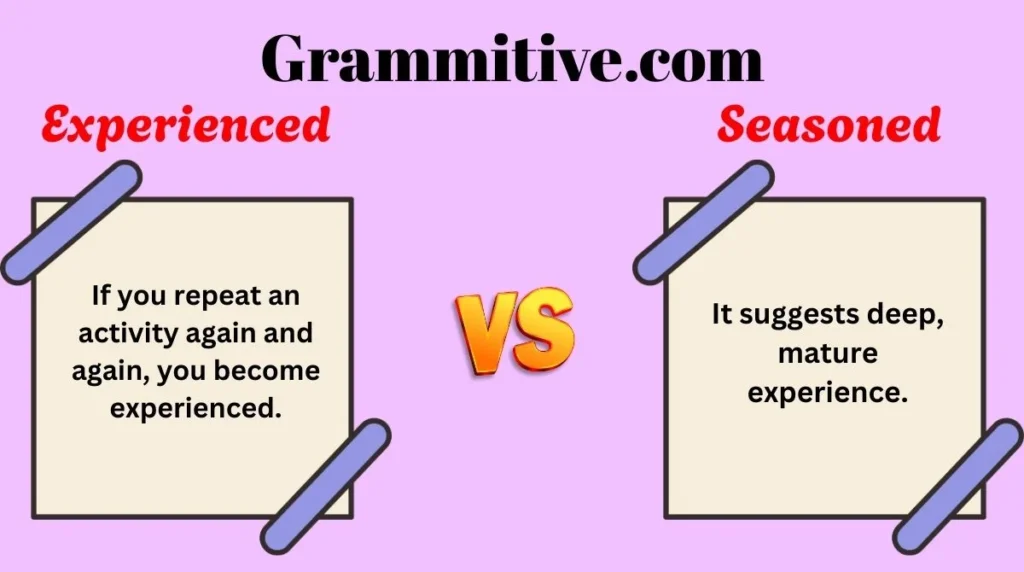
If you repeat an activity again and again, you become experienced.
When to use it
Use experienced when talking about:
- jobs
- skills
- professional work
- training
- education
- abilities
It sounds neutral and professional.
That’s why it is very common in resumes and job descriptions.
Grammar rule
Experienced is usually:
- an adjective before a noun → an experienced nurse
- or after “be” → She is experienced
Structure:
- experienced + noun
- be + experienced (in/with)
Examples:
- experienced in marketing
- experienced with children
Example sentences (6–8)
- She is an experienced teacher.
- We need an experienced driver for this job.
- He is experienced in computer programming.
- The company hired an experienced manager.
- I am not experienced with babies yet.
- They chose an experienced lawyer.
- This guide is experienced in mountain climbing.
- My sister is experienced at handling customers.
Common learner confusion
Many learners think experienced = old.
That’s not correct.
You can be young and still experienced.
For example:
- A 22-year-old gamer can be experienced.
- A young chef can be experienced after years of training.
So the word talks about practice, not age.
What Does “Seasoned” Mean?
Simple definition
Seasoned means:
👉 someone who has gained skill through long experience, often in difficult or challenging situations.
It suggests deep, mature experience.
There is a feeling of:
- wisdom
- toughness
- confidence
- real-world knowledge
When to use it
Use seasoned when describing:
- professionals with many years
- experts
- leaders
- people who have faced challenges
- people who are calm under pressure
It sounds:
- stronger
- more advanced
- sometimes more impressive
It often appears in:
- news articles
- formal writing
- storytelling
Grammar rule
Seasoned is also an adjective.
Structure:
- seasoned + noun
- be + seasoned (rare but possible)
Common phrases:
- seasoned professional
- seasoned traveler
- seasoned expert
- seasoned journalist
Example sentences (6–8)
- She is a seasoned journalist.
- The team needs a seasoned leader.
- He is a seasoned traveler who has visited 40 countries.
- The company hired a seasoned professional.
- That boxer is a seasoned fighter.
- We asked for advice from a seasoned investor.
- The police officer is seasoned and calm in danger.
- They brought in a seasoned coach to improve the team.
Common learner confusion
Many learners think seasoned only means food spices.
Yes, it can mean that too:
- seasoned chicken
- seasoned soup
But when talking about people, it means rich life experience, not spices.
So remember:
For people → experience
For food → spices
Difference Between Experienced and Seasoned (Detailed)
Both words talk about experience, but they feel different.
Think of it like this:
- experienced → skill from practice
- seasoned → deep skill from long, tough experience
Comparison Table
| Feature | Experienced | Seasoned |
|---|---|---|
| Meaning | practiced skill | deep, mature skill |
| Tone | neutral | stronger, impressive |
| Time length | some time | usually many years |
| Feeling | trained | wise & tough |
| Common use | jobs, resumes | experts, leaders |
| Formality | neutral | slightly formal/literary |
Usage difference
Use experienced when:
- talking generally about skills
- writing resumes
- describing qualifications
Use seasoned when:
- praising someone
- highlighting long history
- showing respect
- talking about experts
Grammar logic
Both are adjectives.
But seasoned usually sounds heavier and more descriptive.
Compare:
- experienced nurse → normal description
- seasoned nurse → nurse with many years and real-life challenges
Sentence structure difference
Both use the same grammar, but collocations differ.
Common with experienced:
- experienced worker
- experienced teacher
- experienced driver
Common with seasoned:
- seasoned professional
- seasoned expert
- seasoned traveler
- seasoned leader
Meaning comparison
Picture two cooks:
Cook A has worked 2 years → experienced
Cook B has worked 25 years in many busy restaurants → seasoned
Both are skilled, but Cook B has deeper knowledge.
That’s the key difference.
Grammar Rules You Must Remember
Rule #1 – Use “experienced” with “in/with/at”
Correct:
- She is experienced in design.
- He is experienced with children.
Wrong:
- She is experienced of design.
Rule #2 – “Seasoned” rarely uses prepositions
Correct:
- a seasoned traveler
Not common:
- seasoned in traveling
Usually just:
- seasoned + noun
Rule #3 – Both come before nouns
Correct:
- an experienced engineer
- a seasoned lawyer
Do not say:
- an experience engineer
Rule #4 – Don’t use them as verbs
Wrong:
- I seasoned my skills.
Correct:
- I gained experience.
These words are adjectives only when describing people.
Common Mistakes Students Make
Why mistakes happen
The problem is:
- similar dictionary meanings
- direct translation from native language
- overusing one word
Let’s fix the common errors.
Mistake 1
❌ He is a seasoned beginner.
✅ He is an experienced beginner.
Seasoned and beginner don’t match. Seasoned means advanced.
Mistake 2
❌ I am seasoned in Excel.
✅ I am experienced in Excel.
Excel is a skill. Use experienced.
Mistake 3
❌ She is very experienced traveler.
✅ She is an experienced traveler.
Don’t forget articles (a/an).
Easy correction tips
Ask yourself:
- Is it a normal skill? → experienced
- Is it long, deep, impressive experience? → seasoned
Simple.
Easy Trick to Remember the Difference
Here’s a memory trick students love.
Think about cooking.
Seasoning takes time.
Food tastes better after long cooking with spices.
So:
Seasoned = long time + rich flavor
Now connect it to people:
A seasoned person = rich life flavor (many years, many lessons)
Experienced = just practice
So:
- practice → experienced
- long life lessons → seasoned
Easy to remember.
Daily Life Examples (Very Important)
These are natural spoken English sentences you might really hear.
- We need an experienced babysitter tonight.
- She’s experienced with social media marketing.
- My dad is a seasoned traveler. He never gets lost.
- They hired a seasoned police officer for the case.
- I’m not experienced enough to fix this car.
- The team wants a seasoned coach this year.
- He looks young but he’s very experienced.
- That seasoned chef can cook anything.
- Are you experienced with kids?
- She’s a seasoned professional. Everyone respects her.
Notice how natural they sound.
Practice Section
Choose the correct word: experienced or seasoned
Questions
- We need an ______ teacher for this class.
- He is a ______ traveler who has visited 60 countries.
- I am not ______ with Photoshop yet.
- The company hired a ______ professional to solve the crisis.
- She is an ______ nurse with five years of work.
Answers
- experienced
- seasoned
- experienced
- seasoned
- experienced
FAQs
1. What is the difference between experienced and seasoned?
Experienced means skilled through practice. Seasoned means deeply skilled through long, tough experience. Seasoned sounds stronger and more impressive.
2. Can we use experienced and seasoned in questions?
Yes.
Examples:
Are you experienced with computers?
Is she a seasoned professional?
Both are correct.
3. Is seasoned more formal than experienced?
Yes, slightly. Seasoned sounds more professional or literary. Experienced is neutral and common in everyday speech.
4. Can beginners be seasoned?
No. Seasoned suggests many years of experience. Beginners can only be experienced at a basic level, not seasoned.
5. Which word is better for resumes?
Experienced is safer and more common. Most resumes use “experienced in…” Seasoned can sound good but may feel too strong in some contexts.
6. Can seasoned mean something else?
Yes. It also means food with spices, like seasoned chicken. The meaning depends on context.
Final Conclusion
Small vocabulary differences can change how natural your English sounds. Experienced and seasoned are perfect examples. They look similar, but they carry slightly different feelings.
Experienced is simple and practical. It shows skill gained from practice. It works well for jobs, resumes, and daily talk.
Seasoned feels deeper. It shows long years, wisdom, and real-life challenges. It adds respect and strength to your sentence.
If you remember just one idea, keep this in mind:
practice makes you experienced, time makes you seasoned.
Start noticing how native speakers use these words in movies, news, and conversations. Try using both in your own sentences. The more you practice, the more natural it will feel.
Language grows slowly, just like experience itself. Keep learning step by step, and you’ll sound more confident every day.

I am Lucas Bennett, a digital content creator passionate about social media trends and online growth strategies.
I share practical insights and guides to help users better understand and navigate the digital world.