
Many English learners get confused when it comes to “everything” and “every thing.”
At first glance, they seem the same because they sound similar and are written almost the same.
But in reality, they are used differently, and mixing them up can make your sentences sound strange or even wrong.
Understanding the difference between these two will help you speak and write English more naturally.
In daily English, people use these words a lot. For example, you might hear someone say, “I packed everything for the trip” or “Check every thing on the list.”
If you use them incorrectly, your listener might get confused or think you are not fluent.
After reading this article, you will know the exact meaning of each word, when to use them, and the grammar rules behind them.
You will also see clear examples, common mistakes, easy tricks to remember the difference, and real-life sentences that you can practice and use every day.
By the end, you will never hesitate when choosing between “everything” and “every thing.”
What Does “Everything” Mean?
“Everything” is one word, and it is a pronoun. It means all things together, as a whole. We use it when we talk about all items, people, ideas, or situations without separating them individually.
When to Use “Everything”
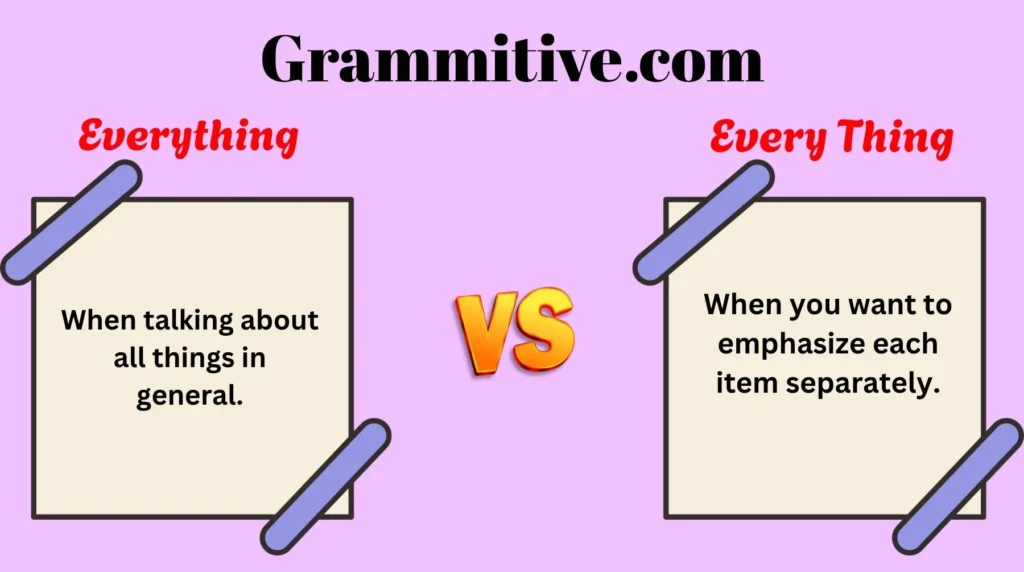
- When talking about all things in general.
- When you mean “all that exists” or “all the things in a group.”
- When referring to things as a complete set.
Grammar Rule
- “Everything” is singular. You use singular verbs with it.
- Example: Everything is ready. Not: Everything are ready.
Example Sentences
- Everything in the house is clean.
- She knows everything about the project.
- I tried everything, but nothing worked.
- Everything seems perfect today.
- He wants to do everything by himself.
- Everything will be fine if we follow the plan.
- I love everything about this city.
- Everything is included in the price.
Common Learner Confusion
Many learners think “everything” is plural because it talks about multiple things, but remember it is singular in grammar. Also, learners sometimes try to write it as “every thing,” which is usually incorrect.
What Does “Every Thing” Mean?
“Every thing” is two words. It means each individual item in a group, emphasizing them one by one rather than as a whole. It is less common in modern English but still correct in specific contexts.
When to Use “Every Thing”
- When you want to emphasize each item separately.
- When you are being precise or formal.
- Often used in instructions or lists.
Grammar Rule
- “Every” is an adjective, and “thing” is a singular noun.
- You also use singular verbs with it.
- Example: Every thing has its place.
Example Sentences
- Every thing on the list must be checked.
- She noticed every thing in the room.
- Every thing he said was important.
- Make sure every thing is ready before the party.
- Every thing must fit into the box.
- He inspects every thing carefully.
- Every thing has a reason.
- I want to understand every thing about this issue.
Common Learner Confusion
Some learners use “everything” instead of “every thing” when they mean to highlight items individually. For example, “Check everything on the list” is okay, but “Check every thing on the list” stresses each item separately.
Difference Between Everything and Every Thing
Understanding the difference is easier when you see it in a comparison.
| Feature | Everything | Every Thing |
|---|---|---|
| Form | One word | Two words |
| Meaning | All things as a whole | Each individual item |
| Grammar | Singular pronoun | Singular noun + adjective |
| Usage | General, informal, spoken | Specific, formal, precise |
| Example | Everything is ready. | Every thing on the desk is ready. |
| Emphasis | Group/whole | Individual items |
| Common Confusion | Thought plural, written as two words | Often written as one word incorrectly |
Usage Difference
- Everything: Focuses on totality.
- Every thing: Focuses on each component.
Sentence Structure Difference
- Everything: Subject + verb
- Example: Everything is perfect.
- Every thing: Every + singular noun + verb
- Example: Every thing is perfect.
Meaning Comparison
- Everything: “all at once”
- Every thing: “each one individually”
Grammar Rules You Must Remember
Rule #1: Everything is singular
- Correct: Everything is ready.
- Incorrect: Everything are ready.
Rule #2: Every thing is singular
- Correct: Every thing has its own color.
- Incorrect: Every thing have its own color.
Rule #3: Everything cannot be broken into parts
- Correct: Everything is important.
- Wrong: Every thing is important (unless emphasizing individual items).
Rule #4: Use every thing for formal or detailed writing
- Example: Every thing must be checked before shipment.
- Everyday spoken English often uses everything instead.
Common Mistakes Students Make
Many learners make mistakes because English is flexible, and pronunciation is the same. Here’s why:
Mistake #1: Writing “every thing” when “everything” is correct
- Wrong: I packed every thing for the trip.
- Correct: I packed everything for the trip.
Mistake #2: Using plural verbs with everything
- Wrong: Everything are ready.
- Correct: Everything is ready.
Mistake #3: Confusing emphasis
- Wrong: Everything on the list must be checked. (if you mean each item)
- Correct: Every thing on the list must be checked.
Easy Correction Tips:
- Ask yourself: Am I talking about the group as a whole or individual items?
- Remember: Everything = all together; Every thing = each item.
Easy Trick to Remember the Difference
Think of it like this:
- Everything = one thing made of many (like a cake). You eat the whole cake at once.
- Every thing = each ingredient in the cake. You look at each ingredient separately.
Another way:
- Everything = all in one basket.
- Every thing = each in separate baskets.
This trick helps you decide whether to write it as one word or two.
Daily Life Examples
- I want to see everything in the museum. (whole museum)
- Check every thing in your bag. (each item)
- She loves everything about the city. (all aspects)
- Every thing on the desk needs cleaning. (each object)
- I tried everything to fix my phone. (all methods)
- Every thing he owns is valuable. (each item individually)
- Everything is ready for the party. (the whole preparation)
- Every thing on the menu looks delicious. (each dish)
- He explained everything clearly. (all information)
- Every thing in this box must be counted. (individual objects)
Practice Section
Choose the correct option:
- I packed ___ for the picnic. (everything / every thing)
- ___ on the shelf needs dusting. (Everything / Every thing)
- She knows ___ about the topic. (everything / every thing)
- ___ on the list is checked. (Everything / Every thing)
- I love ___ about this town. (everything / every thing)
Answers:
- everything
- Every thing
- everything
- Every thing
- everything
FAQs
Q1: What is the difference between everything and every thing? A: Everything is used for all things together; every thing emphasizes each item individually.
Q2: Can we use everything in questions? A: Yes. Example: Did you see everything in the store?
Q3: Is every thing formal or informal? A: Every thing is more formal and precise; everything is common in everyday speech.
Q4: Can everything and every thing be used interchangeably? A: Sometimes in casual conversation, but for clarity, it’s better to use them correctly.
Q5: Why do learners confuse these words? A: They sound identical, but one is a pronoun (everything) and the other is adjective + noun (every thing).
Q6: Is everything singular or plural? A: Singular. You should use singular verbs with everything.
Final Conclusion
Understanding “everything” and “every thing” is simple once you know the rule: one word for all together, two words for each item.
Using them correctly makes your English sound natural and clear. Pay attention to context, and notice whether you mean the group or individual items.
Practice with real-life sentences, and soon choosing the right form will become automatic.
Remember, the difference is small but important, and mastering it will make your English stronger and more confident.

I am Lucas Bennett, a digital content creator passionate about social media trends and online growth strategies.
I share practical insights and guides to help users better understand and navigate the digital world.