

English learners often stumble over small words that seem simple but carry hidden rules. One of these tricky spots is knowing whether to say “everyone was” or “everyone were.”
On the surface, it might feel like a small choice. After all, both sound correct in different situations.
But using the wrong form can make your sentences sound awkward or even grammatically wrong.
Why is this confusing? The word “everyone” refers to all people in a group, but it behaves like a singular noun in grammar.
That’s counterintuitive because we naturally think of “everyone” as many people, not just one.
Because of this mismatch between meaning and grammar, learners often make mistakes, especially when writing essays, chatting online, or speaking in formal settings.
Understanding the difference between “everyone was” and “everyone were” is important.
It helps you speak clearly, write correctly, and even sound more natural in English conversations.
After mastering this rule, you will confidently know which verb to use with everyone, whether it’s past tense stories, polite invitations, or hypothetical situations.
By the end of this guide, you will:
- Know why everyone takes singular or plural verbs.
- Avoid common mistakes in past tense sentences.
- Use everyone was and everyone were naturally in daily English.
- Practice with real-life examples and exercises.
Let’s unpack this step by step in a simple, easy-to-understand way.
What Does “Everyone Was” Mean?
Definition:
“Everyone was” is used when talking about all the people in a group as a single unit in the past. The verb was is the singular past tense of to be, which agrees with everyone as a singular noun.
When to Use:
- To describe a fact about a group of people in the past.
- To describe feelings, actions, or situations involving the whole group.
Grammar Rule:
Even though everyone refers to multiple people, it is grammatically singular. Therefore, the correct verb is always was, not were, in normal statements.
Examples:
- Everyone was happy at the party yesterday.
- Everyone was excited to meet the new teacher.
- During the trip, everyone was tired but smiling.
- Everyone was ready when the bus arrived.
- Last week, everyone was talking about the festival.
- Everyone was invited to the meeting.
- After the exam, everyone was relieved.
- Everyone was surprised by the announcement.
Common Learner Confusion:
Many learners think everyone is plural because it refers to a group. That’s why you might hear “Everyone were happy,” which is incorrect in standard English. Remember: everyone = singular, so it takes was.
What Does “Everyone Were” Mean?
Definition:
“Everyone were” is less common and usually appears in hypothetical or formal contexts. It is often used in the subjunctive mood to talk about wishes, suggestions, or unreal situations.
When to Use:
- In sentences that describe imaginary or contrary-to-fact scenarios.
- Often follows phrases like “if”, “wish”, or “as if.”
Grammar Rule:
- The subjunctive mood uses were for all singular and plural subjects in hypothetical situations.
- In normal past statements, everyone were is incorrect.
Examples:
- If everyone were on time, we could start the meeting earlier.
- I wish everyone were here to see this.
- It would be great if everyone were happy.
- Imagine if everyone were able to speak five languages!
- Suppose everyone were given the same chance, what would happen?
- If everyone were more careful, accidents would decrease.
- I wish everyone were aware of the new rules.
- If everyone were participating, the game would be more fun.
Common Learner Confusion:
Learners often think that because everyone refers to many people, it should naturally take were. The key is to recognize that “everyone were” only works in hypothetical or imagined situations. In most past-tense facts, everyone was is correct.
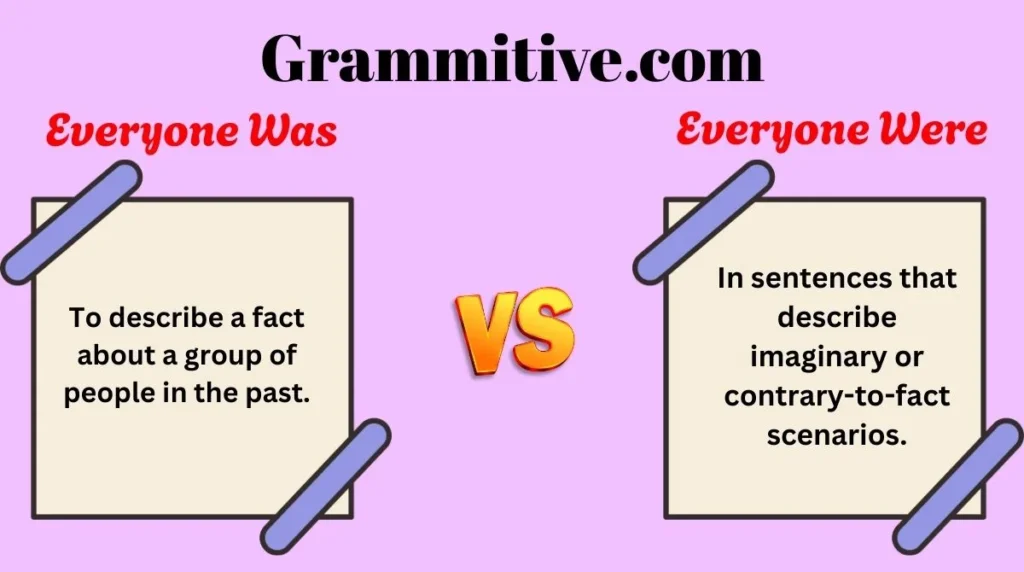
Difference Between “Everyone Was” and “Everyone Were”
Understanding the difference is much easier when we break it into a comparison.
| Feature | Everyone Was | Everyone Were |
|---|---|---|
| Verb type | Singular past (was) | Subjunctive past (were) |
| Usage | Real past events | Hypothetical or imagined situations |
| Examples | Everyone was happy yesterday. | If everyone were rich, life would be easier. |
| Grammar logic | “Everyone” treated as singular | “Everyone” used in subjunctive mood |
| Sentence structure | Normal past tense sentence | Usually follows “if”, “wish”, or “as if” |
| Meaning | Fact | Unreal or imagined scenario |
Usage Difference Explained:
- Use everyone was for reality: “Everyone was at school.”
- Use everyone were for imagination, hope, or condition: “I wish everyone were at school.”
Grammar Logic:
- Was = singular past, fact
- Were = subjunctive, unreal past
Sentence Structure Difference:
- Statement: “Everyone was happy.”
- Hypothetical: “If everyone were happy, life would be perfect.”
Meaning Comparison:
- “Everyone was” → past reality.
- “Everyone were” → unreal, imagined, or wished scenario.
Grammar Rules You Must Remember
Rule #1: “Everyone” is singular
- Example: Everyone was excited about the trip.
- Even though it refers to a group, treat it as singular.
Rule #2: Use “was” in past statements
- Example: Everyone was present at the party.
- Don’t use were for real past events.
Rule #3: Use “were” in hypothetical or wished situations
- Example: I wish everyone were more careful.
- Subjunctive mood always uses were for unreal conditions.
Rule #4: Identify context first
- Past reality → use was
- Imaginary → use were
- Example: “If everyone were honest, the world would be better.”
Common Mistakes Students Make
Mistake 1: Treating “everyone” as plural
- ❌ Everyone were happy at the park.
- ✅ Everyone was happy at the park.
Mistake 2: Using “was” in wishes or unreal situations
- ❌ I wish everyone was at the meeting.
- ✅ I wish everyone were at the meeting.
Mistake 3: Mixing up past tense storytelling with subjunctive
- ❌ If everyone was rich, we would buy a yacht.
- ✅ If everyone were rich, we would buy a yacht.
Why Mistakes Happen:
- Learners naturally think of “everyone” as “all people.”
- Subjunctive mood is less familiar in English classes.
Easy Correction Tips:
- Ask yourself: Is this real or imagined?
- Real → was, Imagined → were
- Remember “wish” + were always.
Easy Trick to Remember the Difference
Memory Trick:
- “WAS” = We Actually Saw it → real past
- “WERE” = We Envision Reality Else → imagined or wished
Student-Friendly Explanation:
Think of was as telling a story that really happened. Think of were as dreaming about what could happen. If it’s a fact, it’s was. If it’s a wish, it’s were.
Real-Life Logic:
- Past birthday party → Everyone was happy.
- Imagined perfect birthday → I wish everyone were happy.

Daily Life Examples (Spoken English)
- Everyone was tired after the long journey.
- Everyone was laughing at the joke.
- Everyone was watching the fireworks last night.
- I wish everyone were more patient with each other.
- If everyone were careful, accidents would be fewer.
- Everyone was invited to the picnic.
- Everyone was talking about the new movie.
- Imagine if everyone were learning a new language!
- Everyone was shocked when the news came.
- Everyone was smiling in the group photo.
Practice Section
Choose the correct option:
- Everyone ___ at the concert yesterday. (was/were)
- I wish everyone ___ on time tomorrow. (was/were)
- Everyone ___ ready when the teacher arrived. (was/were)
- If everyone ___ here, we could start the game. (was/were)
- Everyone ___ excited about the surprise party. (was/were)
Answers:
- was
- were
- was
- were
- was
FAQs
Q1: What is the difference between everyone was and everyone were?
A1: “Everyone was” describes real past events. “Everyone were” is used in hypothetical or wished situations.
Q2: Can we use everyone were in statements?
A2: Only in imagined or unreal contexts. For normal past events, always use “everyone was.”
Q3: Is everyone was formal or informal?
A3: It is neutral and can be used in both formal and informal contexts.
Q4: Can I say “Everyone were happy yesterday”?
A4: No. Use “Everyone was happy yesterday” because it’s a real past event.
Q5: Why do learners confuse was and were with everyone?
A5: Because “everyone” refers to multiple people, learners often think it should take a plural verb.
Q6: How do I remember when to use were?
A6: Use “were” after words like “if” or “wish” to indicate something imagined, not real.
Final Conclusion
Understanding everyone was and everyone were is simpler than it seems once you know the rule.
Remember, everyone is singular in grammar, so most of the time, you will use was to describe real past events. Use were only in imagined, wished, or hypothetical situations.
Mistakes happen because our brains naturally focus on meaning rather than grammar rules. By thinking:
real = was, imagined = were, you can avoid common errors. Practicing daily with real-life sentences, like talking about friends, school, or work, will make this rule second nature.
The key is not to overthink. Speak and write in context, and soon it will feel natural to choose the right verb with everyone.
With consistent practice, your English will sound accurate and confident. Start noticing these sentences in conversations, movies, or books, and try using them yourself.
Soon, “everyone was” or “everyone were” will no longer be confusing—it will just feel right.

I am Lucas Bennett, a digital content creator passionate about social media trends and online growth strategies.
I share practical insights and guides to help users better understand and navigate the digital world.