
Many English learners feel confused when they see the words especially and particularly. At first, they look almost the same.
Both words talk about something special, important, or more than others. Both are adverbs. Both often come before adjectives or nouns.
So students start to think, “Are they the same word?”
Not exactly.
In daily English, using the wrong one does not always cause a big problem. People may still understand you.
But your sentence may sound strange, unnatural, or slightly wrong. Native speakers can feel the difference, even if they cannot explain it.
This small difference matters a lot in speaking, writing, exams, and professional English.
For example, in essays, emails, or presentations, choosing the right word makes your English sound more clear and confident.
The good news is that this topic is not difficult once you understand the logic behind each word.
After reading carefully, you will clearly know:
- what especially really means
- what particularly really means
- when they are similar
- when they are different
- how native speakers use them in daily life
- and how to never mix them up again
By the end, you’ll feel comfortable using both naturally in conversation.
What Does “Especially” Mean?
Simple definition
Especially means:
👉 more than others
👉 in a special way
👉 more important than the rest
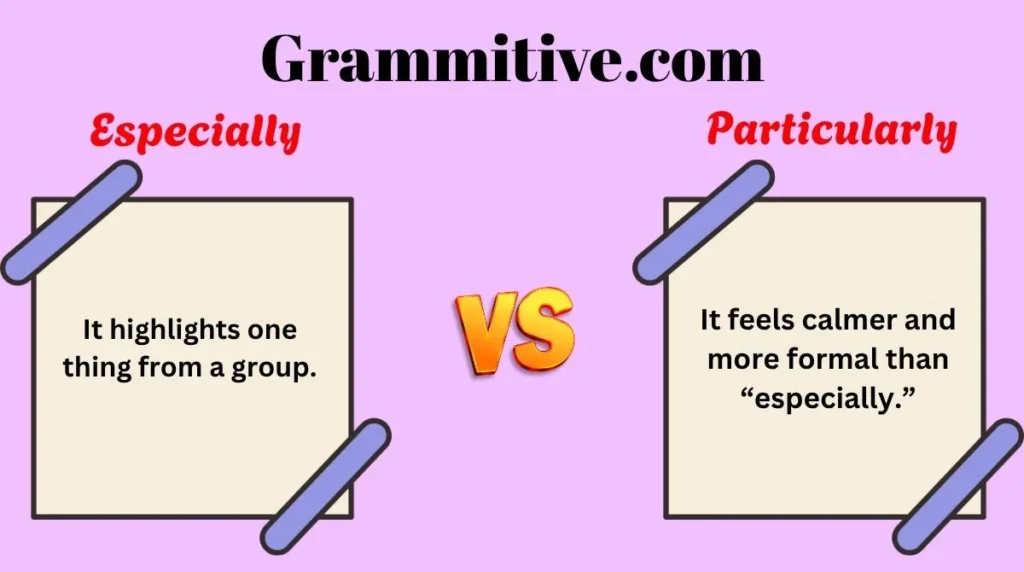
It highlights one thing from a group.
Think of it like a spotlight. You shine light on one thing and say, “This one is special.”
When to use it
Use especially when:
- something is extra important
- you like something more than others
- you want to emphasize one thing
- you talk about feelings, preferences, or strong reasons
It often shows emotion or emphasis.
Grammar rule
Especially usually comes:
- before adjectives
- before prepositional phrases
- sometimes at the beginning or middle of a sentence
Structure examples:
- especially + adjective
- especially + noun phrase
- especially when/if/because
Examples
- I love fruits, especially mangoes.
- This road is dangerous, especially at night.
- She enjoys music, especially classical songs.
- I feel tired, especially after work.
- Kids love sweets, especially chocolate.
- He was nervous, especially during the exam.
- Winter is cold, especially in the mountains.
- I like all sports, especially football.
Common learner confusion
Students often think especially = very.
❌ I am especially happy today.
(This sounds a bit unnatural unless you compare something.)
Better:
✔ I am especially happy because you came.
It usually compares something with others, even if the comparison is not directly said.
What Does “Particularly” Mean?
Simple definition
Particularly means:
👉 specifically
👉 in detail
👉 more than usual
👉 exactly this one
It focuses on precision, not emotion.
It feels calmer and more formal than “especially.”
When to use it
Use particularly when:
- you want to be specific
- you talk about details
- you explain something carefully
- you write formally
- you talk about facts or opinions
It sounds more logical than emotional.
Grammar rule
Particularly usually comes:
- before adjectives
- before nouns
- before negative statements
- in formal writing
Structures:
- particularly + adjective
- particularly + noun
- not particularly
Examples
- I am particularly interested in science.
- She didn’t like the movie, particularly the ending.
- This job is particularly difficult.
- He speaks particularly slowly.
- I’m not particularly hungry.
- The teacher was particularly strict today.
- This book is particularly useful for beginners.
- Nothing particularly special happened.
Common learner confusion
Students use it to show strong emotion.
❌ I particularly love you.
(This sounds odd and too formal.)
Better:
✔ I especially love you.
“Particularly” sounds less emotional, more factual.
Difference Between Especially and Particularly (Detailed)
Here’s where things become clearer.
Both words show importance, but the feeling is different.
Quick Comparison Table
| Feature | Especially | Particularly |
|---|---|---|
| Feeling | emotional | logical/neutral |
| Use | highlight favorite or special thing | focus on specific detail |
| Tone | informal, natural | slightly formal |
| Common in speech | very common | less common |
| Common in writing | yes | very common |
| Shows preference | yes | sometimes |
Usage difference
Especially = strong emphasis or feeling
Particularly = careful focus or precision
Compare:
- I like winter, especially snow. (snow is my favorite)
- I like winter, particularly in December. (specific time)
Grammar logic
Especially → compares one thing with others
Particularly → narrows down to one specific thing
It’s about emotion vs detail.
Sentence structure difference
- especially + noun
- particularly + adjective or detail
Examples:
✔ especially my sister
✔ particularly useful
Meaning comparison
Look at these:
- I like this teacher, especially her smile.
→ emotional preference - I like this teacher, particularly her teaching style.
→ specific reason
Small difference, but very natural for native speakers.
Grammar Rules You Must Remember
Rule #1 – Use “especially” for favorites
✔ I like all desserts, especially cake.
Not: particularly cake (sounds too cold)
Rule #2 – Use “particularly” for specific detail
✔ This lesson is particularly important for beginners.
Not: especially important (possible, but less precise)
Rule #3 – “Not particularly” is very common
✔ I’m not particularly interested.
We rarely say “not especially interested.”
Rule #4 – Formal writing prefers “particularly”
✔ This method is particularly effective.
Sounds more academic and professional.
Common Mistakes Students Make
Why mistakes happen
Because both words seem similar in dictionaries. Many translations show the same meaning. But usage is different.
Learners translate directly from their language.
Mistake 1
❌ I particularly love my mom.
✔ I especially love my mom.
Reason: emotion → use especially
Mistake 2
❌ This tool is especially useful for engineers.
✔ This tool is particularly useful for engineers.
Reason: formal/specific → particularly
Mistake 3
❌ I’m not especially interested.
✔ I’m not particularly interested.
“Not particularly” is the natural phrase.
Easy correction tip
Ask yourself:
👉 Feeling or detail?
Feeling → especially
Detail → particularly
Easy Trick to Remember the Difference
Here’s a simple memory trick my students love.
Think like this:
Especially = Special + Feeling
If something feels special to you → use especially.
Particularly = Part + Detail
You talk about one part or detail → use particularly.
So:
- favorite food → especially
- specific reason → particularly
Easy and fast.
Daily Life Examples (Very Important)
These are real spoken sentences you may hear every day:
- I love street food, especially samosas.
- I’m tired today, especially after walking so much.
- She didn’t enjoy the trip, particularly the hotel.
- This phone is particularly good for photos.
- I miss my family, especially my grandmother.
- I’m not particularly worried about the test.
- That joke was funny, especially the last part.
- This chair is particularly comfortable.
- I like all colors, especially blue.
- He isn’t particularly friendly with strangers.
These sound very natural in everyday English.
Practice Section
Choose the correct word: especially or particularly.
- I like tea, ______ green tea.
- This lesson is ______ useful for exams.
- I’m not ______ hungry right now.
- She was nervous, ______ before the interview.
- This rule is ______ important for beginners.
Answers
- especially
- particularly
- particularly
- especially
- particularly
FAQs
What is the difference between especially and particularly?
Especially shows emotion or preference. Particularly shows specific detail or precision. One feels warm, the other feels logical.
Can we use especially in questions?
Yes.
Example: Do you like any fruit, especially mangoes?
It sounds natural when you highlight something.
Can we use particularly in questions?
Yes, mostly in formal speech.
Example: Are you particularly interested in science?
It sounds more careful and specific.
Which one is more formal?
Particularly is more formal. It is common in essays, reports, and academic writing.
Can they sometimes replace each other?
Sometimes yes, but the feeling changes. The sentence may sound slightly different or less natural.
Why do native speakers say “not particularly”?
Because it is a fixed, natural phrase. It means “not very.” It is very common in daily English.
Final Conclusion
Understanding small words like especially and particularly can make a big difference in your English.
These two words look similar, but they carry different feelings. One shows emotion and preference. The other shows detail and precision.
When you talk about favorites or something special in your heart, choose especially. When you explain something specific or write formally, choose particularly.
Don’t worry if you mix them sometimes. Even many learners at higher levels make this mistake.
What helps most is practice. Listen to movies, read books, and notice how native speakers use these words.
Try using them in your daily conversations. Say simple sentences. The more you use them, the more natural they will feel.
Small improvements like this slowly build strong, confident English.
Keep practicing. You’re doing great.

I am Lucas Bennett, a digital content creator passionate about social media trends and online growth strategies.
I share practical insights and guides to help users better understand and navigate the digital world.