
English questions can feel tricky, especially when two small phrases look almost the same but mean different things. One of the most confusing pairs for learners is do you and are you.
Many students say things like:
❌ Do you happy?
❌ Are you like coffee?
Both sound strange to native speakers, but learners often mix them up because both are used in questions.
Both come at the beginning of a sentence. And both talk about “you.” So it’s easy to feel unsure.
But here’s the good news: the difference is not hard once you see the pattern.
These two forms follow different grammar rules and ask different types of questions. One talks about actions, and the other talks about states, feelings, or conditions.
When you understand this idea, everything becomes clearer.
By the end, you will know:
- when to use each form
- how to build questions correctly
- how native speakers use them in daily life
- and how to avoid common mistakes
Step by step, everything will make sense.
What Does “Do You” Mean?
Simple definition
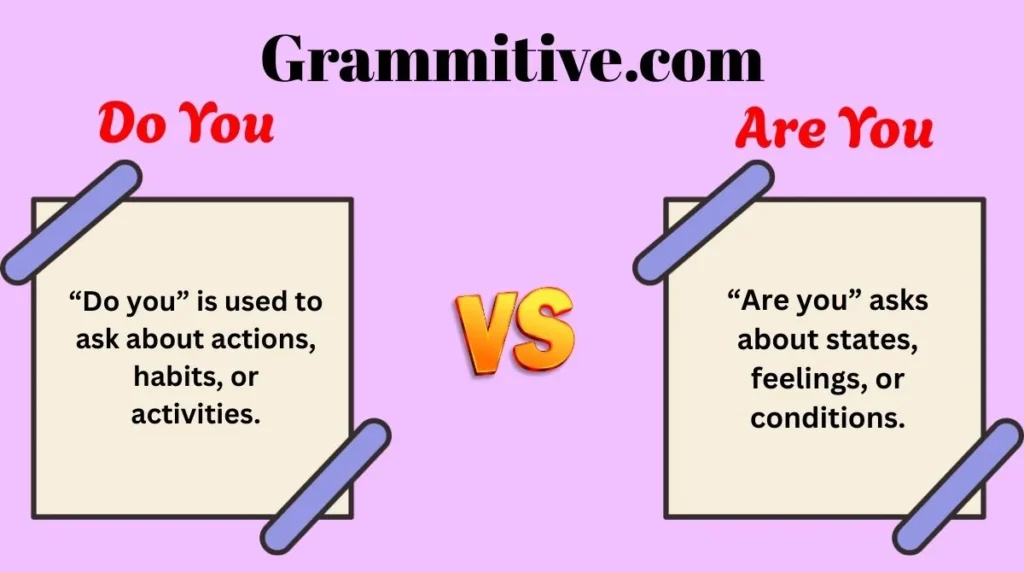
“Do you” is used to ask about actions, habits, or activities.
It comes from the verb do, which helps us make questions in the present simple tense.
If something is an action you can do, choose do you.
When to use it
Use do you when asking about:
- habits
- routines
- likes/dislikes
- actions
- behaviors
- facts
Basically, things people do, not things people are.
Grammar rule
Structure:
Do + subject (you) + base verb
Formula:
Do you + verb?
Notice something very important:
After do you, the verb must stay in base form.
Not:
❌ Do you goes
❌ Do you going
Correct:
✅ Do you go
✅ Do you like
Examples
- Do you like coffee?
- Do you play football?
- Do you work on weekends?
- Do you live here?
- Do you watch movies at night?
- Do you understand this lesson?
- Do you drive to work?
- Do you need help?
All of these ask about actions.
Common learner confusion
Many students think:
“Happy is about me, so maybe I use do you?”
But adjectives (happy, tired, hungry) are not actions.
You cannot “do happy.”
So don’t use do you with adjectives.
❌ Do you happy?
❌ Do you tired?
These are wrong.
We’ll soon see the correct form.
What Does “Are You” Mean?
Simple definition
“Are you” asks about states, feelings, or conditions.
It uses the verb to be (am / is / are).
This verb describes what someone is, not what someone does.
When to use it
Use are you when talking about:
- feelings
- emotions
- health
- age
- jobs
- identity
- location
- descriptions
Think of it as describing a situation or state.
Grammar rule
Structure:
Are + subject (you) + adjective/noun/phrase
Formula:
Are you + description?
No action verb comes after directly.
Examples
- Are you happy?
- Are you tired?
- Are you ready?
- Are you a teacher?
- Are you at home?
- Are you busy today?
- Are you sick?
- Are you okay?
All of these describe a condition or state.
Common learner confusion
Many learners add a verb after are you incorrectly.
❌ Are you like pizza?
❌ Are you play football?
Wrong, because like and play are action verbs.
Use do you for those.
Difference Between Do You and Are You (Detailed)
This is where everything becomes simple.
The difference is mainly about:
👉 Action vs State
Here’s a clear comparison.
| Feature | Do you | Are you |
|---|---|---|
| Verb type | Action verbs | Be verb |
| Talks about | Actions & habits | Feelings & conditions |
| Grammar | Do + you + verb | Are + you + adjective/noun |
| Example | Do you work? | Are you tired? |
| Meaning | Something you do | Something you are |
Usage difference
Do you → asks what you do
Are you → asks what you are or how you feel
Compare:
- Do you work today? (action)
- Are you tired today? (feeling)
Different meanings, different structures.
Grammar logic
Why does English use do?
Because present simple questions need a helper verb.
Example:
You like pizza.
To ask a question → add “do”
Do you like pizza?
But the verb be does not need a helper.
You are happy.
Just switch:
Are you happy?
Easy.
Sentence structure difference
Do you + verb
- Do you cook?
- Do you study?
Are you + adjective/noun
- Are you hungry?
- Are you a student?
Meaning comparison
Let’s compare side by side:
- Do you cook? → action
- Are you a cook? → job/identity
Big difference.
Grammar Rules You Must Remember
Rule #1 — Use “do” with action verbs
If the word is something you can do physically or mentally, use do you.
Example:
Do you drive?
Rule #2 — Use “are” with adjectives
Feelings or descriptions need are you.
Example:
Are you nervous?
Rule #3 — Don’t use “do” with the verb “be”
Never say:
❌ Do you be happy?
Correct:
✅ Are you happy?
Rule #4 — No “ing” after “do you”
Use base form only.
❌ Do you going?
✅ Do you go?
Common Mistakes Students Make
Why mistakes happen
Students often:
- translate from their first language
- think all questions need “do”
- confuse verbs and adjectives
English separates these clearly, but many languages don’t.
Wrong vs Correct examples
❌ Do you tired?
✅ Are you tired?
❌ Are you like tea?
✅ Do you like tea?
❌ Do you happy today?
✅ Are you happy today?
❌ Are you work here?
✅ Do you work here?
Easy correction tips
Ask yourself:
👉 Is it an action? → use do
👉 Is it a feeling/state? → use are
This quick check fixes most mistakes.
Easy Trick to Remember the Difference
Here’s a simple memory trick students love.
Think:
Do = Do something
Are = Are something
If you can add the word “something” naturally, use do.
Do you eat something? ✔
If you can add “something”, it sounds wrong, then use are.
Are you something? (No)
Instead:
Are you happy? ✔
So:
Action → do
Description → are
Keep it simple.
Daily Life Examples (Very Important)
Here’s how real people speak every day.
Conversation style sentences
- Do you need help with your homework?
- Are you free this evening?
- Do you watch TV before bed?
- Are you hungry? Let’s eat.
- Do you like this music?
- Are you cold? Close the window.
- Do you use Instagram?
- Are you ready to go?
- Do you work tomorrow?
- Are you excited about the trip?
You hear these kinds of questions all the time in shops, homes, schools, and offices.
Practice Section
Choose the correct option.
Questions
- ___ you like chocolate?
- ___ you busy today?
- ___ you play tennis?
- ___ you sick?
- ___ you understand this lesson?
Answers
- Do
- Are
- Do
- Are
- Do
FAQs
What is the difference between “do you” and “are you”?
“Do you” asks about actions or habits. “Are you” asks about states or feelings. One uses action verbs, the other uses the verb “be.”
Can we use “do you” in questions only?
Mostly yes. It is commonly used to form present simple questions and negatives. It helps the main verb.
Can we use “are you” with verbs?
Only with “be + -ing” forms like: “Are you working?” For simple verbs like “like” or “eat,” use “do you.”
Is “do you” formal or informal?
It works in both. You can use it with friends or in professional situations. It’s normal everyday English.
Why can’t we say “Do you happy”?
Because “happy” is an adjective, not an action. “Do” works only with action verbs. Use “Are you happy?”
Which is more common in daily speech?
Both are extremely common. You will hear them many times every day. They just serve different purposes.
Final Conclusion
Small grammar differences can feel confusing at first, but they become easy when you understand the logic behind them. The key idea is simple: actions need “do,” and states need “are.”
When you ask about habits, routines, or things someone does, choose do you. When you ask about feelings, identity, or condition, choose are you.
That’s it.
Practice by listening to real conversations. Notice how people speak. Try making your own questions every day. Even five minutes of practice helps a lot.
Soon, you won’t need to think about the rule. It will feel natural, just like native speakers.
Keep practicing, keep speaking, and your English will grow faster than you expect.

I am Lucas Bennett, a digital content creator passionate about social media trends and online growth strategies.
I share practical insights and guides to help users better understand and navigate the digital world.