

Many English learners feel confused when they see “do not” and “don’t.”
They look almost the same. They mean almost the same thing. So why are there two forms?
You might hear a teacher say, “Do not talk.”
But your friend says, “Don’t talk.”
Which one is correct?
Should you use the long form or the short form?
Is one more polite? More formal? More natural?
These small questions create big confusion, especially for beginners and non-native speakers.
In daily English, we use negative sentences all the time. We say things like “don’t worry,” “don’t forget,” or “do not enter.”
If you don’t understand the difference between the two forms, your English may sound too formal, too casual, or sometimes unnatural.
The good news is that this topic is actually very simple once you see the logic behind it.
By the end, you’ll clearly understand:
- what each form means
- when to use each one
- the grammar rules
- common mistakes
- easy memory tricks
- real-life conversation examples
After that, choosing the correct form will feel natural, just like a native speaker.
What Does “Do Not” Mean?
Simple definition
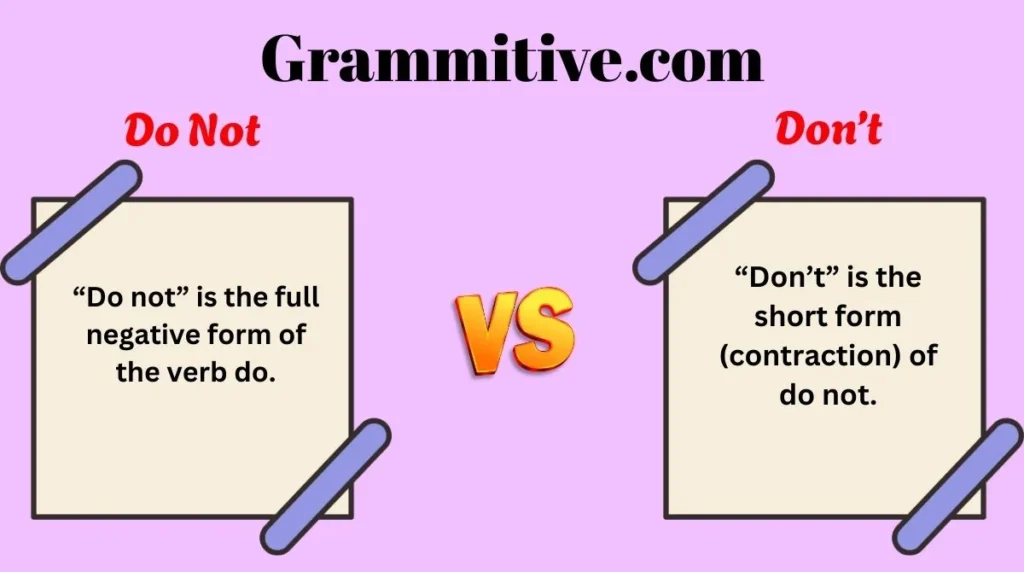
“Do not” is the full negative form of the verb do.
It is used to say no, refuse, or tell someone not to do something.
It is the formal or stronger version.
When to use it
Use do not when:
- writing formally
- giving instructions
- making rules
- showing strong emphasis
- writing academic or official text
It sounds serious and clear.
Grammar rule
Structure:
Subject + do/does + not + base verb
Examples:
- I do not like coffee.
- They do not understand.
- She does not work here.
Notice:
For he/she/it, we use does not, not do not.
Example sentences
- I do not agree with this plan.
- Please do not touch the machine.
- They do not live here anymore.
- Do not open the door.
- We do not accept late homework.
- He does not know the answer.
- Do not worry about the test.
- She does not eat meat.
Common learner confusion
Many students think “do not” is old or unnatural. That is not true.
Native speakers still use it — just mostly in:
- writing
- rules
- serious speech
For example:
- Do not smoke.
- Do not enter.
- Do not disturb.
You often see these on signs.
What Does “Don’t” Mean?
Simple definition
“Don’t” is the short form (contraction) of do not.
It means exactly the same thing, but it sounds more natural, relaxed, and conversational.
When to use it
Use don’t when:
- speaking
- chatting with friends
- casual writing
- daily conversation
- texting
It feels friendly and modern.
Grammar rule
Don’t = do + not
Structure:
Subject + don’t + base verb
Examples:
- I don’t like tea.
- They don’t understand.
For he/she/it → doesn’t, not don’t.
Example sentences
- I don’t like spicy food.
- Don’t run in the hallway.
- They don’t watch TV much.
- Don’t forget your keys.
- We don’t have time.
- Don’t be late.
- I don’t feel well today.
- Don’t worry, everything is fine.
Common learner confusion
Some students believe contractions are “bad grammar.” That’s a myth.
Native speakers use contractions all the time.
In fact, if you always say “do not” in casual speech, you may sound too formal or robotic.
Compare:
- I do not like it. (serious)
- I don’t like it. (normal, everyday)
The second one sounds more natural.
Difference Between Do Not and Don’t (Detailed)
Both forms mean the same thing, but the tone and situation are different.
Comparison table
| Feature | Do Not | Don’t |
|---|---|---|
| Type | Full form | Contraction |
| Tone | Formal/serious | Casual/natural |
| Common in | Writing, rules, instructions | Speaking, conversation |
| Length | Longer | Shorter |
| Emphasis | Strong | Soft/normal |
| Sounds | Strict | Friendly |
Usage difference
Do not feels stronger.
It can sound strict or official.
Example:
👉 Do not park here. (rule)
Don’t feels relaxed.
It sounds like everyday speech.
Example:
👉 Don’t park here. (friendly advice)
Grammar logic
Grammatically, there is no difference in meaning.
Don’t is simply a shorter version.
Think of it like:
- cannot → can’t
- will not → won’t
- do not → don’t
Same meaning. Just shorter.
Sentence structure difference
Structure stays the same:
- I do not understand
- I don’t understand
Only the form changes.
Nothing else.
Meaning comparison
Both sentences mean 100% the same:
- Do not worry.
- Don’t worry.
The only change is tone.
Grammar Rules You Must Remember
Rule #1 – Use “do not” for formal writing
Formal emails, school essays, instructions, and notices often use full forms.
Example:
✔ Students do not use phones during class.
Rule #2 – Use “don’t” in daily conversation
Most spoken English uses contractions.
Example:
✔ I don’t like horror movies.
Rule #3 – Use “doesn’t” with he/she/it
Never say: ❌ He don’t
Correct: ✔ He doesn’t
Example:
✔ She doesn’t drive.
Rule #4 – Use “do not” for strong emphasis
When you want to sound serious or strict.
Example:
✔ Do not press this button.
It feels stronger than “don’t.”
Common Mistakes Students Make
Why mistakes happen
Students often:
- translate from their language
- think contractions are wrong
- mix “don’t” with he/she/it
- use only one form everywhere
Mistake 1
❌ He don’t like pizza.
✔ He doesn’t like pizza.
Tip: remember “S” needs “doesn’t.”
Mistake 2
❌ Do not forget me, bro. (too formal for friends)
✔ Don’t forget me, bro.
Tip: casual speech → contractions.
Mistake 3
❌ Don’t enter. (for official sign)
Better:
✔ Do not enter.
Tip: rules/signs → full form.
Easy correction tips
Ask yourself:
- Formal or casual?
- Speaking or writing?
- Serious or friendly?
This quickly helps you choose.
Easy Trick to Remember the Difference
Here’s a simple memory trick.
Think of clothes.
- Do not = suit and tie (formal)
- Don’t = T-shirt and jeans (casual)
You wouldn’t wear a suit to play football.
And you wouldn’t wear pajamas to a wedding.
Same with English.
Match the style to the situation.
This makes it easy and fun to remember.
Daily Life Examples (Very Important)
These sound like real conversations you hear every day.
- Don’t worry, I’ll help you.
- I don’t understand this question.
- Don’t forget your lunch.
- We don’t have enough money.
- Don’t call me late at night.
- I don’t feel hungry.
- Don’t touch my phone.
- They don’t work on Sundays.
- Don’t be scared.
- I don’t like waking up early.
Now compare with formal style:
- Do not smoke inside.
- Do not feed the animals.
See the difference in tone? Much stricter.
Practice Section
Choose the correct option.
Questions
- ___ talk during the exam. (Do not / Don’t)
- I ___ like coffee. (do not / don’t)
- He ___ understand math. (don’t / doesn’t)
- ___ enter this room. It’s dangerous. (Do not / Don’t)
- We ___ have enough chairs. (don’t / do not)
Answers
- Do not
- don’t
- doesn’t
- Do not
- don’t
FAQs
1. What is the difference between do not and don’t?
They mean the same thing. “Do not” is formal and serious. “Don’t” is casual and used in everyday speech.
2. Can we use don’t in questions?
Yes. Example:
“Don’t you like pizza?”
It’s common in conversation.
3. Is don’t informal?
Yes. It’s more relaxed and natural. Perfect for speaking and texting.
4. Is do not more polite?
Sometimes. It sounds more respectful or official, especially in writing or instructions.
5. Which one do native speakers use more?
Native speakers mostly use “don’t” when talking. Contractions are very common in speech.
6. Can I always use do not instead of don’t?
Yes, grammatically you can. But it may sound too formal in normal conversation.
Final Conclusion
Understanding the difference between these two forms is easier than it looks.
Both express the same negative meaning. The real difference is style and tone, not grammar.
Use do not when writing formally, giving rules, or sounding serious.
Use don’t in daily conversation and relaxed speech.
That’s it.
When you listen to native speakers, you’ll notice contractions everywhere. So don’t be afraid to use them. They make your English sound smooth and natural.
Practice saying both forms aloud. Read signs. Listen to movies. Pay attention to how people speak.
Soon, choosing between the long and short form will feel automatic.
Small grammar details like this make a big difference in sounding confident and fluent.

