

Many English learners see the words director and co director and think, “They look almost the same… so they must mean the same.”
But that small word “co” changes everything.
This tiny prefix can confuse even good students.
Is a co director the same as an assistant?
Is the co director lower in rank?
Do both have equal power?
Can we use both words in business and movies?
These questions come up very often in classrooms.
You might hear:
- “She is the director of the company.”
- “He worked as co director of the film.”
Both sound similar, but the meaning is different.
Understanding this difference is important because these words appear in jobs, offices, schools, companies, films, and projects. If you use the wrong one, people may misunderstand someone’s role or authority.
After reading this full guide, you will clearly understand:
- what director means
- what co director means
- how they are different
- when to use each one
- grammar rules
- common mistakes
- easy memory tricks
- real-life examples
By the end, you’ll feel confident using both words naturally in daily English.
What Does “Director” Mean?
✅ Simple definition
A director is a person who is in charge of something.
They lead, manage, control, or guide a group, project, company, or activity.
Think of a director as the main decision-maker.
✅ When to use it
Use director when:
- one person leads something
- someone has the highest responsibility
- someone manages others
- talking about films, companies, schools, or departments
✅ Grammar rule
“Director” is a countable noun.
You can say:
- a director
- the director
- directors (plural)
It often comes with of + noun.
Structure:
director of + department/company/film/project
Examples:
- director of marketing
- director of the movie
- director of the school
✅ Example sentences (6–8)
- She is the director of the hospital.
- The director approved the plan.
- Our school director spoke to the parents.
- He wants to become a film director.
- The director hired five new workers.
- I emailed the director yesterday.
- The company has three directors on the board.
- The director made the final decision.
✅ Common learner confusion
Some students think director = manager.
Not exactly.
A manager handles daily tasks.
A director usually has higher authority and makes bigger decisions.
So, director is often more senior.
What Does “Co Director” Mean?
✅ Simple definition
A co director is a person who shares the director’s job with another director.
The key idea is shared responsibility.
Two (or more) people lead together.
They have equal or similar power.
✅ When to use it
Use co director when:
- two people lead the same project
- two people share control
- responsibility is divided
- teamwork leadership exists
Common in:
- films
- research projects
- companies
- nonprofit groups
- events
✅ Grammar rule
“Co” is a prefix meaning together or jointly.
co + director = co director (or co-director)
Both spellings are correct:
- co director
- co-director
Many modern style guides prefer co-director with a hyphen.
Plural:
- co directors / co-directors
Structure:
co director of + noun
✅ Example sentences (6–8)
- She worked as co director of the movie.
- They are co directors of the company.
- John and Maya are co directors of the program.
- The project has two co directors.
- He became co director after five years.
- Both co directors signed the contract.
- The co director helped plan the event.
- She shares duties with her co director.
✅ Common learner confusion
Many students think:
co director = assistant director
This is wrong.
An assistant director helps the director.
A co director shares equal authority.
That’s a big difference.
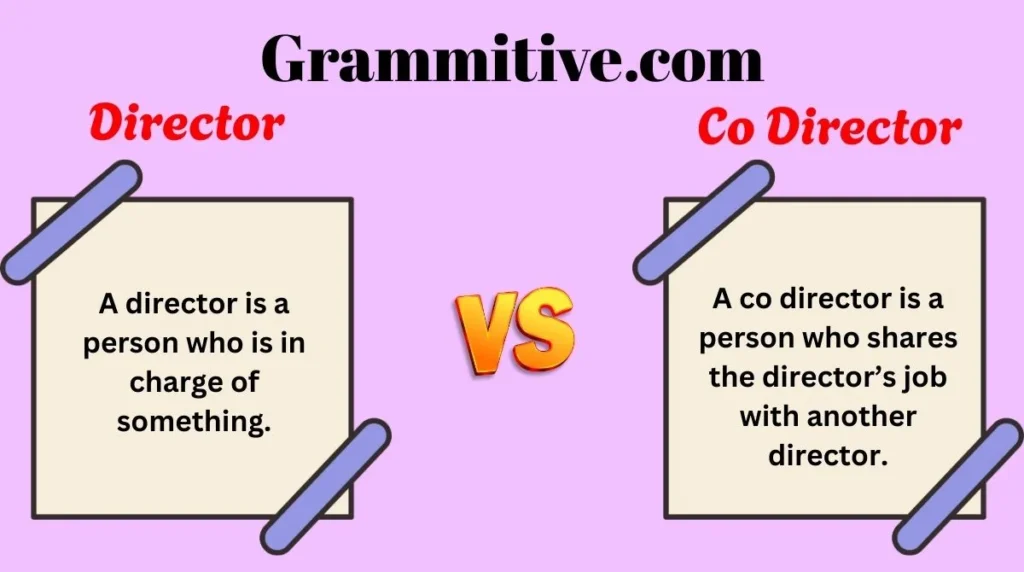
Difference Between Director and Co Director (Detailed)
Here is the clearest way to understand it.
✅ Quick comparison table
| Feature | Director | Co Director |
|---|---|---|
| Number of leaders | One | Two or more |
| Authority | Full control | Shared control |
| Meaning | Main leader | Joint leader |
| Prefix | None | “co” = together |
| Example | director of the film | co director of the film |
| Responsibility | Single | Shared |
✅ Usage difference
Director → one person leads
Co director → two people lead together
Examples:
- The director decided everything alone.
- The co directors discussed and decided together.
✅ Grammar logic
“Co” means:
- together
- jointly
- shared
Other examples:
- co worker
- co owner
- co author
- co pilot
Same idea.
So, a co director is simply a shared director role.
✅ Sentence structure difference
Director:
- She is the director of the film.
Co director:
- She is the co director of the film.
Notice:
Just one extra word changes the meaning.
✅ Meaning comparison
Director → leader
Co director → leader + partner
So:
director = solo leadership
co director = team leadership
Grammar Rules You Must Remember
✅ Rule #1: “Director” is countable
Correct:
- a director
- many directors
Wrong:
- much director
Example:
✔ The company has three directors.
✅ Rule #2: Use “co” only when leadership is shared
Wrong:
✘ She is the co director alone.
Correct:
✔ She is the director.
✔ She is a co director with Alex.
✅ Rule #3: Use “of” to show responsibility
Correct structure:
director of / co director of
Examples:
✔ director of sales
✔ co director of research
✅ Rule #4: Don’t confuse with assistant
Assistant director ≠ co director
Example:
✔ She is the assistant director (helper)
✔ She is the co director (equal leader)
Common Mistakes Students Make
❌ Mistake 1: Using co director for one person
Wrong:
✘ He is the co director of the company. (only one leader)
Correct:
✔ He is the director.
Why?
“Co” needs a partner.
❌ Mistake 2: Mixing with assistant director
Wrong:
✘ She is co director, so she helps the director.
Correct:
✔ She shares the director’s job.
Tip:
Assistant = help
Co = equal
❌ Mistake 3: Forgetting plural form
Wrong:
✘ Two co director
Correct:
✔ Two co directors
❌ Mistake 4: Wrong spelling
Sometimes students write:
✘ codirector
Better:
✔ co director
✔ co-director
✅ Easy correction tip
Ask yourself:
“Does this person share leadership?”
Yes → co director
No → director
Easy Trick to Remember the Difference
Here’s a simple memory trick students love.
Think of “co” = company or companion.
It means not alone.
So:
Director → alone
Co director → not alone
Or imagine:
Director = 1 chair
Co directors = 2 chairs
Two chairs = shared leadership
This mental picture helps you choose quickly.

Daily Life Examples (Very Important)
These are natural, spoken-style sentences you may hear.
- She’s the director of our language center.
- My brother is co director of a small startup.
- The two friends worked as co directors on the film.
- Please ask the director for permission.
- Both co directors attended the meeting.
- He became director after ten years of experience.
- They share the job as co directors.
- The director approved the budget.
- Our project has one director and two managers.
- The co directors solved the problem together.
Notice how natural and simple these sound.
That’s how English speakers use them in daily life.
Practice Section
Choose the correct word: director or co director.
Questions
- She is the ______ of the movie. (only one leader)
- Tom and Sam are ______ of the company.
- The ______ made the final decision alone.
- Both ______ signed the paper.
- He worked as ______ with his partner.
Answers
- director
- co directors
- director
- co directors
- co director
FAQs (SEO Focused)
1. What is the difference between director and co director?
A director leads alone and has full control.
A co director shares leadership with another person.
The main difference is single vs shared responsibility.
2. Can we use co director for one person?
No.
“Co” means together.
If only one person leads, use director.
3. Is co director formal or informal?
It is formal and common in business, films, and organizations.
You will often see it in job titles and official documents.
4. Is assistant director the same as co director?
No.
An assistant director helps.
A co director shares equal power.
They are very different roles.
5. Which spelling is correct: co director or co-director?
Both are correct.
Modern English often uses co-director with a hyphen.
Choose one style and stay consistent.
6. Where are these words commonly used?
You’ll hear them in movies, companies, schools, nonprofits, research teams, and events.
They describe leadership positions.
Final Conclusion
The difference between these two words is small in spelling but big in meaning.
A director stands alone at the top and makes decisions independently.
A co director stands beside another leader and shares the same responsibility.
That tiny prefix “co” changes the whole picture.
Once you remember that co = together, everything becomes easy.
Pay attention to the number of leaders.
Ask yourself if the job is shared or not.
Then your choice becomes clear.
Keep practicing with real-life sentences.
Notice how movies, companies, and schools use these titles.
Soon, you’ll use both words naturally and confidently, just like a native speaker.

I am Lucas Bennett, a digital content creator passionate about social media trends and online growth strategies.
I share practical insights and guides to help users better understand and navigate the digital world.