

Many English learners say sentences like “I didn’t had time” or “She didn’t went home.”
If you have ever said something like this, don’t worry. You are not alone.
This mistake is very common, even for students who study English for years. It happens because English grammar has a small but tricky rule about past tense verbs after “did.”
Your brain wants to use the past form twice. But English doesn’t work that way.
The problem usually starts with verbs like have → had, go → went, eat → ate, and others. When we add didn’t, many learners feel confused. Should we say had or have? Both sound possible. But only one is correct.
And this is not just a school rule. This structure appears every day in normal speaking:
- I didn’t have money
- We didn’t have time
- She didn’t have lunch
If you use the wrong form, native speakers still understand you, but it sounds unnatural and incorrect.
By the end of this guide, you will clearly understand:
- Why “didn’t had” is wrong
- Why “didn’t have” is correct
- The grammar rule behind it
- Easy tricks to remember
- Real-life examples and practice
After this, you won’t make this mistake again.
What Does “Didn’t Had” Mean?
Simple answer first:
“Didn’t had” is NOT correct English.
It has no proper meaning because the grammar is broken.
Still, many learners say it. So let’s understand why.
Why people say it
Students often think:
- have → had (past)
- didn’t → past
So they try to use two past forms together.
But English does not allow two past markers in the same verb phrase.
Grammar rule behind the problem
“Did” already shows the past.
So the main verb must go back to base form, not past form.
Wrong structure:
❌ didn’t + had
Correct structure:
✅ didn’t + have
Examples of the incorrect form (for learning only)
These sentences are wrong, but they show the common mistake:
- ❌ I didn’t had time.
- ❌ She didn’t had money.
- ❌ We didn’t had food.
- ❌ They didn’t had tickets.
- ❌ He didn’t had breakfast.
- ❌ I didn’t had a car.
You may hear learners say these, but native speakers never use them.
Common learner confusion
Students often ask:
“If it’s past, why can’t we use ‘had’?”
Because “did” already carries the past tense.
Adding “had” creates double past, which is grammatically wrong.
Think of it like wearing two watches on one hand. One is enough.
What Does “Didn’t Have” Mean?
Now we look at the correct and natural form.
Simple definition
“Didn’t have” means you did not possess, experience, or receive something in the past.
It talks about something missing in the past.
When to use it
Use didn’t have when:
- talking about lack of something
- talking about past situations
- making negative past sentences
Grammar structure
Subject + didn’t + base verb
So:
didn’t + have (not had)
Examples (correct sentences)
- I didn’t have money yesterday.
- She didn’t have a pen.
- We didn’t have enough time.
- They didn’t have tickets for the movie.
- He didn’t have breakfast.
- I didn’t have my phone with me.
- The store didn’t have milk.
- She didn’t have any questions.
All of these sound natural and correct.
Why it works
“Didn’t” already shows past.
So the verb stays simple: have.
Not had.
Common learner confusion
Many students think:
“Past sentence = past verb”
But with did/didn’t, that rule changes.
When did appears, the verb goes back to base form.
This is true for ALL verbs:
- didn’t go (not went)
- didn’t eat (not ate)
- didn’t see (not saw)
- didn’t have (not had)
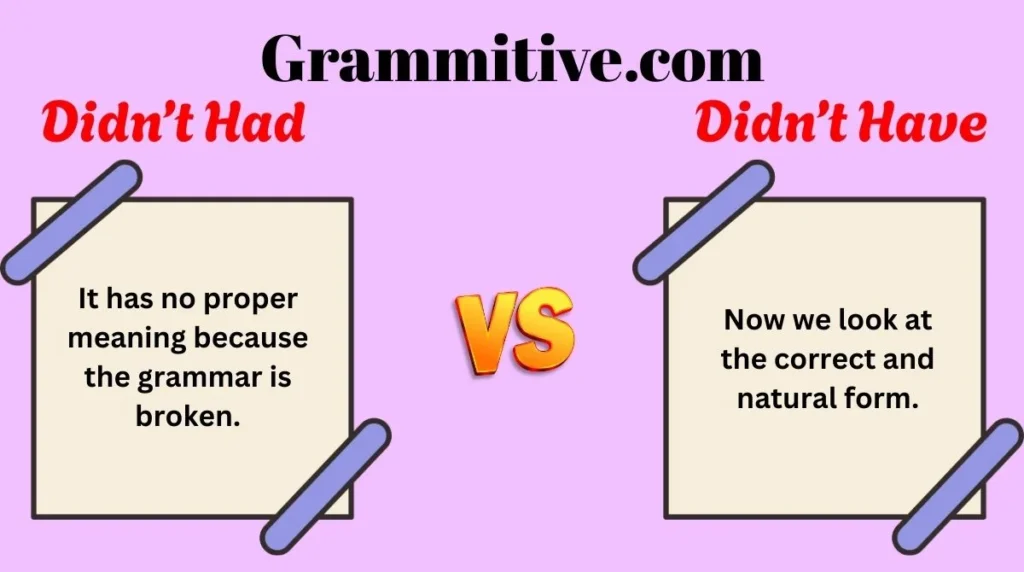
Difference Between Didn’t Had and Didn’t Have
Here is a clear comparison to make things simple.
| Feature | Didn’t Had | Didn’t Have |
|---|---|---|
| Grammar | Incorrect | Correct |
| Used by native speakers | No | Yes |
| Verb form | Past + past | Past + base |
| Sounds natural | No | Yes |
| Should you use it? | Never | Always |
Usage difference
- “Didn’t had” → grammar error
- “Didn’t have” → proper past negative
Grammar logic
“Did” = past tense helper
So the main verb must stay basic.
Sentence structure difference
Wrong:
didn’t + had
Correct:
didn’t + have
Meaning comparison
Only didn’t have carries meaning.
“Didn’t had” simply sounds broken.
Grammar Rules You Must Remember
Rule #1: After did/didn’t, use base form
✅ I didn’t go
❌ I didn’t went
Rule #2: Never use past tense twice
Only one past marker is allowed.
✅ She didn’t have money
❌ She didn’t had money
Rule #3: This rule works for all verbs
Not only “have”
✅ didn’t eat
✅ didn’t see
✅ didn’t play
❌ didn’t ate
❌ didn’t saw
❌ didn’t played
Rule #4: Questions follow the same rule
Use base form in questions too.
✅ Did you have lunch?
❌ Did you had lunch?
Common Mistakes Students Make
Why mistakes happen
There are three main reasons:
- Translating from their native language
- Thinking past tense must always use past verb
- Speaking fast without checking grammar
Wrong vs Correct examples
❌ I didn’t had time
✅ I didn’t have time
❌ She didn’t went home
✅ She didn’t go home
❌ We didn’t ate dinner
✅ We didn’t eat dinner
❌ He didn’t saw me
✅ He didn’t see me
Easy correction tips
When you say “didn’t,” stop and ask:
“Is my next verb base form?”
If not, fix it.
Easy Trick to Remember the Difference
Here’s a simple memory trick students love.
Think of did as the “past carrier.”
It already carries the past.
So the next verb doesn’t need past clothes.
Imagine:
- “did” = past backpack
- verb = just walk normally
So:
didn’t + have
not
didn’t + had
One past is enough.
If you see two past forms together, something is wrong.

Daily Life Examples (Very Important)
These are real spoken English sentences you may hear every day.
- I didn’t have cash, so I used my card.
- Sorry, I didn’t have your number.
- We didn’t have class today.
- She didn’t have breakfast this morning.
- They didn’t have enough chairs.
- I didn’t have time to call you.
- He didn’t have his keys.
- The shop didn’t have my size.
- We didn’t have internet last night.
- She didn’t have any idea.
These sound completely natural in conversations.
Try saying them aloud.
Practice Section
Choose the correct option.
- I didn’t (have / had) money.
- She didn’t (have / had) lunch.
- We didn’t (go / went) home.
- They didn’t (eat / ate) rice.
- He didn’t (see / saw) me.
Answers
- have
- have
- go
- eat
- see
If you got them right, great job. If not, read again and practice more.
FAQs
What is the difference between didn’t had and didn’t have?
“Didn’t had” is grammatically wrong. “Didn’t have” is correct. After “didn’t,” we must use the base verb, not the past form.
Can we use didn’t had in spoken English?
No. Native speakers never use it. It sounds incorrect and unnatural.
Why do we use have instead of had?
Because “did” already shows the past tense. The verb must stay in base form.
Can we use didn’t have in questions?
Yes. For example:
Did you have time?
Did they have lunch?
Is didn’t have formal or informal?
It works in both. You can use it in daily speech, writing, exams, and professional English.
Does this rule work for all verbs?
Yes. After did/didn’t, always use the base form: go, eat, see, make, take, have.
Final Conclusion
Small grammar rules can create big confusion, and this one tricks many learners. But the idea is actually very simple once you understand it clearly.
Remember this: “did” already shows the past.
So your verb stays in its basic form.
That’s why didn’t have is correct and didn’t had is wrong.
Whenever you speak or write, quickly check your sentence. If you see “didn’t,” make sure the next verb is simple. No “-ed,” no past forms.
Practice with real-life sentences. Say them out loud. Listen to native speakers. Soon this structure will feel natural.
English becomes easier when you learn small rules like this step by step. Keep practicing, keep speaking, and don’t be afraid to make mistakes. That’s how real learning happens.
You’ve got this.

I am Lucas Bennett, a digital content creator passionate about social media trends and online growth strategies.
I share practical insights and guides to help users better understand and navigate the digital world.