
English has many small words that create big confusion.
“Did” and “done” are perfect examples.
They look similar. They both come from the verb do. They both talk about actions. Yet they cannot be used in the same way.
Many learners say things like:
❌ I done my homework yesterday.
❌ Did you have done it?
❌ I did finished.
If you have ever said something like this, don’t worry. You are not alone. Even intermediate students mix these two words every day.
The problem is simple:
“Did” is past tense.
“Done” is a past participle.
But those grammar terms sound scary, right?
So instead of heavy grammar talk, think of it like this:
- One word works alone
- The other word needs help
By the end of this guide, you will clearly understand:
- When to use did
- When to use done
- Why they are different
- Easy sentence patterns
- Real-life examples
- Common mistakes to avoid
- A simple memory trick
After that, you’ll never hesitate again when speaking or writing.
What Does “Did” Mean?
Simple definition
Did is the past tense of “do.”
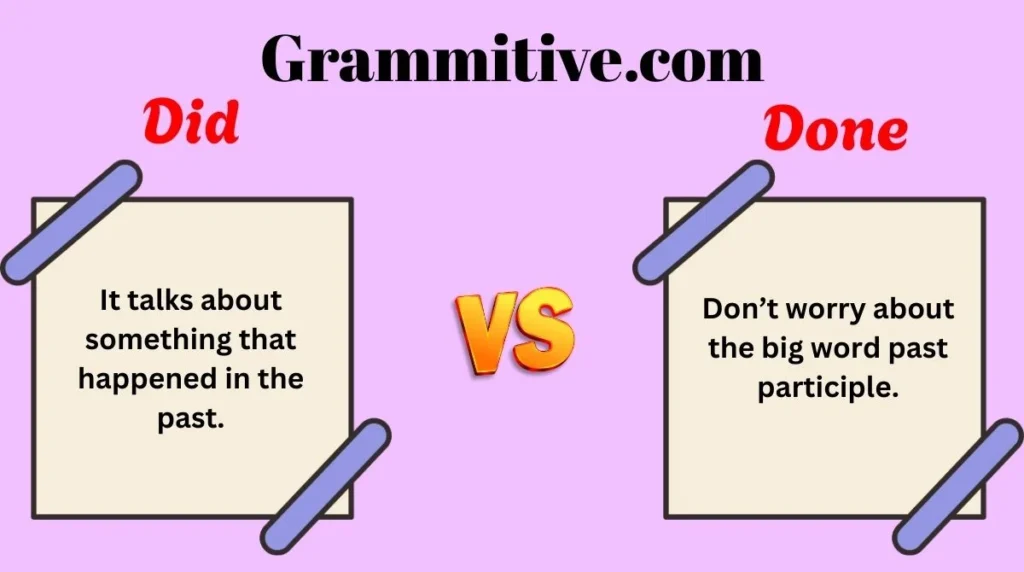
It talks about something that happened in the past.
Think of it as:
👉 an action already finished
When to use it
Use did when:
- talking about yesterday or earlier
- asking questions about the past
- making negative sentences in the past
- emphasizing an action
Grammar rule
Did works alone.
It does NOT need helping verbs like have/has/had.
Basic structure:
- Subject + did
- Did + subject + verb
- Subject + did not + verb
Examples
- I did my homework last night.
- She did the dishes after dinner.
- We did our best in the exam.
- Did you call your mom?
- They did not finish the project.
- He did everything by himself.
- What did you say?
- I did the laundry this morning.
Common learner confusion
Many students think:
❌ I have did my work.
But did cannot come after “have.”
Because “did” is already past tense. You don’t mix two past forms together.
So remember:
✔ I did my work.
✔ I have done my work.
❌ I have did my work.
What Does “Done” Mean?
Simple definition
Done is the past participle of “do.”
Don’t worry about the big word past participle.
Just remember:
👉 Done needs help.
It cannot stand alone.
When to use it
Use done with:
- have
- has
- had
- be (is/was/were/been)
It usually shows:
- completed actions
- experiences
- passive voice
Grammar rule
Structure:
- have/has/had + done
- be + done
Examples
- I have done my homework.
- She has done the cleaning.
- They had done the work before lunch.
- The job is done.
- Everything was done on time.
- We have already done this exercise.
- He has done a great job.
- The cake is done.
Common learner confusion
Students often say:
❌ I done my homework yesterday.
But done cannot be used alone.
It must have help.
So:
✔ I did my homework yesterday.
✔ I have done my homework.
❌ I done my homework.
Difference Between Did and Done (Detailed)
Here is the easiest way to see the difference.
Comparison Table
| Feature | Did | Done |
|---|---|---|
| Verb form | Past tense | Past participle |
| Works alone? | Yes | No |
| Needs helper verb? | No | Yes |
| Time | Past only | Completed action |
| Common helpers | none | have/has/had/be |
| Example | I did it | I have done it |
Usage difference
Did → simple past
Used for something finished at a specific time.
Done → perfect/passive
Used with helper verbs to show completion.
Grammar logic
Think about this:
Past tense = finished → use did
Perfect tense = completed result → use done
Examples:
- I did my homework yesterday. (past time)
- I have done my homework. (result now)
Sentence structure difference
Did structure
Subject + did + object
→ I did the work.
Done structure
Subject + have/has/had + done
→ I have done the work.
Meaning comparison
Sometimes both talk about the same action, but the feeling changes.
I did my homework yesterday.
👉 Focus on time.
I have done my homework.
👉 Focus on result (it’s finished now).
Small difference. Big meaning.
Grammar Rules You Must Remember
Rule #1: Use “did” for simple past
✔ I did the dishes.
✔ We did our project.
If you mention time (yesterday, last night, last week), use did.
Rule #2: Use “done” with have/has/had
✔ I have done it.
✔ She has done her work.
✔ They had done everything.
Never use done alone.
Rule #3: After “did,” use base verb
This is very important.
❌ Did you did it?
✔ Did you do it?
❌ I did finished.
✔ I did finish.
After did, the verb goes back to base form.
Rule #4: “Done” can show passive voice
✔ The work is done.
✔ The cake was done.
This means someone finished it.
Common Mistakes Students Make
These mistakes happen because students translate from their own language or mix grammar rules.
Mistake 1
❌ I done it yesterday.
✔ I did it yesterday.
Tip: yesterday = past → use did
Mistake 2
❌ I have did my homework.
✔ I have done my homework.
Tip: have = use done
Mistake 3
❌ Did you did your work?
✔ Did you do your work?
Tip: after did → base verb
Mistake 4
❌ The job did.
✔ The job is done.
Tip: passive voice needs done
Why mistakes happen
- “Did” and “done” sound similar
- Both come from “do”
- Grammar names are confusing
- Many languages don’t use participles
The solution is simple practice and pattern memory.
Easy Trick to Remember the Difference
Here’s a small trick my students love.
Think:
👉 Did = Dead past
👉 Done = With have
If you hear have/has/had, your brain should shout:
“DONE!”
Examples:
I have ___ it.
Your brain: have → done
Yesterday I ___ it.
Your brain: yesterday → did
Another trick:
Did works alone
Done needs a friend
If it’s lonely → did
If it has a friend → done
Simple, right?
Daily Life Examples (Very Important)
These are the kinds of sentences you hear every day.
- Did you eat breakfast?
- I did my shopping after work.
- Have you done your homework yet?
- She has done the laundry.
- I did the cleaning this morning.
- The food is done. Let’s eat.
- We had done everything before the boss came.
- Who did this mess?
- I’ve done this movie before.
- He did not call me.
Notice how natural they sound.
These are real conversations, not textbook sentences.
Practice Section
Choose the correct word: did or done
- I have ___ my work.
- She ___ the dishes yesterday.
- Have you ___ your homework?
- We ___ not understand the lesson.
- The job is ___.
Answers
- done
- did
- done
- did
- done
FAQs About Did vs Done
1. What is the difference between did and done?
Did is the simple past form of “do.” It talks about past actions. Done is the past participle and needs helper verbs like have or has.
2. Can we use done alone?
No. Done always needs a helper verb. You must say “have done” or “is done,” not just “done.”
3. Can we use did in questions?
Yes. Did is very common in questions. Example: “Did you finish your work?”
4. Is done formal or informal?
It works in both. “Have done” is used in everyday speech and also in formal writing.
5. Why can’t we say “have did”?
Because “have” needs a past participle. The past participle of “do” is “done,” not “did.”
6. Which is more common in daily English?
Both are very common. Did is used for past events. Done is used with perfect tenses and passive sentences.
Final Conclusion
“Did” and “done” may look like twin brothers, but they behave very differently.
One is independent. The other needs help.
When talking about the past, use did.
When using have/has/had or passive voice, use done.
That’s really the heart of the rule.
Try to notice these forms in movies, conversations, and books. The more you hear them, the more natural they feel. Speak small sentences every day: “I did this,” “I have done that.” Practice makes everything easier.
Don’t stress about mistakes. Every learner mixes them up at first. With a little time, your brain will choose the right word automatically.
Keep practicing, keep listening, and English grammar will slowly become your friend.

I am Lucas Bennett, a digital content creator passionate about social media trends and online growth strategies.
I share practical insights and guides to help users better understand and navigate the digital world.