
Many English learners stop for a second when they see two words that look almost the same. One has an extra letter.
One looks shorter. Both sound the same. Both appear in books, movies, and websites.
Then the question comes: Which one is correct?
That is exactly what happens with dialog and dialogue.
You might write an essay and type dialog, but your spell checker changes it. Or maybe you read an American website that uses dialog and a British book that uses dialogue. It feels confusing.
Some students even think they have different meanings.
Here’s the truth: this is not a grammar problem. It is mainly a spelling and usage difference. But if you don’t understand it, you can lose marks in exams or sound less natural in writing.
These words are common in daily English. Teachers use them. Writers use them. Business people talk about customer dialogue.
Movie scripts are full of dialogue. So knowing the correct form really matters.
By the end of this guide, you will clearly understand:
- What each word means
- When to use each spelling
- Which one is more common
- Which one is better for exams
- How native speakers use them
- Easy tricks to remember forever
After this, you won’t hesitate again. You’ll just write with confidence.
What Does “Dialog” Mean?
Simple definition
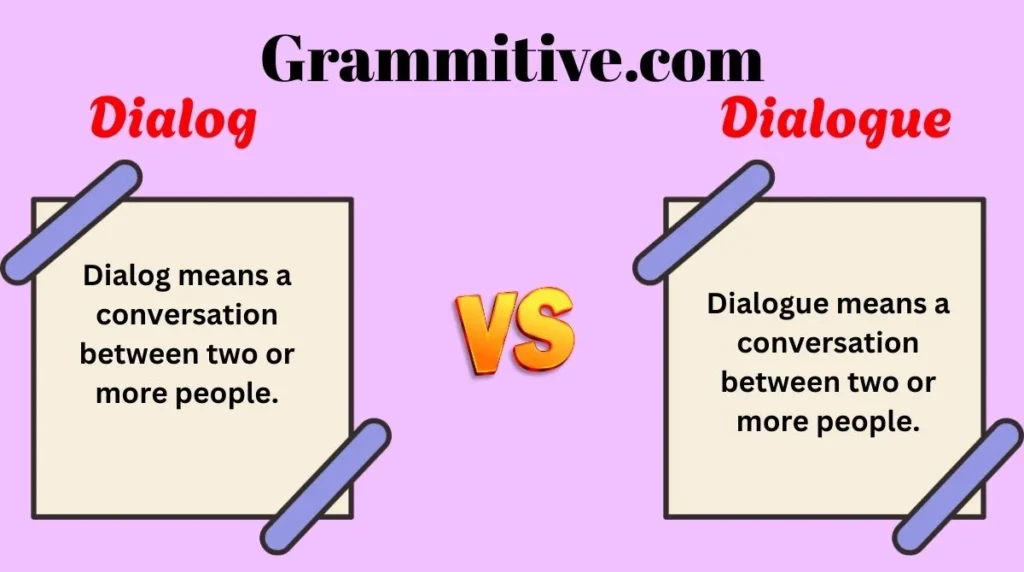
Dialog means a conversation between two or more people.
It is simply another spelling of dialogue.
The meaning is the same.
When to use it
This spelling is mostly used:
- In American English
- In technology or computing
- In software language (like “dialog box”)
You may see it in casual writing or technical documents.
However, it is less common in normal essays, stories, or books.
Grammar rule
Dialog is a noun.
It is not a verb.
You use it like this:
- a dialog
- the dialog
- dialogs
It follows normal noun rules.
Example sentences
- The movie has funny dialog between the two brothers.
- The teacher asked us to write a short dialog in class.
- Their dialog helped solve the problem.
- The play needs stronger dialog to sound natural.
- The app shows a dialog when you click “Save.”
- The dialog felt realistic and emotional.
- We had an open dialog about our plans.
- The game uses voice dialog for the characters.
Common learner confusion
Many students think:
- dialog = short talk
- dialogue = long talk
This is not true.
Both words mean the same thing.
The only real difference is spelling style, not meaning.
Also, in formal school writing, teachers often prefer dialogue, not dialog.
So using dialog in essays may look strange or incorrect, even though it is technically acceptable in American English.
What Does “Dialogue” Mean?
Simple definition
Dialogue means a conversation between two or more people.
It is the traditional and standard spelling in English.
This is the form you will see most often in books, novels, newspapers, and schools.
When to use it
Use dialogue:
- In essays
- In exams
- In stories and novels
- In academic writing
- In British English
- In formal situations
It is the safest choice everywhere.
If you are unsure, choose dialogue.
Grammar rule
Dialogue is also a noun.
It follows normal noun grammar:
- a dialogue
- the dialogue
- dialogues
It can also appear in phrases like:
- dialogue writing
- inner dialogue
- open dialogue
Example sentences
- The dialogue in this novel sounds very natural.
- The two leaders began a peaceful dialogue.
- Please write a dialogue between a doctor and a patient.
- Their dialogue helped improve the relationship.
- The teacher corrected our dialogue homework.
- The film’s dialogue made everyone laugh.
- Good dialogue makes a story feel real.
- We need more dialogue, not arguments.
Common learner confusion
Some students avoid this spelling because it looks longer and harder.
But remember:
Longer does not mean more formal or difficult.
It is simply the standard spelling.
Most dictionaries list dialogue as the main form.
So this is the word teachers expect you to use.
Difference Between Dialog and Dialogue (Detailed)
Both words mean the same thing, but there are small differences in usage and style.
Here is a clear comparison.
| Feature | Dialog | Dialogue |
|---|---|---|
| Meaning | Conversation | Conversation |
| Spelling style | Short/modern | Traditional |
| Region | Mostly American | British + American |
| Formal writing | Rare | Preferred |
| Exams | Not recommended | Recommended |
| Technology | Very common | Less common |
| Books/novels | Rare | Very common |
Usage difference
In daily English:
- Writers → dialogue
- Teachers → dialogue
- Novels → dialogue
- Software → dialog
So dialog often appears in technical settings like computers.
Example:
- dialog box
- dialog window
But in storytelling, dialogue is almost always used.
Grammar logic
There is no grammar difference.
Both are nouns.
Both follow the same structure.
Only spelling changes.
Sentence structure difference
No difference at all.
You can replace one with the other without changing grammar.
Example:
- The dialogue was funny.
- The dialog was funny.
Both are correct grammatically. Only style changes.
Meaning comparison
Meaning is identical.
Think of it like:
- color / colour
- center / centre
Just a spelling variation.
Grammar Rules You Must Remember
Rule #1: Both words are nouns only
Correct:
- The dialogue is interesting.
Wrong:
- They dialoged for hours. ❌
Use “talked” or “had a dialogue” instead.
Rule #2: Use “dialogue” in formal writing
Correct:
- Write a dialogue between two friends.
Avoid:
- Write a dialog between two friends.
Teachers usually prefer the longer spelling.
Rule #3: “Dialog box” is standard in computing
Correct:
- A dialog box appeared on the screen.
This is a special technical phrase. It is very common.
Rule #4: Plural form adds -s
Correct:
- dialogues
- dialogs
Example:
- The book has many dialogues.
Common Mistakes Students Make
Why mistakes happen
Students get confused because:
- Spellings look similar
- Pronunciation is the same
- Internet shows both
- Dictionaries list both
So they think the words must be different.
But they are not.
Wrong vs Correct examples
Wrong:
- I wrote a dialog for my English exam.
Better:
- I wrote a dialogue for my English exam.
Wrong:
- The story has many dialogs. (formal essay)
Better:
- The story has many dialogues.
Wrong:
- We dialoged about the problem.
Correct:
- We had a dialogue about the problem.
- We talked about the problem.
Easy correction tips
- School writing → dialogue
- Stories → dialogue
- Technology → dialog
- Unsure → dialogue
Simple and safe.
Easy Trick to Remember the Difference
Here is a very easy memory trick.
Think:
“Long talks need a long word.”
Dialogue is longer.
And we usually use it for real conversations in books and writing.
So:
Long word → real conversations → dialogue
Dialog is shorter and often used in computer screens or quick messages.
You can also remember:
- Software → short
- School → long
Short spelling for software.
Long spelling for school.
It sticks fast in your brain.
Daily Life Examples (Very Important)
These are natural spoken English examples. You may hear them every day.
- “The dialogue in that movie was so funny!”
- “We need better dialogue between parents and teachers.”
- “Can you write a short dialogue for homework?”
- “The characters have realistic dialogue.”
- “Click OK when the dialog box appears.”
- “Their dialogue helped solve the fight.”
- “This book has too much dialogue and not enough action.”
- “Open the dialog to change the settings.”
- “Good dialogue makes stories feel alive.”
- “Let’s keep the dialogue respectful.”
Notice something?
Most normal conversation uses dialogue.
Only computer talk uses dialog.
Practice Section
Choose the correct word: dialog or dialogue
Questions
- The teacher asked us to write a ______ between two strangers.
- A small ______ box popped up on my screen.
- The movie’s ______ sounded natural.
- We need open ______ to fix this issue.
- The game uses voice ______ for characters.
Answers
- dialogue
- dialog
- dialogue
- dialogue
- dialog
FAQs
What is the difference between dialog and dialogue?
There is no meaning difference. Both mean a conversation. The only change is spelling style. Dialogue is more common and formal.
Which spelling is correct in exams?
Dialogue is safer. Teachers expect this form in essays and tests. It looks more standard and professional.
Is dialog American English?
Yes. It appears mostly in American English, especially in technical or software writing. But even Americans often use dialogue in books.
Can we use dialog in stories or novels?
You can, but it may look unusual. Most publishers and writers prefer dialogue. It sounds more natural to readers.
Is dialogue formal or informal?
It works in both. You can use it in academic papers, novels, and daily speech. It is flexible and widely accepted.
Why do computers say “dialog box” instead of “dialogue box”?
Technology prefers shorter words for labels and menus. Dialog is shorter and easier to fit on screens. That’s why software uses it.
Final Conclusion
Small spelling differences can cause big confusion for English learners. Dialog and dialogue are a perfect example. They look different, but they mean exactly the same thing.
The good news is simple: you don’t need to learn two meanings or two grammar rules. Just remember the style difference.
Dialogue is the standard form. It is used in schools, books, stories, and formal writing. It is the safest and most natural choice almost everywhere.
Dialog is mostly used in American technical or computer language, especially in phrases like dialog box.
If you ever feel unsure, choose dialogue. You will almost always be right.
Keep practicing by reading novels, watching movies with subtitles, and writing your own short conversations. The more you see the word, the more natural it will feel.
Soon, you won’t even think twice. You’ll just write it correctly without effort.

I am Lucas Bennett, a digital content creator passionate about social media trends and online growth strategies.
I share practical insights and guides to help users better understand and navigate the digital world.